IndianSanskriti
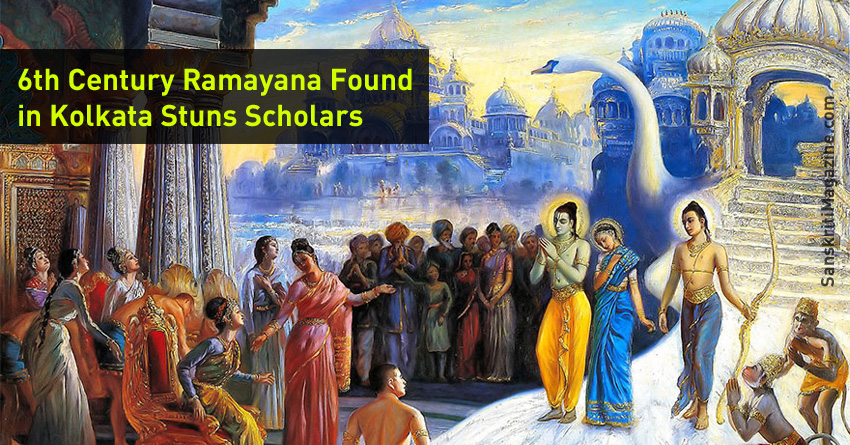
6th Century Ramayana Found in Kolkata Stuns Scholars

6th Century Ramayana Found in Kolkata Stuns Scholars

A 6th-century manuscript of Ramayana, which focuses on the separation of Rama and Sita and portrays them more as humans, has been found tucked inside a Purana at a Sanskrit library here. It is markedly different from the more accepted 4 BC Valmiki Ramayana. The 12th-century rendition by Tamil poet Kamba is generally considered the second oldest among the more popular versions. However, now that may change.

The 6th-century manuscript was discovered purely by chance. Scholars working on the 6th-century Vanhi (fire) Purana at the Asiatic Society library were puzzled to find that the manuscript seemed incomplete. They began looking through the Catalogus Catalogorum – a global repository of Sanskrit manuscripts compiled by German scholar Aufrecht – and realized two more identical manuscripts existed.One was preserved at the India Office Library, London; the second at the Kolkata-based Samskrita Sahitya Parishad, a 100-year-old research institution.

The scholars scoured the archives and found the complete version of the Vanhi Purana manuscript. When they were analyzing it, they stumbled upon the Dasa Griba Rakshash Charitram Vadha, which did not have any bearing with the Vanhi Purana. For some time they could not understand why the slokas of the Purana suddenly started telling another story – albeit a familiar one, as the main characters were Rama, Sita and Ravana. Before long, they realized it was a 6th-century version with many interpolations.

“Interestingly in this version, there are just five kandas (sections) instead of the accepted seven. There is no Balakanda – the part that deals with Rama’s childhood – or Uttarkanda. This Ramayana ends with the return of Rama and Sita from exile and his ascension to the Ayodhya throne,” said Anasuya Bhowmick, lead scholar of the Asiatic Society, who is working with the manuscript. This Ramayana does not begin with the curse that drove Dasarath to send his son to exile.

Instead, it begins with a curse that befell goddess Lakshmi when Shukracharya got angry with Narayan for killing Shukracharya’s wife.

The other curse falls on both Lakshmi and Narayan when Dharitri cannot bear the pain of the constant battle between gods and demons. In both cases, Laxmi and Narayan are told they will have to bear the pain of separation.

“Ram here is more human than God, with follies like anger and failure. Some interesting details – like the ages of Sita and Rama at the time of marriage and the date when Sita was abducted by Ravana -are in this version,” said scholar Manabendu Bandyopadhyay.


You may also like

Search the website

Like us on Facebook

Get daily updates via Email

Enter your email address:

Recent Posts

Jamai Shashthi 2026 — The Story of Maa Shashthi, the Cat, and the Wife Who Was Forgiven

Jamai Shashthi 2026 — The Story of Maa Shashthi, the Cat, and the Wife Who Was Forgiven

On Saturday, June 20, 2026, Bengali households across Bharata will welcome their married daughters and sons-in-law home for the legendary jamai-aador feast and perform the Shashthi Vrata. But behind the warmth lies a story most Bengalis know by heart and most non-Bengalis have never heard — the wife who stole the hilsa, blamed the cat, lost six sons to Maa Shashthi’s wrath, and was finally forgiven. The Vrat Katha, the vidhi, the mantras, and the deeper teaching.

Vat Purnima 2026 — The Wife Who Argued Yama Into Returning Her Husband’s Life

On Monday, June 29, 2026, women across Maharashtra, Gujarat, and southern Bharata will tie red thread around banyan trees and hear the story of Savitri — the wife who walked behind Yamaraja Himself when He came for her husband, and out-argued the Lord of Dharma into returning Satyavan’s life. The Mahabharata’s Pativrata Mahatmya Parva, the vrat vidhi, and why the banyan witnessed everything.

Purushottam Maas — The Month No Deity Would Claim, and the Lord Who Made It Supreme

Every month of the Hindu calendar has a lord — except the rare thirteenth, the Adhika Maas, born an orphan and shunned as the “impure month.” The Puranas tell how this rejected month went in grief to Bhagavan Vishnu, who claimed it, gave it His own name — Purushottam — and made it the most fruitful month of all. The origin story, the teaching, and what it means for Purushottam Maas 2026 (May 17 – June 14).

Padmini Ekadashi 2026 — The Ekadashi Even the Devas Descend to Keep

Padmini Ekadashi 2026 — The Ekadashi Even the Devas Descend to Keep

The rarest Ekadashi of the entire Hindu calendar is three days away. The Padma Purana preserves a conversation between Bhagavan Krishna and Yudhishthira about a single Ekadashi the great Rishis spend lifetimes waiting for — Padmini. The Vrat Katha of Queen Padmini of Mahishmati, the lotus teaching, and why May 27, 2026 is the morning Vaishnavas across Bharata are preparing for.

Varada Chaturthi 2026 — The Rare Ganesha Day of Purushottam Maas

Varada Chaturthi 2026 — The Rare Ganesha Day of Purushottam Maas

Once every 2.5–3 years — when the rare 13th month of Adhika Maas opens — a thirteenth Vinayaka Chaturthi appears. The Mudgala Purana calls it Varada Chaturthi, the “boon-giving” Chaturthi, and holds it as the most fruit-bearing Ganesha day of the entire calendar. Today, Wednesday May 20, 2026, is that day.

css.php