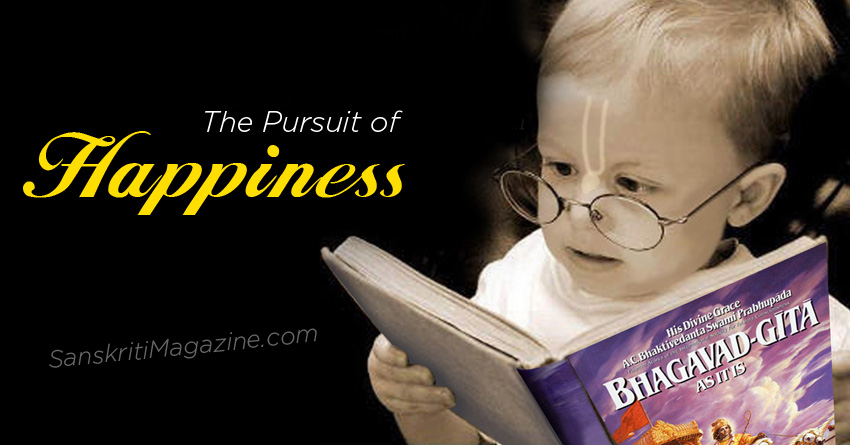
According to the English dictionary, the word ‘Happiness’, signifies one of the following emotions – pleasure, joy, bliss, contentedness, delight, enjoyment, satisfaction, etc . If we think calmly and carefully, we would come to realize that , all of us living beings, are essentially hankering after the above and throughout our lives,we only try to work towards moulding our existence in a way , so that we achieve the much sought after ‘Happiness’.
In today’s world, little boys and girls spend most of their youth, studying hard for hoursaltogether. They put in a tremendous effort, taking tuitions after schools, spending hours in libraries,sometimes going sleepless for entire nights, completely disregarding their mental and physical health, to ensure they get a good grade in school/college so that they can eventually land up with a good job. In jobs, people are made to slog for more than ten hours daily,and sometimes work even in weekends, so much so that they hardly find time for their friends and family.
Parents raise their children, with the hope that they will be successful one day and spread the name and fame of the family, and look after them in their old age. Instead, we find increasing number of parents, finding their place in the old-age homes, where they rarely get to meet their progenies, whom they had spent their entire lives raising.
Noting this irony the Dalai Lama says :
“The world does not need more successful people.
The world desperately needs more peacemakers and healers,
restorers and storytellers and lovers of all kinds.”
The society is fast realizing that their modern objectives and lifestyle is actually making people’s lives more complicated and increasingly frustrating.They are chasing a mirage, which promises Happiness, but only gives disappointment, stress, sorrows,sour relationships, unfulfilled desires, and emptiness of heart in the end. People often wonder what is missing from their lives and how to deal with it, where exactly are they going wrong, are they making their lives better or even worse, what is the secret mantra for achieving that illusive happiness.
Looking For Answers
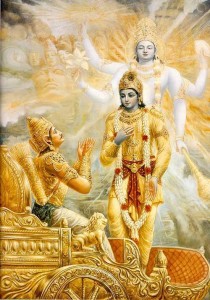 To look for the answers, we must pause for a while, and take a fresh look at life itself. We must ask ourselves what is it that makes us really happy.Is it the material possessions like cars, bungalows, gadgets, fame, power,money etc or is it something higher, some higher pleasure that we have been searching for. If riches were everything, then why is it that the richest nations of the world, have the highest rates of suicide, homicide and suffer so much from stress related disorders?
The oldest books of the world, the Vedic literature, talk about the above subjects in great detail.They explain to us the goals of life and provide us the mantra to achieve the much prized happiness.
The Vedic literature lays an emphasis on ‘Simple living and High Thinking’ and explains that we are basically spiritual beings who are entrapped in material bodies.
The real goal of our lives is to rediscover our spiritual identity and instead of pampering the gross body made of matter all day, we should instead focus on catering to the needs of our spiritual self. Care should be taken to ensure that we remain healthy and are able to fulfill our daily physical requirements, but routing our entire attention to our bodily demands can lead to the starvation of our spiritual realization.
Fish without water
The Vedic literatures explain that we, living beings, are essentially spiritual sparks, who long to associate with the Supreme Spirit,God. Forgetting the Lord, we tend to quench that eternal thirst of associating with the Lord, by seeking refuge in temporal pleasures. But no matter how much we try, the temporary material pleasures of this world can never satisfy the urges of our spiritual self which can only be happy by reconnecting with its Supreme master. We are like that Fish without water, who cannot be satisfied, with any amount of pleasure that might be provided on the land.Instead, indulgence in the temporal pleasures like intoxication, illicit sex only serve to frustrate us even more, as they cannot provide us with what we are looking for, but drag us further into the material conception of life.
Yoga – Connecting with the Supreme
The Vedic literature instructs us to undertake the process of yoga, to reconnect with the supreme. In fact,the word ‘Yoga’ means to link oneself with God.
The characteristics of a person who has undergone the yogic process is described by Lord Krishna in Bhagavad Gita –
“A person is said to be established in self-realization and is called a yogī [or mystic] when he is fully satisfied by virtue of acquired knowledge and realization. Such a person is situated in transcendence and is self-controlled. He sees everything – whether it be pebbles, stones or gold – as the same.”[BG 6.8]
And what is the prize for such a yogi ?
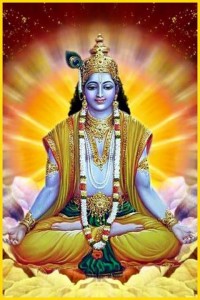 “Thus the self-controlled yogī, constantly engaged in yoga practice, becomes free from all material contamination and achieves the highest stage of perfect happiness in transcendental loving service to the Lord.” [BG 6.28]
The relationship between such a perfect yogi and the Supreme Lord is described by Lord Krishna below :
“A true yogi observes Me in all beings and also sees every being in Me. Indeed, the self-realized person sees Me, the same Supreme Lord, everywhere.
For one who sees Me everywhere and sees everything in Me, I am never lost, nor is he ever lost to Me.” [BG 6.29-6.30]
So by the process of Yoga, not only can one remove his material contamination, and be situated in perfect happiness, but also revive his intimate love and relationship with the Supreme Lord ; something that our soul has been hankering for since time immemorial.
After Krishna describes to Arjuna the various yogic processes, he enquires from the Lord about the fate of an unsuccessful yogi.
To which the Lord replies that “The unsuccessful yogī, after many, many years of enjoyment on the planets of the pious living entities, is born into a family of righteous people, or into a family of rich aristocracy.
On taking such a birth, he revives the divine consciousness of his previous life, and he again tries to make further progress in order to achieve complete success, O son of Kuru.
By virtue of the divine consciousness of his previous life, he automatically becomes attracted to the yogic principles – even without seeking them. Such an inquisitive transcendentalist stands always above the ritualistic principles of the scriptures.
And when the yogi engages himself with sincere endeavor in making further progress, being washed of all contaminations, then ultimately, achieving perfection after many, many births of practice, he attains the supreme goal.”[BG 6.41-45]
Hence we can understand that thereis no loss on this path of Yoga and a person who makes even some Yogic progress carries on from where he left off in his previous birth until he achieves the Supreme Goal of the association and thelove of lord.
The Yogic process
In the Bhagavad Gita Lord Krishna instructs Arjuna of the various Yogic processes. He talks to him about karma yoga , in which, one should be engaged in performing all his duties and activities without attachment to the results.
He instructs him about the path of Jnana yoga by which one takes refuge of mental speculation to understand the supreme.
In Dhyana Yoga section, Lord Krishna instructs Arjuna of the different postures of Astanga Yoga,like holding one’s body,neck and head in an erect straight line and with an unagitated mind stare steadily at the tip of the nose, thereby meditating on Him.
After instructing all of the above , Lord Krishna tells Arjuna about the topmost of them all- Bhakti Yoga
yoginām api sarveṣāṁ
mad-gatenāntar-ātmanā
śraddhāvān bhajate yo māṁ
sa me yukta-tamo mataḥ
Translation – And of all yogīs, the one with great faith who always abides in Me, thinks of Me within himself and renders transcendental loving service to Me – he is the most intimately united with Me in yoga and is the highest of all. That is My opinion.[BG 6.47]
Elsewhere in Bhagavad Gita it is mentioned – “Always think of Me and become My devotee. Worship Me and offer your homage unto Me. Thus you will come to Me without fail. I promise you this because you are My very dear friend.”[BG 18.65]
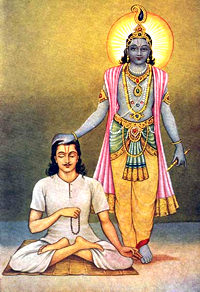 All throughout the Vedic literature the superiority of Bhakti Yoga is stressed :
bahunam janmanam ante
jnanavan mam prapadyate
vasudevah sarvam iti
sa mahatma su-durlabhah
Translation – After many births and deaths, he who is actually in knowledge surrenders unto Me, knowing Me to be the cause of all causes and all that is. Such a great soul is very rare.[BG 7.19]
So Jnanis after many many many births understand that devotional service to the Lord is the essence of it all.
And one who once tastes the mercy, the love of the Lord, can no longer be attracted to anything else; the world of matter can no longer bewilder him.As Sita Devi explains below that if there is devotion to Lord Rama, nothing else is needed.
“After having rested on the worshiped arm of the Lord of the world, how can I now take rest on the arm of any other?” (Sita Devi speaking to Ravana, Valmiki Ramayana, Sundara Kand, 21.16-17)
So let us now explore Bhakti Yoga in more detail.
Bhakti Yoga – Devotional service to the Lord
So how does one practice Bhakti Yoga? How does one revive his lost relationship with the Lord? Especially when all of us are suffering so much with our immediate material problems.
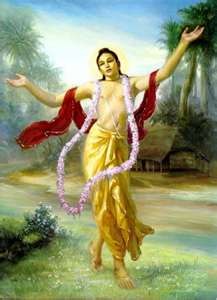 The present age that we are living in is described as the age of Kali, in the Vedic scriptures. It is the age of quarrel and hypocrisy and is described as the worst of the ages. Srimad Bhagatam (12.2.1) states that “religion, truthfulness, cleanliness, tolerance, mercy, duration of life, physical strength and memory will all diminish day by day because of the powerful influence of the age of Kali.”
People, being sinful, have to suffer a lot and are generally very unfortunate in this age of Kali.
kaler dosa-nidhe rajann
asti hy eko mahan gunah
krrtanad eva krsnasya
mukta-sarigah param vrajet
Translation – “My dear king, although Kaliyuga is full of faults, there is still one good quality about this age. It is that simply by chanting Hare Krsna maha mantra, one can become free from material bondage and be promoted to the transcendental kingdom.”(Srimad Bhagvatam 12.3.51)
Hence, although the situation seems to be very gloomy in this dark age of Kali, and people in general are ignorant and averse to spirituality, still there is a ray of hope in the form of chanting of the holy names of the Lord, which can not only counter all the ill effects of Kali Yuga, and relieve one of the pangs of material miseries, but also make one situated in the perfect stage of pure love (devotional service) with the Lord.
Chanting the holy name of the Lord is especially advised in this age of Kali, and described as the only means of deliverance. In Brhad Naradiya Purana (38.126) for instance, it is mentioned : “In this age of quarrel and hypocrisy, the only means of deliverance is the chanting of the holy name of the Lord. There is no other way. There is no other way. There is no other way.”
The Kali-Santarana Upanishad specifically mentions the chanting of the Hare Krishna Mahamantra for the deliverance of the suffering souls in Kali:
(1)
harih om
dvaparante narado brahmanam jagam katham
bhagavan gam paryatan-kalim santare-yamiti
sa hovaca brahma –
sadhu prsto’smi sarva sruti-rahasyam gopayam
tacchrnu yena kali-samsaram tarisyasi bhagavata
adi-purusasya narayanasya namoccarana-matrena nirdhuta-kalir bhavati
At the end of Dvapara-Yuga, Narada, who had traversed the whole world, went to Brahma and addressed him thus, ‘O Lord, how shall I be able to ward off the effects of Kali?’ Brahma thus replied, ‘You have asked an excellent question. Listen to that secret which all the Vedas keep hidden, through which one may cross over material existence during the age of Kali. One becomes free from the influence of Kali by merely uttering the Names of Lord Narayana, who is the original Supreme Person.
(2)
naradah punah papraccha tananam kimiti
sa hovaca hiranyagarbah –
hare krsna hare krsna krsna krsna hare
hare rama hare rama rama rama hare hare
iti sodasakam namnam
kali-kalmasa-nasanam
natah parataropayah
sarva-vedesu drsyate
Thus again Narada asked Brahma, ‘What are those Names?’
Lord Brahma replied, ‘Hare Krsna Hare Krsna Krsna Krsna Hare Hare, Hare Rama Hare Rama Rama Rama Hare Hare. These sixteen Holy Names will destroy the sinful influences of the age of Kali. I do not see any other method.
We should all incessantly chant the Hare Krishna Mahamantra in order to obtain the fruit of ecstatic love for the lord. The Mahamantra is capable of dissolving sins and removing impediments.The maha-mantra embalms sufferings and diminishes the detriments that are so characteristic of Kali-yuga.
The scriptures declare that the chanting of the Hare Krishna maha-mantra is the highest spiritual activity, higher than making pilgrimages to the holiest of places.
The maha-mantra is omnipotent and benedicts the chanter with unimaginable good fortune-Its very nature is that It elevates one to experience divine bliss.
The maha-mantra is the only means of salvation for the fallen conditioned souls, and It is always worshippable for It offers the much desired liberation, exalts one to the supreme spiritual abode and blesses the chanter with transcendental love of Godhead, Shri Hari.
It is the supreme destination of all spiritual aspirations and the mainstream of the current of bhakti Yoga (devotional service).
Hence, Let us all Chant and Be Happy –
Hare Krishna Hare Krishna
Krishna Krishna Hare Hare
Hare Rama Hare Rama
Rama Rama Hare Hare
~Dwaipayan De, Kolkata