Hindu Pilgrimage practice in India takes many forms. It is very difficult to identify any common behaviour or ideas to all pilgrim who journeying to sacred places. Two significant features which do recur consistently are sacred places and the act of journeying itself.
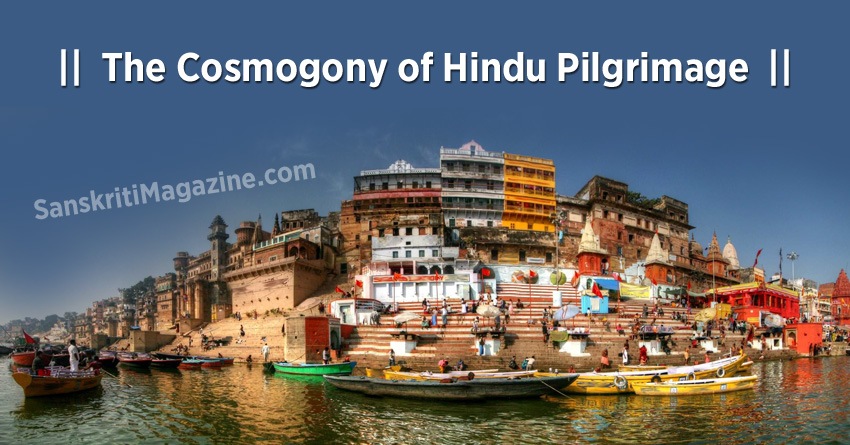
A large number of Hindu pilgrims from whole of the country are visiting to Varanasi/Kashi in everyday, where is one of the most famous Hindu sacred place in India. Varanasi is holy city and city of Siva.
Siva is considered as a god without any form or attributes, and further stands for all knowledge. His name Sambhu is derived from Svayambhuva which reflects the meaning of self-born. It has been realized in ancient past that he was at the bottom of everything that is moving, he was called Livara or i-chara (a=this, and chara=to move) (Pillai, 1959, p. 11). It is the reason why various forms of Siva are transposed in Varanasi as the form of Isvara (as suffix to the various forms of Siva), and a lingam has been installed there to honour that form.
It’s a popular saying that every piece of stone has divinity of Siva in Kashi. This proverb clearly indicates a large number of Siva lingams, and also peoples’ strong belief to worship Siva as the patron deity of the city. In the processes of humanization and sanctification all human performances are added to Lord Siva, therefore worship of various lingams is associated to different motives.
There are many legends and Puranic descriptions about the origin of worship of Siva in anthropomorphic and ithyphallic form, usually as the stylized lingam (Morinis, 1984, pp. 27-30).
The Siva lingam consists of three parts: a square at the bottom, an octagon in the centre, and a cylinder with special end at the top. Symbolically speaking, the square represents Brahma, the create; the octagon represents Vishnu, the preserver; the round portion which vanishes at the top even without a point represents Siva, the destructor. As so the lingam integrates evalution, existence and involuation, i. e. sristhi, stiti, and samhara (Pillai, 1959, pp. 19-20). This number three also be compared with Siva’s trisula-three pronged spear, Trident. These are symbolized in the landscape of Varanasi with the three sacred segments, each having antargriha route and the patron deity: Visvesvara in the centre, Omkaresvara in the north, and Kedaresvara in the south. It is the perception that Varanasi/Kashi is believed to be settled on the trisula.
Typology of Siva Lingams
According to the Skanda Purana-Kasi Khanda (97, 261, 269, 280), there are exist 511 Siva lingams in Kashi region (Sukul, 1977, p. 122). Referring to typology in Kashi, a five-tier hierarchy of lingams, famous for their various niches of spiritual magnetism can be identified:
1. Self-born lingams (Svayambhuva)
2. Lingams installed by the Hindu Planets and Gods.
3. Lingams installed by the Great Saints.
4. Lingams installed by Siva Ganas.
5. Spatially Transposed Lingams.
The Universal personality of Siva is represented with number five which shows wholeness. The five faces of Siva originated out of the formless Absolute (9unya), and they are source of the five saktis and five kalas (energies and their subtle material manifestations) from which the world is created. Each face is connected with certain meaning of power, specific mantra, direction, colour and the five basic elements of the organism Wail, 1985, p. 124, 183). Therefore, Siva is regarded as Panchamukha (five-headed) with different symbolic colours for different forms, and each form is installed in Varanasi separately. The merit and glories of these five forms are given in the Linga Purana (I. 23, 18-23). Even the mantra to please Siva, panchakshari (Namah Sivaya), is related to the five forms thus its muttering represents the absolute entity of the whole universe.
Reflection on Cosmogony
The Puranic literature describe Varanasi as the first deity after the great cosmic dissolution (mahapralaya) which later developed as resort of Lord Siva (Parry, 1981, p. 331). This was first perceived long ago and promoted the installation of enormous forms of Siva as Isvara (the Universal Lord) in the sacred topography of Varanasi.
The concept of spatial transposition and the cosmogony of the yatras (routes of pilgrimage), can be represented with model of a series of concentric circles with sansity increasing as one moves towards the centre. In totaly there are seven layers of main circles of which each is intersected at eight places by radials. The number eight signifies the eight directions, and seven, the seven layers in the atmosphere. Seven layers and eight directions intersect each other at points where shrines of Ganesa in the Vinayaka are established (Sigh Rana, 1985). This elephant-headed deity is the son of Siva and considered as Lord of Obstacles and Gurdian of Thresholds who popularly exists on doorways and temple gateways.
According to another interpretation Ganesa is considered leader of the army’. Moreover, he is also known as Vighnesvara, “the god who removes not only the jungle in front of the marching soldiers, but all that obstructs his devotees” (Pillai, 1959, p. 14). With this perception the peopling and territorialization of Kashi can be highlighted. The existence of first layer of eight Vinayakas on the Panchakroshi route, i. e. Arka (Lolark), Durg (Durgakund), Bhima Chanda (Bhimchandi), Delhi, Uddanda, Paspani, Kharva (Adi Keshva Ghat) and Siddha Vinayakas, may be interpreted as the outermost limit of the territory established through forest clearning, therefore the first ring of eight Vinayakas are lying there.
The number three, four and five are again represented with various layers of yatras: three with Avimukta, Negara Pradaksina and Panchakroshi; four additionally including Antargriha (i. e. Visvesvara Antargriha); five in addition to above four Brinhada Panchakroshi route. These numbers may be symbolized with trident (three prongs), four arms, and five-headed image of Siva. This again shows that Siva is an universal God having control over three realms, four directions and five elements. It is the form of sacred topography in Varanasi/Kashi which promotes its character towards “wholeness”.
As we continue analyzing Siva lingams and searching their linkages with various types of routes of pilgrimages, Hindu’s synthetic view of “expanding universe” and “universe within universe” would be projected clearly.
The nature of expansion is marked from the centre of the patron deity, Visvesvara to the layers of yatras surrounding him. Further in reference to shrinking process, one can metaphorically analyse “universe within universe”. This interactional system of expanding-shrinking reflects the polytheistic character of Indian religion, what Max Muller termed as Kathenotheism (Eck, 1982, p. 40).
This notion is practiced by the Varanasi dwellers through worshipping one supreme (Siva) but along with all other gods together, as they are called as bahudevapujakas (worshippers of so many gods together).
~ Masaaki Fukunaga, Lecturer, Takushoku University