IndianSanskriti
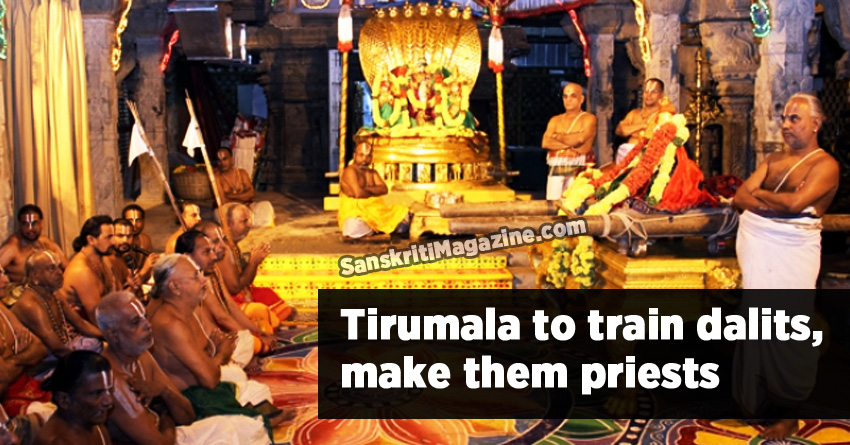
Tirumala to train dalits, make them priests

Tirumala to train dalits, make them priests

In a sharp departure from tradition, the Tirumala Tirupati Devasthanams has decided to train non-Brahmins in temple rituals and practices. About 200 people from dalit and backward communities will be given rigorous training for three months as part of a pilot project. To begin with, the beneficiaries will be selected from Chittoor and West Godavari districts.

This is the first time that the administration of the world’s richest temple is offering a certificate course in Vedic rituals for dalits and backward classes. Earlier, the TTD had conducted several short training sessions for tribal priests in Vedic rituals. But now, the training will be full-fledged with a certificate awarded at the end of the programme.

“The TTD will train youths from downtrodden sections of society in temple rituals. We will focus on people living in remote and backward areas. The endowments department, in association with the TTD, will also build temples in far-flung villages. Once the training session is over, these youths will be handed over the task of daily rituals in those proposed temples,” AP endowments minister P Manikyala Rao said.

The TTD had earlier launched a similar initiative, Dalita Govindam, to spread the Hindu Dharma in Dalit hamlets by training the youths in offering ‘prasadam’ to the deity. “It was a week-long programme. They were simply trained in offering ‘prasadam’ and a couple of rituals. There was no follow-up action either. Now we will take up a comprehensive training program,” said an official in the endowments department. The TTD will conduct the certificate program in Sri Venkateswara Vedic University.

According to TTD officials, ‘Agamas’ (traditional doctrine for temple ritual) are of three types. While the highest form of these rituals is practised by traditional priests, the other two forms can be performed by the general public.

As part of the certificate program, about 100 youth each from West Godavari and Chittoor districts will be trained in ‘Smartha’ traditions. Smartha deals with all types of common rituals in a family including fixing muhurthams for weddings. The training programme will focus on the general tenets of the Vedic religion, evolution of temple system, the dos and don’ts of idol worship and rituals, and conduct of festivals among other things. During the training session, the priests-to-be should wake up before the sunrise, perform yoga and recite the prescribed mantras before attending to the classroom. 
You may also like

Search the website

Like us on Facebook

Get daily updates via Email

Enter your email address:

Recent Posts

Jamai Shashthi 2026 — The Story of Maa Shashthi, the Cat, and the Wife Who Was Forgiven

Jamai Shashthi 2026 — The Story of Maa Shashthi, the Cat, and the Wife Who Was Forgiven

On Saturday, June 20, 2026, Bengali households across Bharata will welcome their married daughters and sons-in-law home for the legendary jamai-aador feast and perform the Shashthi Vrata. But behind the warmth lies a story most Bengalis know by heart and most non-Bengalis have never heard — the wife who stole the hilsa, blamed the cat, lost six sons to Maa Shashthi’s wrath, and was finally forgiven. The Vrat Katha, the vidhi, the mantras, and the deeper teaching.

Vat Purnima 2026 — The Wife Who Argued Yama Into Returning Her Husband’s Life

On Monday, June 29, 2026, women across Maharashtra, Gujarat, and southern Bharata will tie red thread around banyan trees and hear the story of Savitri — the wife who walked behind Yamaraja Himself when He came for her husband, and out-argued the Lord of Dharma into returning Satyavan’s life. The Mahabharata’s Pativrata Mahatmya Parva, the vrat vidhi, and why the banyan witnessed everything.

Purushottam Maas — The Month No Deity Would Claim, and the Lord Who Made It Supreme

Every month of the Hindu calendar has a lord — except the rare thirteenth, the Adhika Maas, born an orphan and shunned as the “impure month.” The Puranas tell how this rejected month went in grief to Bhagavan Vishnu, who claimed it, gave it His own name — Purushottam — and made it the most fruitful month of all. The origin story, the teaching, and what it means for Purushottam Maas 2026 (May 17 – June 14).

Padmini Ekadashi 2026 — The Ekadashi Even the Devas Descend to Keep

Padmini Ekadashi 2026 — The Ekadashi Even the Devas Descend to Keep

The rarest Ekadashi of the entire Hindu calendar is three days away. The Padma Purana preserves a conversation between Bhagavan Krishna and Yudhishthira about a single Ekadashi the great Rishis spend lifetimes waiting for — Padmini. The Vrat Katha of Queen Padmini of Mahishmati, the lotus teaching, and why May 27, 2026 is the morning Vaishnavas across Bharata are preparing for.

Varada Chaturthi 2026 — The Rare Ganesha Day of Purushottam Maas

Varada Chaturthi 2026 — The Rare Ganesha Day of Purushottam Maas

Once every 2.5–3 years — when the rare 13th month of Adhika Maas opens — a thirteenth Vinayaka Chaturthi appears. The Mudgala Purana calls it Varada Chaturthi, the “boon-giving” Chaturthi, and holds it as the most fruit-bearing Ganesha day of the entire calendar. Today, Wednesday May 20, 2026, is that day.

css.php