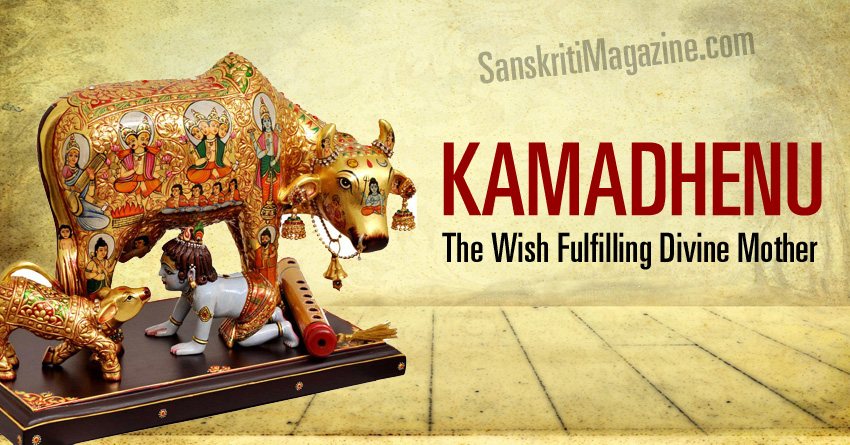
Kamadhenu, also known as Surabhi is the divine bovine-goddess and the mother of all cows in Hinduism. She is the sacred cow who emerged from the ocean of milk (kshira-sagar) at the time of samudra manthan – the churning of ocean – by suras (gods) and asuras (demons), lives in swarga-loka (heaven) and grants all wishes and desires.
Originally presented to the seven sages by the Devas, Kamadhenu came into the possession of Sage Vasishta in due course.
Kamadhenu is also well-known through her other five forms:
- Nanda
- Sunanda
- Surabhi
- Susheela and
- Sumana
Kamadhenu’s complexion is like the white clouds and every part of her body has a religious significance. Her four legs symbolize the four Vedas, and teats the four Purusharthas. Her horns symbolize the gods, face symbolize the sun and the moon, shoulders Agni (the god of fire), and legs the Himalayas.
Brahma, the Creator is her back, while Vishnu is her throat. To the right, a man is seen as protecting the cow from being slaughtered. She is described as sometimes taking on an anthropomorphic form, with a human head, a cow’s body, a peacock’s tail, and the wings of a parrot.
As described in Ramayana:
Surabhi is the daughter of Sage Kashyapa and his wife Krodhavasha, the daughter of Daksha. Her daughters Rohini and Gandharvi are the mothers of cattle and horses respectively. Still, it is Surabhi who is described as the mother of all cows in the text.
However, in the Puranas, such as Vishnu Purana and Bhagavata Purana, Surabhi is described as the daughter of Daksha and the wife of Kashyapa, as well as the mother of cows and buffaloes.
As described in Matsya Purana:
Surabhi is described as the consort of Brahma and their union produced the cow Yogishvari, the eleven Rudras, lower animals, goats, swans and high class drugs. She is then described as the mother of cows and quadrupeds.
In another instance, she is described as a daughter of Daksha, wife of Kashyapa and the mother of cows. The Harivamsa, an appendix of the Mahabharata, calls Surabhi the mother of Amrita (ambrosia), Brahmins, cows and Rudras.
As described in Bhagavad Gita:
The Bhagavad Gita, a discourse by the Krishna in the Mahabharata, twice refers to Kamadhenu as Kamadhuk.
In verse 3.10, Krishna makes a reference to Kamadhuk while conveying that for doing one’s duty, one would get the milk of one’s desires. In verse 10.28, when Krishna declares to the source of the universe, he proclaims that among cows, he is Kamadhuk.
The cow symbolizes Dharma itself.
Kamadhenu is said to have stood steadily upon the earth with her four feet during the Satya yuga (world’s first age of truth), upon three feet during the Treta yuga (the second stage of less than perfection), upon two feet during the Dwapara yuga (the third stage of dwindling and disappearing perfection) and only on one leg during Kali yuga (the fourth and current age of decadence).
Regarded as the source of all prosperity in Hinduism, she is a form of Devi, the Divine Mother and is closely related to the fertile Mother Earth (Prithvi), who is often described as a cow in Sanskrit.
The sacred cow denotes “purity and non-erotic fertility, sacrificing and motherly nature, and sustenance of human life”.