IndianSanskriti

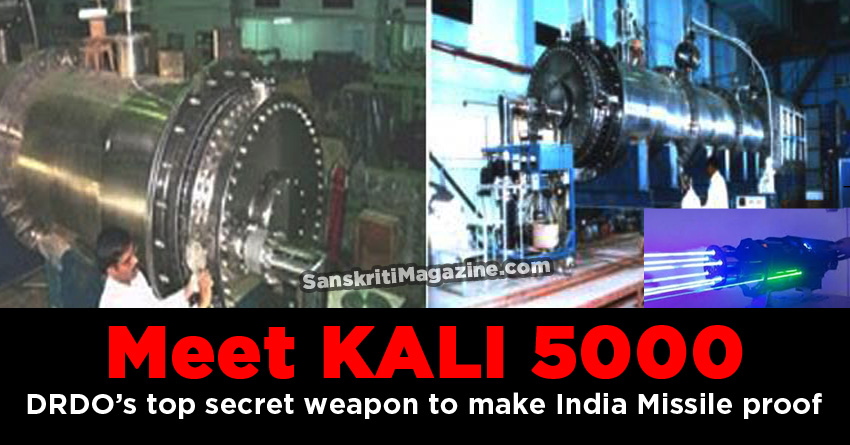
Meet India’s top secret weapon: KALI 5000

KALI-5000 is India’s answer to any uninvited incoming missiles and planes. Moreover, the beam can also be used to cripple the enemy satellite and UAVs in no time.

KALI stands for Kilo Ampere Linear Injector. It  is a linear electron accelerator being developed by the Defence Research Development Organization (DRDO) and the Bhabha Atomic Research Centre (BARC).

Earlier the Kali system was developed for industrial applications and that the defence use was a recent spinoff.

The machine essentially generated pulses of highly energetic electrons. Other components in the machine down the line converted the electrons into flash x-rays (for ultra high-speed photography) or microwaves.

The electron beam itself can be used for welding.

The KALI project was first mooted in 1985 by the then Director of the BARC, Dr. R. Chidambaram. Work on the Project began in 1989, being developed by the Accelerators & Pulse Power Division of the BARC.

The project was designed to produce electron pulses of about 100 ns with an energy of about 1 MeV, current 40 kA and a power of 40 GW. This Relativistic Electron Beams (REB) thus generated will be used for the generation of High Power Microwaves (HPM) & Flash X Rays (FXR).

This has fueled hopes that the KALI could, one day be used in a High-Power Microwave gun, which could destroy incoming missiles and aircraft through soft-kill (destroying the electronic circuitry on the missile).

The KALI’s potential for a military role as a beam weapon has made it, in the eyes of China a threat. The KALI-5000 was commissioned for use in late 2004.

However, weaponisation of the KALI will take some time. The system is still under development, and efforts are being made to make it more compact, as well as improve its recharge time, which, at the present, makes it only a single use system.

You may also like

Search the website

Like us on Facebook

Get daily updates via Email

Enter your email address:

Recent Posts

Adi Shankaracharya Jayanti 2026 — Advaita Vedanta, Om symbol, and four Amnaya Peethas

Adi Shankaracharya — The Monk Who Reunited Bharata

Shankaracharya Jayanti 2026 — the 1238th birth anniversary of Adi Shankaracharya. His extraordinary life, the Digvijaya, the debate with Mandana Mishra, Advaita Vedanta, the four Amnaya Peethas, and his timeless literary legacy.

Akshaya Tritiya 2026 — royal purple hero banner with Akshaya Patra vessel and Devanagari text

Akshaya Tritiya 2026 — The Day That Never Diminishes

Akshaya Tritiya (April 19, 2026) is one of the most auspicious days in the Vedic calendar — when any act of dharma, dana, or japa yields imperishable merit. Discover the five sacred Puranic events, complete puja vidhi, timings, mantras, and the deeper spiritual teaching beyond gold-buying.

Baisakhi 2026 — Mesha Sankranti Hindu Solar New Year hero banner with rising sun, Om symbol and wheat harvest

Baisakhi 2026 — Harvest, Hope, and the Hindu Solar New Year

Baisakhi 2026 falls on Tuesday, April 14 — the day Bhagavan Surya enters Mesha Rashi at 9:39 AM, marking the Hindu Solar New Year. Discover the sacred science of Mesha Sankranti, the Punya Kaal rituals, and how this one cosmic moment is celebrated across Bharata as Vishu, Puthandu, Pohela Boishakh, Bohag Bihu, and Pana Sankranti.

Varuthini Ekadashi 2026 — sacred vrat guide hero banner with Vishnu Chakra mandala

Varuthini Ekadashi 2026 — The Sacred Vrat That Shields from Sin

Varuthini Ekadashi (April 13, 2026) is one of the most powerful Ekadashi vrats — dedicated to Lord Vamana, it dissolves lifetimes of karmic burden and shields the devoted soul with Bhagavan Vishnu’s protective grace. Complete vrat vidhi, timings, mantra, and the sacred Vrat Katha from the Bhavishya Purana.

css.php