Q: In the fifteenth chapter of the Gita, there is a description of a tree which is upside down. The branches are in the ground and the roots are in the sky. What could be the significance of this?
A: This is a symbol to signify that your origin is the Divinity; the consciousness. That is your root. The mind and all its paraphernalia are like the branches. And all the different types of rhythms in life, all the different emotions, are like the leaves. They don’t stay permanently, they wither away. If you are focusing on the leaves, and you forget to water the roots, then the tree will not remain.
So, it says, ‘Asvattham enam su-virudha-mulam asanga-sastrena drdhena chittva’ (BG 15:3). Notice that you are not these different emotions, these different aspects of life. Feel the distance from all these branches and retrieve back. That is what it is saying.
Otherwise we get so immersed in the outer, that we forget the main root. You need to prune the tree otherwise it goes here and there. So prune all that, and know that your origin is somewhere up. Adi Shankaracharya has said this beautifully, – ‘My original place is in heaven, I have come here just for few days; just to have fun. Today I have just come for the purpose of relaxing, but this is not my original place, it is somewhere else.’
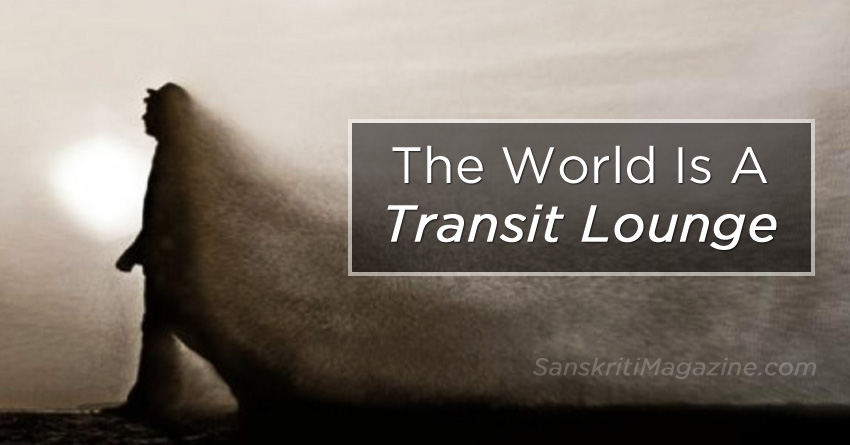
The thought itself – My home is somewhere else, I have just come to visit – creates a distance inside you. This world is a transit lounge.
You know, in airports and railway stations there are lounges, and in a lounge what do you do? You keep your luggage and start eating. You use the bathroom and everything, but you don’t open your suitcase and hang your clothes all over the place. You don’t do that in a transit lounge. You keep your things packed.
So this world is just a transit lounge. Don’t mistake it to be your home.
Q: The Ashtavakra Gita says, ‘You can go on reading scriptures, but you will get liberation only when you forget the scriptures.’ So then what is the purpose of reading the scriptures?
A: See, you get into a bus, but then you also need to get out of the bus. Now if you argue with me that, ‘If I have to get out of the bus then why should I get into the bus?’ What can I say? You get into the bus from somewhere else and you get out from somewhere else. If you have to get out of the bus, why should you get into the bus in the first place – this argument doesn’t hold.
So, the scriptures are to make you understand your nature, the nature of the universe, the nature of this mind which is stuck in small things, and to give it a bigger vision.
Knowledge is like detergent. See, you put soap on your body but at some point you wash it off as well, isn’t it? Similarly, you have this desire, ’I want to be liberated’, and that desire takes you away from all other small desires. But if you keep holding on to that thought, then it will also become a problem at some point. You have to wash that off as well and become free. A point comes when you say, ‘If I have to get liberation let it be, otherwise let thy will be done.’ In that moment you are already free.
~ Sri Sri Ravi Shankar