IndianSanskriti
Classification of Warriors by Bhishma in the Mahabharata

Classification of Warriors by Bhishma in the Mahabharata

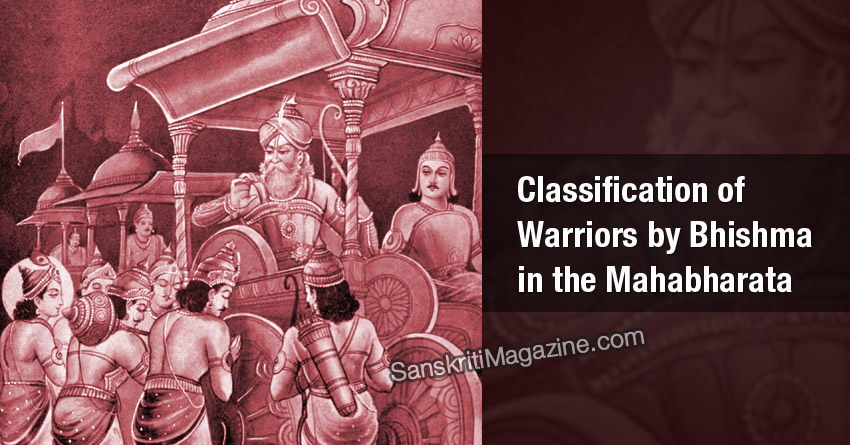
Bhishma, the grandsire of both the Kauravas and the Pandavas, analyzed each warrior on both sides of the battle. He said there are 3 types of warriors. They are the Rathi, the Atirathi and the Maharathi. Based on his judgement and knowledge of the science of weapons he classified every warrior involved in the Mahabharata war. According to him the highest level of a warrior is the Maharathi.

He defined the three classifications as follows:

Rathi: A warrior capable of attacking 5,000 warriors simultaneously.

Atirathi: A warrior capable of contending with 12 Rathi class warriors or 60,000 warriors simultaneously.

Maharathi: A warrior capable of fighting 12 Atirathi class warriors or 720,000 warriors simultaneously, and having complete mastery of all forms of weapons and combat skills.

Classification of Warriors from the Kaurava Side:

Rathis:

  • Sudhakshina, the ruler of the Kamvojas
  • Sakuni, King of Gandhar and uncle of Kauravas
  • Duryodhana’s son Lakshmana and the son of Dushasana
  • Jayadrath, the king of the Sindhu and brother in law of Kauravas
  • All 99 brothers of Duryodhana, including Dushasan, are single Rathis
  • Duryodhana is classified as a warrior equal to 8 Rathis

Atirathis:

  • Bhoja chief Kritavarman
  • The ruler of Madras, Salya
  • Bhurisravas, the son of Somadatta
  • Kripa, also known as Kripacharya, the son of Saradwat

Maharathis:

  • Alambhusha, the Chief of Rakshasas
  • The ruler of Pragjyotisha, the brave Bhagadatta
  • Vrishasena, the son of Karna,
  • Guru Drona
  • Asvathama, the son of guru Drona and the avatar of Lord Shiva. (Even though he was classified as a Maharathi, in reality he was peerless and equal to Lord Shiva in battle according to Bhishma; but the only pre-condition is that Asvathama has to become extremely angry to unleash his full potential.)
  • Karna is equal to 2 Maharathi.
  • Bhishma, even though he never classified himself. Later it was revealed that Bhishma was equal to 2 Maharathi warriors.

Classification of Warriors from the Pandava Side:

Rathis:

  • Uttamaujas
  • Sikhandi, the son of the king of the Panchalas
  • Yudishtira the son of Pandu and Kunti, is a Rathi.
  • Nakul and Sahadeva are single Rathis
  • Bhima is regarded as equal to 8 Rathis.

Atirathis:

  • Satyaki of the Vrishni race,
  • Dhrishtadyumna the son of Drupuda
  • Kuntibhoja,the maternal uncle of Pandavas
  • Ghatotkacha, prince of Rakshasas and master of all illusions, son of Bhima and Hidimva.

Maharathis:

  • Virata King
  • Drupuda, King of Panchalas
  • Dhrishtaketu, the son of Sisupala, the king of the Chedis
  • All sons of Draupadi are Maharathis
  • Abhimanyu, the son of Arjuna is equal to 2 Maharathi.
  • Arjuna is equal to 2 Maharathi warriors.
You may also like

Search the website

Like us on Facebook

Get daily updates via Email

Enter your email address:

Recent Posts

Jamai Shashthi 2026 — The Story of Maa Shashthi, the Cat, and the Wife Who Was Forgiven

Jamai Shashthi 2026 — The Story of Maa Shashthi, the Cat, and the Wife Who Was Forgiven

On Saturday, June 20, 2026, Bengali households across Bharata will welcome their married daughters and sons-in-law home for the legendary jamai-aador feast and perform the Shashthi Vrata. But behind the warmth lies a story most Bengalis know by heart and most non-Bengalis have never heard — the wife who stole the hilsa, blamed the cat, lost six sons to Maa Shashthi’s wrath, and was finally forgiven. The Vrat Katha, the vidhi, the mantras, and the deeper teaching.

Vat Purnima 2026 — The Wife Who Argued Yama Into Returning Her Husband’s Life

On Monday, June 29, 2026, women across Maharashtra, Gujarat, and southern Bharata will tie red thread around banyan trees and hear the story of Savitri — the wife who walked behind Yamaraja Himself when He came for her husband, and out-argued the Lord of Dharma into returning Satyavan’s life. The Mahabharata’s Pativrata Mahatmya Parva, the vrat vidhi, and why the banyan witnessed everything.

Purushottam Maas — The Month No Deity Would Claim, and the Lord Who Made It Supreme

Every month of the Hindu calendar has a lord — except the rare thirteenth, the Adhika Maas, born an orphan and shunned as the “impure month.” The Puranas tell how this rejected month went in grief to Bhagavan Vishnu, who claimed it, gave it His own name — Purushottam — and made it the most fruitful month of all. The origin story, the teaching, and what it means for Purushottam Maas 2026 (May 17 – June 14).

Padmini Ekadashi 2026 — The Ekadashi Even the Devas Descend to Keep

Padmini Ekadashi 2026 — The Ekadashi Even the Devas Descend to Keep

The rarest Ekadashi of the entire Hindu calendar is three days away. The Padma Purana preserves a conversation between Bhagavan Krishna and Yudhishthira about a single Ekadashi the great Rishis spend lifetimes waiting for — Padmini. The Vrat Katha of Queen Padmini of Mahishmati, the lotus teaching, and why May 27, 2026 is the morning Vaishnavas across Bharata are preparing for.

Varada Chaturthi 2026 — The Rare Ganesha Day of Purushottam Maas

Varada Chaturthi 2026 — The Rare Ganesha Day of Purushottam Maas

Once every 2.5–3 years — when the rare 13th month of Adhika Maas opens — a thirteenth Vinayaka Chaturthi appears. The Mudgala Purana calls it Varada Chaturthi, the “boon-giving” Chaturthi, and holds it as the most fruit-bearing Ganesha day of the entire calendar. Today, Wednesday May 20, 2026, is that day.

css.php