There are many reasons for this. The sun is the most magnificent object in nature. The sun gives us light and energy. Without the sun, there would be no life on earth. Our existence depends on the sun. Also, the sun was considered the master of time. The sun creates days and nights, thus making us grow old. So the ancient people treated the sun as a god. Most of the ancient cultures that we still know about have a reference to the sun god.
From the limited information available about our past, we know that Hinduism is the oldest religion (or “way of life”, as some people prefer to call it) and in this tradition, the Rigveda Samhita is the oldest work. The Rigveda Samhita is divided into ten sections (known as maṇḍalas) and each section has several poems (called sūktas). Each poem is further made up of verses (known as ṛks). Perhaps the most famous verse from the Rigveda is the savitā gāyatrī mantra.
The Gayatri mantra is a 6,000-year-old verse recited by millions of Hindus every day all over the world. This mantra – Rigveda Samhita 3.62.10 – was composed by sage Vishwamitra. He composed most of the poems in the third section of the Rigveda.
This verse is called the Gayatri mantra possibly because it is composed in the poetic meter called Gayatri. A verse written in this poetic meter should have three lines and each line must have eight syllables. It is interesting to note that the etymology of the word Gayatri is gāyantaṃ trāyate iti gāyatrī, “Gayatri is that which protects the person who recites it.”
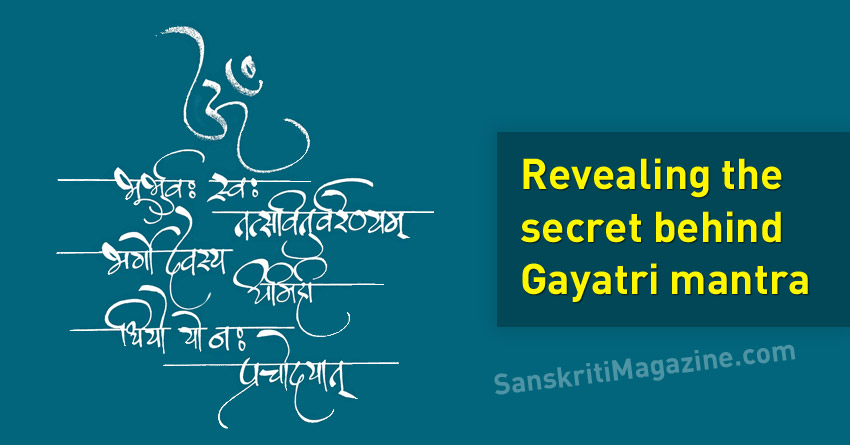
Therefore, although there are thousands of verses composed in the Gayatri metre, when we say Gayatri mantra, it specifically denotes this verse:
tat saviturvareṇyam |
bhargo devasya dhīmahi |
dhiyo yo naḥ pracodayāt ||
In Sanskrit, every word has several meanings. So it’s important for us to understand the context in which a certain word is used. Let us take a look at what each word in this mantra means:
tat = that
savituḥ = the sun; literalley “one who permits”, “one who stimulates”, “one who vivifies”
vareṇyam = best, excellent, worthy of the highest respect
bhargaḥ = light, lustre, radiance
devasya = of god, of the lord, of the deity
dhīmahi = (we) meditate, contemplate
dhiyaḥ = intellect, wisdom, mind, consciousness
yaḥ = the one who, he who
naḥ = to us, for us
pracodayāt = (one who) inspires, motivates, stimulates, empowers
(An astute observer will find that the first line has only seven syllables instead of eight: tat-sa-vi-tu-rva-re-ṇyam; therefore while recitation, we add the syllable om in the beginning or we say tat-sa-vi-tu-rva-re-ṇi-yam).
Let us try to arrange this in the form of a sentence. One who (yaḥ) stimulates (pracodayāt) our (naḥ) mind (dhiyaḥ) – we meditate (dhīmahi) on that (tat) excellent (vareṇyaṃ) radiance (bhargaḥ) of the lord (devasya), the sun (savituḥ).
A simple English translation would give us:
We meditate on
the wonderful radiance of the sun god,
who stimulates our mind.
The same Gayatri mantra also appears in the Yajurveda but with an additional line in the beginning:
oṃ bhūrbhuvassuvaḥ |
om = the single-syllable word that represents brahman, the Supreme Being
bhūḥ = earth
bhuvaḥ = atmosphere
suvaḥ = sky, heaven
With this line, we bring our awareness to the three spheres of existence, thus connecting with something bigger than our tiny selves.
In the Hindu tradition, we believe that there is only one Supreme Being (brahman) but there are several gods. These gods may be realized in any form.
The forces of nature – wind, lightning, thunder, fire – are deified. The animate and inanimate beings – animals, plants, rivers, mountains – are deified. The celestial objects – sun, moon, planets, stars – are deified. We may also see god in a sculpture, a painting, or even in a song.
Among all these various possibilities, the sun is the most magnificent. Of course, an astrophysicist might tell us that the sun in our solar system is a veritable pygmy in front of some of the other stars in the universe. Even so, the sun remains the most brilliant object we can see with our naked eyes. Not only do we see it but we also feel its presence. It removes darkness and brings light. It removes the cold and brings warmth. The radiance of the Supreme represents Knowledge (which removes the darkness of ignorance) and Vitality (which removes the coldness of lethargy).
So the Gayatri mantra is a prayer to the Supreme, in the form of the sun, which stimulates our mind and empowers us. Just like the sun wakes us up every morning, we pray that the Supreme light wakes up our intellect. It is indeed a prayer for internal strength.
In the 1990s cartoon series Captain Planet, there is a beautiful symbolism for this – whenever Captain Planet is on the verge of defeat, he draws energy from the sun. He gets revitalized. He’s ready to face his enemies – those trying to pollute the earth. The Gayatri mantra does something similar, but within.
(In preparing this article, I have drawn heavily from the lectures of HH Sri Rangapriya Swami; my discussions with Shatavadhani Dr R Ganesh; Dr Koti Sreekrishna’s article on the Gayatri mantra; and Vol 17 of the 36-volume Rigveda Samhita translation in Kannada brought out by the Maharaja of Mysore, Sri Jayachamarajendra Wadiyar during 1948-62.)
-As published in Dailyo