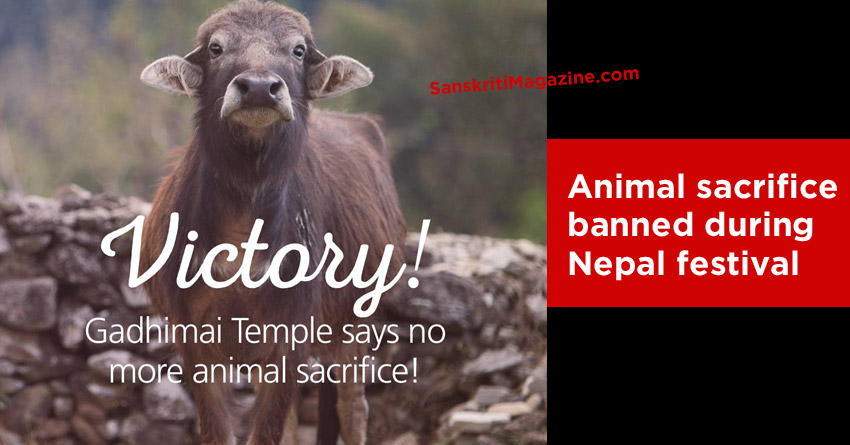
NEW DELHI: In a significant move that may also be termed as a major victory for animal welfare activists across the globe, Nepal’s temple trust on Tuesday announced to cancel all future animal sacrifice at the country’s Gadhimai festival — the world’s biggest animal sacrifice event held every five years.
The Trust also urged all devotees not to bring animals to the festival — a Hindu religious practice which had been continuing for the last 300 years.
“The Gadhimai Temple Trust hereby declares our formal decision to end animal sacrifice. With your help, we can ensure Gadhimai 2019 is free from bloodshed. Moreover, we can ensure Gadhimai 2019 is a momentous celebration of life”, said the chairman of the Trust Ram Chandra Shah.
The decision, announced by the Nepal Gadhimai temple trust, comes after rigorous negotiations and campaigning by Animal Welfare Network Nepal (AWNN) and Humane Society International/India.
Gauri Maulekhi, HSI/India consultant & Trustee, People for Animals who petitioned India’s Supreme Court against the movement of animals from India to Nepal for the Gadhimai festival, on Tuesday said, “This is a tremendous victory for compassion that will save the lives of countless animals. The HSI/India was heartbroken to witness the bloodshed at Gadhimai, and we have worked hard to help secure this ban on future sacrifice.”
She said, “We commend the temple committee but acknowledge that a huge task lies ahead of us in educating the public so that they are fully aware. The HSI/India will now spend the next three and a half years till the next Gadhimai educating devotees in the states of Bihar, Jharkhand, Uttar Pradesh and West Bengal on the temple trusts’ decision not to sacrifice animals. Animal sacrifice is a highly regressive practice and no nation in the modern world should entertain it.”
Manoj Gautam, founding member of AWNN and campaigner against the Gadhimai festival, said, “We applaud the temple committee’s decision to end this mass slaughter of innocent animals and hope that they will continue to support us in our future endeavours for protecting animals in the country. The AWNN’s progressive move to work directly with the temple committee, with Humane Society International/India’s support has been the key that changed the whole face of the campaign and is the reason for the achievement we have now.”
In 2014, HSI/India and AWNN’s global campaign against the Gadhimai animal massacre captured the public imagination when thousands of national and international supporters expressed their ire and displeasure against the ruthless killing. Protests were also held worldwide against this practice.
“With the Supreme Court of India’s intervention to prohibit the movement of animals from India to Nepal, AWNN and HSI/India saw a reduction of up to 70% in the number of animals sacrificed from 2009. The Supreme Court’s order resulted in more than 100 arrests of those breaching the order, and more than 2,500 animals saved,” said a statement, issued by the HSI/India.
It is estimated that more than 500,000 buffalo, goats, chickens and other animals were decapitated at Gadhimai in 2009, but in 2014 the numbers had reduced significantly.
The Supreme Court of India had recently issued directions to states to set up mechanisms to prevent animals from being taken to Gadhimai in future and create awareness against animal sacrifice.
“Earlier this year, following the global outrage stemming from the Gadhimai massacre, the temple committee also decided not to sacrifice any animals during the harvest festival (Sankranti)”, said the statement.
Full statement from Gadhimai’s temple trust chairman, Ram Chandra Shah:
For generations, pilgrims have sacrificed animals to the Goddess Gadhimai, in the hope of a better life. For every life taken, our heart is heavy. The time has come to transform an old tradition. The time has come to replace killing and violence with peaceful worship and celebration.
Our concern has been this: how do we convince the people, so desperate for the favour of Gadhimai, that there is another way? How do we bring them on our journey? Thankfully, the dedicated efforts of the Animal Welfare Network Nepal and Humane Society International/India has shown us the path and provided the motivation to make this transformation a reality.