Maa Shashthi maybe a lesser known Hindu folk Goddess – but she remains a guardian angel for the majority of households in Bengal. She is considered an avatar of Goddess Durga and held in high esteem by the women folk. The worship of Goddess Shashthi is a celebration of ‘Matri Shakti,’ or the power of womanhood and motherhood.
Since ‘Shashthi’ is related to the numeral six, this Goddess is worshiped every sixth day of the lunar calendar.
Held every month, the worship of this Mother Goddess – Shashthi Puja has a different name every month and serves a different purpose. From ‘Shashthi’ is also derived the word “shaat,” which signifies blessings. All mothers keep a fast and pray to this deity for the well-being of their children.
The Form & Significance of Maa Shashthi
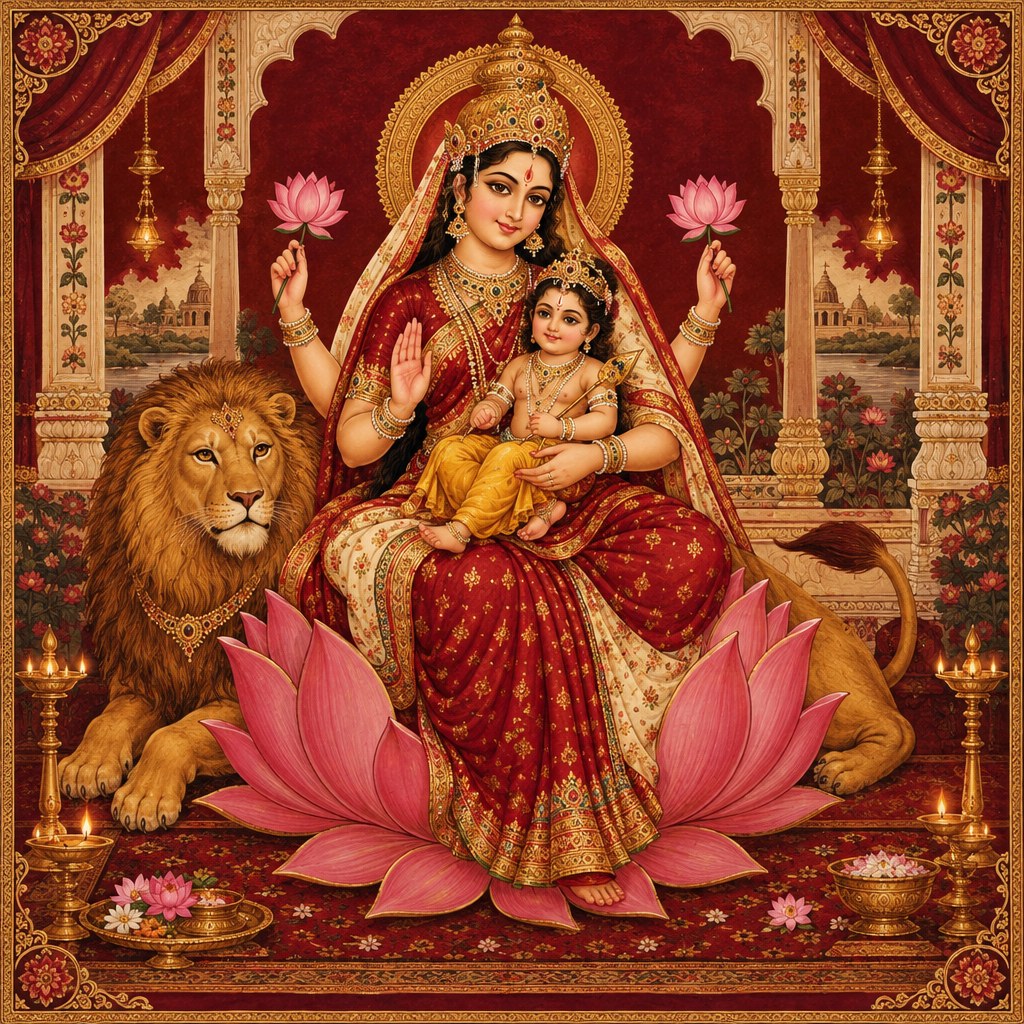
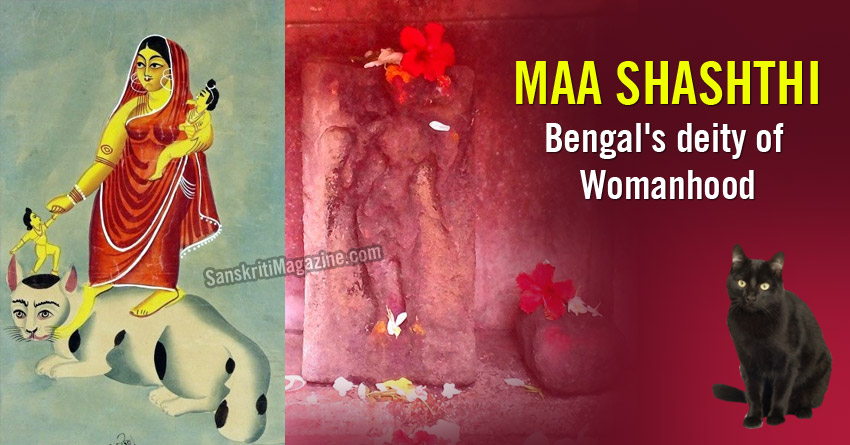
Interestingly, there are no images of the folk deity. She is usually represented by symbolssuch as the “ghat” or earthen pot, a stone under a sacred fig or “peepal” tree or the mill stone that is used to grind spices. Some villages have figurines in stone, depicting a rough feminine form. Dr Shikha Sarkar, in her book, Mother Goddess in Pre-Medieval Bengal, points out that till date, only two images of Mother Shashthi, dating back to the 12th century AD, have been found in erstwhile Bihar. Both show her as a goddess with a child on her lap mounted on a black cat looking up at her.
Known as the Goddess of fertility, procreation, and protector of children, she is much feared and loved by all.
Veneration of the Goddess Shashthi starts with a woman getting married. Daily worshipensures that the woman remains fertile and bears as many children she can.
Shashthi Puja: The 6th Day Worship
In the olden days, maternal and infant mortality was very high. Few women survived a successful delivery and few infants lived past the sixth day milestone. Healthcare was rudimentary and death rate was high. Every Bengali married woman prayed for divine intervention. The first five days of an infants life was considered crucial. On the sixth day, the new mother and her child were made to sit before the Goddess and offer their gratitude to the deity. This sixth day worship is still considered mandatory in most households and termed as ‘shuddhikaran’ or purification.
Jamai Shashthi
Most important of all Shashthis is the Jamai Shashthi, also known as ‘Aranya’ (forest) Shashthi. ‘Jamai’ means the son-in-law and ‘Shashthi’ stands for the sixth day of the lunar cycle. On this day mothers-in-law across Bengal pray for the long life and prosperity of their sons-in-law.
Durga Shashthi
A very important Shashthi, it is celebrated on the sixth day of the ten-day long Durga Puja in Bengal. The banana plant also called ‘Kola Bou’ is worshiped on this day with mustard oil and turmeric. She is regarded as an embodiment of the Goddess Durga. Books on Bengali literature cite stories of how Ganesha lost his head and how his mother prayed for her son’s life. This Shashthi is quite popular among Bengali women.
Gheto Shashthi
Derived from the word bathing ‘ghat,’ this Shashthi is observed mostly by rural women on the banks of rivers. Held every year during the monsoon season, women join hands in cleaning the bathing ghat that they use. This ritual is observed to appease the deity since many children drown during the monsoon season every year.
It was also a tactic to keep the ghats clean and save them from becoming a place to defecate from which spread many a disease.
Ashoka Shashthi
Celebrated in the month of March, when the Ashoka tree starts blooming, this Shashthi gets its name from a young girl Ashoka, borne by a deer and raised by a sage. Like Gheto Shashthi, this ritual too has a rationale. The Ashoka tree is known to have medicinal properties. Its flowers, buds and bark is proven to cure gynecological problems. During this ‘vrat’ or ritual, married women offer Ashoka flowers to the Goddess and break theirfast by swallowing these flowers.
Sheetal Shashthi
Another popular Shashthi, it’s held the day after Saraswati Puja or Vasant Panchami. The word ‘sheetal’ means cool. This day is marked by ‘arandhan’ or no cooking. Food is cooked the day before and no ovens are lit. This is also the day when the ‘sheel’ or the grinding stone is worshiped. The pentagonal slab of stone known as ‘sheel’ and the pestle which is used to grind spices known as ‘nora,’ are symbolic of the mother-child relationship. It is interpreted that the worship of the ‘sheel-nora’ is symbolical of sexual union and procreation.
Neel Shashthi
This is yet another Shashthi celebrated with much fan fare in West Bengal and Assam. ‘Neel’ is the color blue and points to the blur God, Lord Shiva. Celebrated the day before Sankranti, women worship the Goddess and then light a lamp for their children in the altar of Shiva. This Shashthi, once again highlights the union of Shiva and Parvati or Neelmadhav and Neelaboti respectively.
Other Shasthi Pujas
There are other lesser known Shashthis. But, common to all is the practice of offering seasonal fruits and vegetables to the deity. On Lunthon Shashthi ridged gourd is offered, on Mulo Shashthi radish is offered, and on Neel Shashthi mangoes are offered to appease the Goddess.
Goddess Shashthi & the Legend of the Black Cat
The vehicle of Goddess Shashthi is a black cat. The black cat, no matter how glossy, is deemed a bad omen across India and this superstitious believe is still prevalent in Bengal.
The Shashthi Panchali that narrates the story of the Goddess transports us back to a village, many years ago, where a couple lived with their sons and daughters-in-law. Every time a puja was held, the youngest daughter-in-law would steal the fruits and blame it on the black cat. The prayers of the mother-in-law bore fruit and soon the youngest daughter-in-law was expecting her first child. She gave birth to a beautiful baby boy. That night, as the mother and child lay sleeping, the black cat stole the boy. The mother woke up to find her child gone. She spent her days in misery and after a year gave birth to another child. The cat stole even the second child. Next year, when she had another baby, the child went missing again. After delivering her seven sons in succession, the hapless woman decided to end her life.
Goddess Shashthi appeared to her and told her that it was a punishment for lying about her black cat. She returned all her children to the poor woman.
Most women, no matter how much they dislike cats, will think twice before refusing food to it or dare to mess with a cat. Very few lack the guts to tread the path a cat has taken. Such is the fear of black cats in Bengal.
~ Sreemati Sen Karmakar