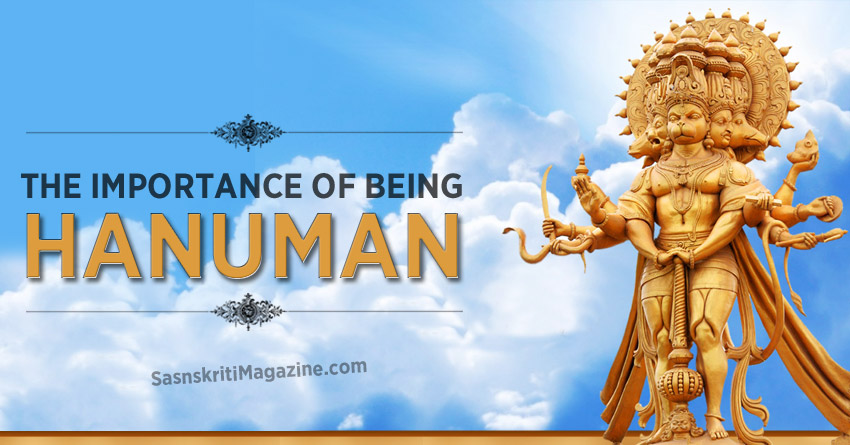
Hanuman was my childhood hero. He became my favourite god then.
While I was a kid my parents used to tell me: “He is your great grandpa. Address him as “Hanumanthabo” (Grandpa Hanuman). Ask him for whatever you need.”
During my school days kids from other religions and half‐baked products of communist breeds used to tease me: “Monkey worshipper!” “Your Grandpa has a tail!!”
I had felt ashamed. Today I regret it. I regret that I felt ashamed then. For, I didn’t realize the importance of being Hanuman. Now I know. I have not yet came across as beautiful concept of God as Hanuman represents anywhere in this world.
Ego is the product of Ignorance. Ego feeds on Memory. Crossing over ego and memory makes a human being eternally happy – this is the gist of our sacred teachings.
For the beginners, Hanuman didn’t have both. He had the power of trillions of supermen together. Yet he chose to be at the feet of an ordinary man – Rama. His surrender to the divine cause and his devotion to Rama were unique, exemplary and unconditional. Hanuman symbolically stands for pure devotion, complete surrender and absence of ego.
Hanuman was so humble that he was not identified with his manifested self. His friend, Jambhavan had to remind him about his own powers: “Anjaneya, you are so powerful that you can jump over the ocean and reach Sri Lanka within no time…”
“Oh, is it so?” He would ask. So egoless he was.
“Yes, you will have to do it for the sake of Rama.”
Next moment – Hanuman jumped across the ocean, burned entire Lanka.
According to Indian mythology, Hanuman was born to a monkey chieftain Kesari and Anjana Devi, with the blessings of Lord Siva. He is also known as the son of the wind god Vayu (hence known as Pavanputra=son of wind). To make it simple, mythology says Hanuman had three fathers.
Nevertheless all three fathers loved him and adored him.
Hanuman was a kid when he saw the rising sun and thought it was a fruit to eat. He tried to snatch the Sun, but ended up collapsed. However, all gods came to his rescue giving him thousands of boons and blessings.
Hanuman was endowed with miraculous powers and strengths. There are eight primary powers that are mentioned in the scriptures in relation to Hanuman: – Anima (the ability to shrink ones size), Mahima (increase size), Lagima (weightless), Garima (increase weight), Brapti (the ability to travel anywhere and acquire anything), Parakamya (an irresistible willpower), Vastiva (mastery over all creatures) and Istiva (to become godlike with the power to create and destroy). These are basically yogic powers that people had in the past. (Repeat – IN THE PAST only)
With so much powers, so much boons and blessing and invincible, Hanuman could have been the real God of the universe. Yet he surrendered to a man, who was known as the Perfect Man (maryada purushothama).
After his rejuvenation from the fall, he went to the same Sun to learn Vedas (Sacred Wisdom). He travelled along with Sun’s movements and learnt everything.
Before that he had a short stint with Sugreva, ousted monkey king, as latter’s minister. This was on request by his mother Anjana. People asked me a question: “If Hanuman was so powerful, why didn’t he kill Vali (or Bali – Sugreva’s brother who threw his away)”. Anjana had clearly instructed Hanuman not to get involve in both brother’s conflict and don’t fight with Vali.
Even though Hanuman was surrendered to Rama, once he had to fight with him regarding a King of Kashi. Rama tried launching arrows at Hanuman, but he could never win Hanuman. For, Rama’s arrows would pierce his own heart because he is residing inside the heart of Hanuman – a concept that never can be digested in modern knowledge.
It is said, you don’t have to pray to Hanuman. Just recite the name of Rama and Hanuman will come there. “Yatra yatra raghunatha kirtanam; Tatra tatra kritha masthakanjalim; Bhaspavaari paripurna lochanam” (Wherever the glorious name of Raghunatha (Rama) are sung, there, with folded hands and his bowed head in salutation, and eyes filled with tears, Maruti (Hanuman) is present).
The mighty Bhima, one of the heroes in the epic Mahabharat, also had ego about his physical powers. Once he saw an old monkey lying across his path blocking the way with his tail. Bhima tried to scare off the monkey, but in vain.
“I am very old and weak and can’t move. Please just move my tail and you may pass”. Bhīma tried his level best to move the tail but failed to move it even for an inch. Humiliated Bhīma realized that this is no ordinary monkey and realized his limitation. Then the old monkey said: “I am Hanuman, son of the wind, your elder brother.”
Since Hanuman represents Success, centuries later, Krishna (also an avatar of Vishnu) advised his friend Arjuna (Bhima’s younger brother and hero of Mahabharat) to hoist a flag of Hanuman so that the chances of winning a war are very high.
Hanuman is regarded as the knowledge body (jnana guna sagara) in man, the immortal man (chiranjeevi), the animal man and the flying human (va+nara). When he is cheerful he is called Prasannanjaneya. When he is in a ferocious mood he is called Veeranjaneya. When he is in a meditative mood he is called Dhayananjaney and when he is absorbed in devotion he is called Bhaktanjaneya.
Once my good friend (not an Indian) teased me calling “monkey worshipper”.
I can explain him about evolution of man and significance of stories of ten avatars to claim that he is our real great grandpa.
Instead I replied to him in a language that he would understand: “Brother, when I believe that my humble monkey is a god – there is at least logic to satisfy my child‐like mind in it. But how would you substantiate a mafia‐kingpin type insecure God who sits beyond the mysterious clouds shamelessly spying on you and threatening you through HIS so‐called, self‐ styled messengers that if you don’t follow HIS commandments and pray to HIM, you will be roasted in the hell. Such irrational and non‐ sense stories don’t even qualify to be a kid’s bed time story.”
Hanuman neither claimed he is god and nor demanded anybody to worship him. (Coming to that, no Hindu gods among 330 million, has ever made such a ridiculous claim). I am worshipping him because I adore that concept.
For, Hanuman is an invitation to the world of love and humility. He is a strong hope of a better creation. For, he is the next Brahma (A creative force according to Indian mythology). Puranas say, after Kaliyuga (present time), the land will be submerged in the ocean and most of the world will be destroyed. Just an Arctic melt or ozone break is more than enough to reach this stage.
Then, the cosmic power known as Hanuman will take birth of a Brahma, whose manifestation will again spread its wings as big bang. The ignorant people call it a creation. And their fallacy will create a separate creator too. And it becomes part of their ego. Such ego results in violence and hurt in this world. The concept of Hanuman is just opposite to that.
Hanuman shows us how to serve ordinary people like Rama who follow the path of Dharma (righteousness). We call such people avatars (incarnation) of gods. They are for real. Great power comes with great responsibility. And the responsibility is surrendering and humility.