Life and Teachings of Lord Gauranga
Sri Krishna Chaitanya Mahaprabhu (1486–1534) was one the most prominent Hindu saints of the 16th century. The most renowned and celebrated proponents of the Vaishnava School of Bhakti Yoga that centers around the unwavering devotion to Lord Krishna, Chaitanya Mahaprabhu, is also regarded as an avatar of Lord Krishna by his followers – a Hindus sect known as Gaudiya Vaishnavas.
 Gauranga’s Birth and Parentage
Sri Chaitanya Mahaprabhu, also known as, Lord Gauranga was born to Pandit Jagannath Misra and Sachi Devi at Nabadwip, on the full moon (lunar eclipsed) evening of February 18, 1486 (23rd day of the month of Falgun in the year 1407 of the Sakabda era).
His father was a pious Brahmin immigrant from Sylhet, Bangladesh, who settled in Nabadwip in the Nadia district of West Bengal north of Kolkata by the holy Ganges, and his mother was the daughter of the scholar Nilambar Chakraborty.
He was the tenth child of his parents and was named Viswambar. Before his birth, his mother lost a number of children. So, he was given the name “Nimai” after the bitter Neem tree as a protection against evil influences. The neighbors called him “Gaur” or “Gauranga” (Gaur = fair; Anga = body) because of his fair-complexion.
Gauranga’s Boyhood and Education
Gouranga studied logic at the school of Vasudev Sarvabhauma, a reputed professor of ‘Nyaya’ – the ancient Indian science of law and logic. The extraordinary intellect of Gauranga attracted the attention of Raghunath, author of the famous book on logic – Didheeti. Raghunath thought that he was the most intelligent youth in the world – even more cerebral than his teacher Sarvabhauma.
Gauranga mastered all branches of Sanskrit learning such as grammar, logic, literature, rhetoric, philosophy and theology. He then started a ‘Tol’ or place of learning at the age of 16 – the youngest professor to be in charge of a ‘Tol.’
Gauranga was a kind and compassionate, and a pure and gentle youth. He was a friend of the poor, and lived a very simple life.
Death of Gauranga’s Father and Marriage
While Gauranga was still a student, his father died. Gauranga then married Lakshmi, the daughter of Vallabhacharya. He excelled in knowledge and even defeated a reputed scholar of a nearby province. He made a tour of the eastern region of Bengal and received many valuable gifts from pious and generous householders. On his return he heard that his wife had died of snake-bite during his absence. He then married Vishnupriya.
The Turning Point in Gauranga’s Life
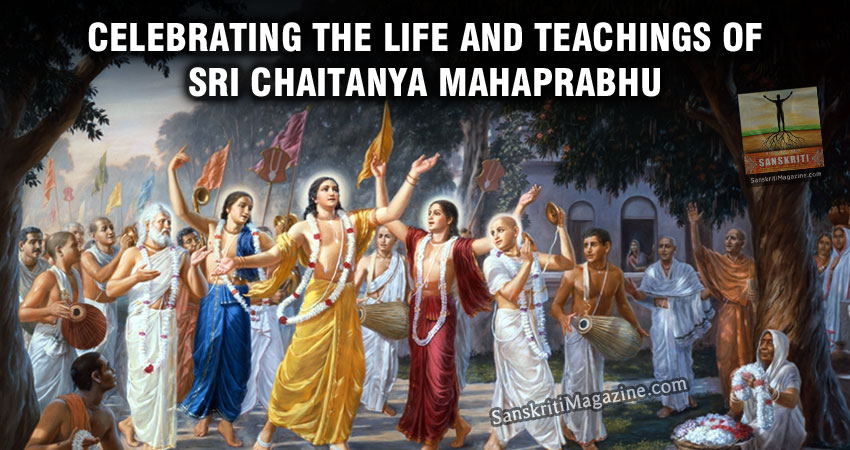
In 1509, Gauranga went on a pilgrimage to Gaya, in northern India, with his companions. Here he met Isvar Puri, an ascetic of the order of Madhvacharya, and took him as his guru. A marvellous change came in his life – he became a devotee of Lord Krishna. His pride of scholastics disappeared. He shouted and chanted, “Krishna, Krishna! Hari Bol, Hari Bol!”. He laughed, wept, jumped, and danced in ecstasy, fell on the ground and rolled in the dust, never ate or drank.
Isvar Puri then gave Gauranga the mantra of Lord Krishna. He always remained in a meditative mood, forgetting to take food. Tears trickled down his eyes as he chanted again and again,
“Lord Krishna, my Father! Where art Thou? I can’t live without Thee. Thou art my sole refuge, my solace. Thou art my real father, friend, and Guru. Reveal Thy form to me …”
Sometimes Gauranga would gaze with vacant eyes, sit in the position of meditation, and concealed his tears from companions. So consumed was his love for Lord Krishna. Gauranga wanted to go to Brindavan, but his companions forcefully took him back to Nabadwip.
Gauranga Becomes an Ascetic or ‘Sannyasin’
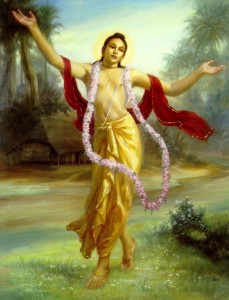 The learned and the orthodox began to hate and oppose Gauranga. But he stood adamant resolving to become an ascetic or a ‘Sannyasin.’ He thought within himself: “As I must get salvation for all these proud scholars and orthodox householders, I must become a Sannyasin. They will undoubtedly bow to me when they see me as a Sannyasin, and thus they will be purified, and their hearts will be filled with devotion. There is no other way of securing emancipation for them.”
So, at the age of 24, Gauranga was initiated to sainthood by Swami Keshava Bharati under the name of ‘Krishna Chaitanya.’ His mother, the tender-hearted Sachi, was heartbroken. But Chaitanya consoled her in every possible way and carried out her wishes. He bore deep love and reverence for his mother till the end of his life.
Gauranga went on to became a great Vaishnava preacher. He disseminated the doctrines and principles of Vaishnavism far and wide. His companions Nityananda, Sanatan, Rupa, Swarup Damodar, Advaitacharya, Sribas, Haridas, Murari, Gadadhar and others helped Chaitanya in his mission.
Krishna Chaitanya’s Pilgrimages
Chaitanya, along with his friend Nityananda, proceeded towards Orissa. He preached Vaishnavism wherever he went and held ‘Sankirtans’ or religious gatherings. He attracted thousands of people wherever he went. He stayed for some time at Puri and then proceeded to the south of India.
Gauranga visited the Tirupathi hills, Kancheepuram and the famous Srirangam on the banks of the Cauvery. From Srirangam he proceeded to Madurai, Rameswaram and Kanyakumari. He also visited Udipi, Pandharpur and Nasik. Up north, he visited Vrindavan, bathed in the Yamuna, and in several sacred pools, and visited the various shrines for worship. He prayed and danced in ecstasy to his heart’s content. He also visited Nabadwip, his birthplace. At last Gauranga returned to Puri and settled there.
The Last Days of Chaitanya Mahaprabhu
Chaitanya spent his last days in Puri by the Bay of Bengal. Disciples and admirers from Bengal, Vrindavan and various other places came to Puri to pay homage. Gauranga held Kirtans and religious discourses daily.
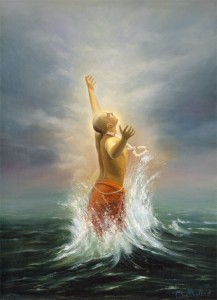
One day, in a fit of devotional ecstasy, he jumped into the water of Bay of Bengal at Puri, imagining the sea to be the holy river Yamuna. As his body was in an emaciated condition, owing to constant fasts and austerities, it floated on the water and fell into the net of a fisherman, who was fishing at night. The fisherman was extremely glad thinking he caught a big fish, and dragged the net to the shore with difficulty. He was disappointed to find a human corpse in the net. When the ‘corpse’ made a faint sound, the fisherman was frightened and abandoned the body. As he was slowly walking along the shore with trembling feet, he met Swaroopa and Ramananda, who were searching for their master from sunset. Swaroopa asked him if he had seen Gauranga and the fisherman narrated his story. Then Swaroopa and Ramananda hurried to the place, removed Gauranga from the net and placed him on the ground. When they sang the name of Hari, Gauranga regained his consciousness.
Before he died, Lord Gauranga said, “The chanting of Krishna’s Name is the chief means of attaining Krishna’s feet in the Kali Yuga. Chant the name while sitting, standing, walking, eating, in bed and everywhere, at any time. Gauranga passed away in the year 1534.
Spreading the Word of Sri Chaitanya
In the 20th century, the teachings of Chaitanya Mahaprabhu were greatly revived and brought to the West by A.C. Bhaktivedanta Swami Prabhupada. He is considered an incarnate of Sri Chaitanya, and credited for founded the International Society for Krishna Consciousness (ISKCON) which spread Chaitanya Mahaprabhu’s bhakti tradition and the famous ‘Hare Krishna’ mantra throughout the world.
~ Based on the biography of Sri Krishna Chaitanya Mahaprabhu by Swami Sivananda