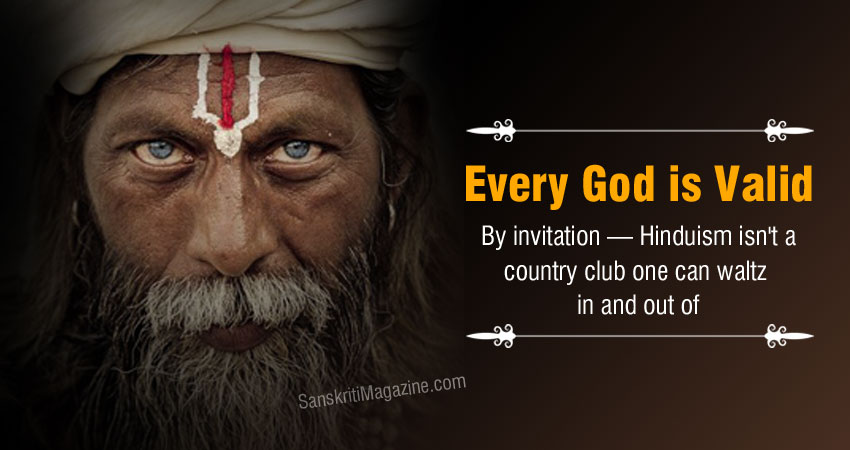
By invitation — Hinduism isn’t a country club one can waltz in and out of…
In India, to convert people out of Hinduism is seen as a fundamental right guaranteed by the Constitution. To convert people from Indian Islam to radical Islam, however, is a cause for concern. While to re-convert anyone into Hinduism is seen as a media joke. Do India-visiting aliens wonder about this confusion? Or are they too busy saving religious Indians (Hindus especially) from cult leaders, and encouraging them to convert: become rational, secular, liberal, scientific atheists? Is that the cosmic or the alien way?
To evangelise means to spread ‘the good word’. To proselytise is to spread the good word using material benefits. To evangelise and proselytise has become a modern way of life, expanding beyond the religious sphere. Education has increasingly become about conversion — teaching children good habits like speaking, reading and writing English (or Sanskrit) rather than their mother tongue. Entertainment has become about conversion — civilizing Indians, and ensuring victory of the ‘truth’ by exposing social evils and shaming wrongdoers, in a spirit of smug self-righteousness. Democracy has become about conversion. Every few years, citizens are expected to reaffirm their faith, or convert, in the hope of ‘good days’ (achhe din).
Everywhere around us, in religious and secular markets, we find people following a seven-step process:
- make fun of, or evoke fear of, the old (caste excesses, demonization of blue-skinned multi-armed animal-riding deities, expensive washing powders).
- extol the virtues of the new (one God, equality, cheaper washing powders).
- offer deals (rice, job, medicine, education, prestige, discounts).
- strike the deal (convert, make the sale).
- ensure loyalty (regular congregations and ritual re-affirmation).
- incentivise forward selling (you become an elder, if you get 10 converts in).
- keep the flock together (stir anger, hatred by turning the other into villains and the self into victim).
Yet in an ecosystem of conversion, re-conversion into Hinduism is problematic. Hinduism is not designed as a community that you can enter by signing a contract (as in baptism, or communist parties) and exit (by refusing to follow the tenets of the religion, or a country club). You are born a Hindu. Or more correctly, you are born into a caste, and whether you convert or re-convert, you cannot shed your caste, just as you cannot shed the colour of your skin. Which is why Hindutva followers have spoken of Hindu Christians and Hindu Muslims when referring to Christians and Muslims whose ancestors converted to these religions centuries ago.
Rather than indulging this feeble attempt to reconcile, there was a media outcry. And so Hindutva followers turned their attention from oldrich converts to newpoor converts, unleashing a new vocabulary — ‘homecoming’ (ghar wapsi), a very American term, which is not surprising considering the massive NRI influence in shaping the current success of Hindutva.
The problem stems from the definition of God. In Abrahamic religions (Judaism, Christianity, Islam), there is the concept of ‘false gods’ and ‘one true God’.
To follow the faith is to reject the false and embrace the true. This doctrine has expanded itself into left liberal, rational atheistic, thought where ‘no God’ has become the one true God.
Hinduism never had the concept of ‘false gods’.
Every god is valid, which is why even every god is valid, which is why even Shitala, the goddess of smallpox and cholera, is worshipped, and not treated as a demon. It’s also why Hindus have no problem praying in a church, synagogue or mosque. God is seen as limitless, ever expanding, inclusive of diversity. Hence God can be rock, plant, animal, male, female, neuter and even formless. Hence the words used to describe God are bhagavan, one who includes all portions (bhaga) and brahman, one who has infinitely expanded (brah-) the mind (manas).
How does this limitless God account for caste? This God appreciates that as long as humans are un-enlightened, they will discriminate, use hierarchy to indulge their insecurities and dominate as animals do. When the mind expands there is wisdom, and with wisdom, all structures with their inherent hierarchies will collapse. This is liberation (moksha).
Yes, re-conversion does mean a return to caste inequality, for people are far from enlightened. But conversion does not mean entry into equality either. It merely enables entry into the tribe of the Chosen People, a member of a group that is now able to feel good about itself by separating itself from the followers of ‘false gods’ and positioning itself as higher and better, a trait seen in many secularists, terrorists, and card-carrying communists. Thus we are able to dominate those ‘savarnas’ who once dominated us, while proclaiming that we stand for liberty, equality and justice.
In conversations of conversion and re-conversion, we forget a very human trait: it feels damn good to win an argument, and seduce (or force) people into our way of thinking.
The limitless rainbow-coloured God, who is also Goddess, watches this and smiles.
~ Dr. Devdutt Pattanaik, renowned author, mythologist, and leadership consultant