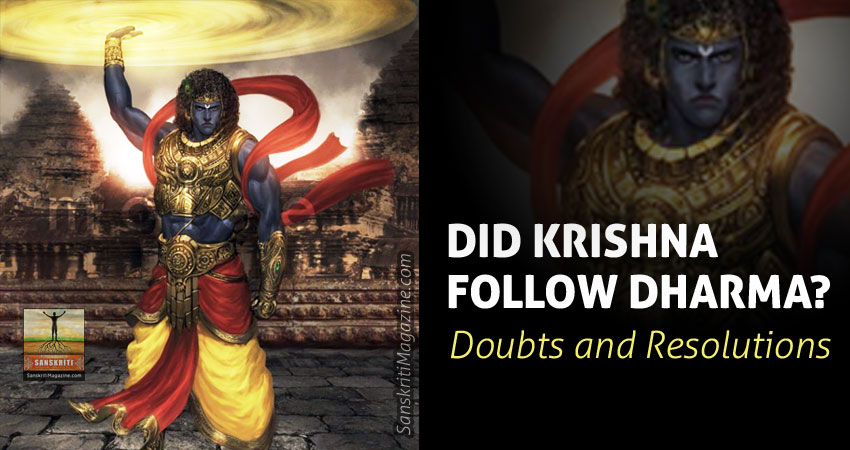
While undoubtedly Krishna is God, nevertheless many of His actions, during His avatar on earth, are difficult to reconcile with the fact that the avowed purpose of His incarnation was the protection of Dharma.
The most common doubt regarding Lord Krishna is framed as follows:
Doubt: There are serious reservations about Lord Krishna’s actions in the Mahabharata war. Before even the war had begun Arjuna expressed the noble sentiment of disgust for war and desired to become a sannayasi. Shri Krishna had at that moment the perfect chance of preventing war and the consequent massive bloodshed. Instead, He chose to dissuade Arjuna and advised him to go to war. Not only that, at many places Krishna advises Arjuna and his brothers to kill their enemies unethically. All the major warriors in the opposite army, be it Bhishma, Drona, Karna or Duryodhana, were killed by immoral tricks on His advice. How are we to view these actions?
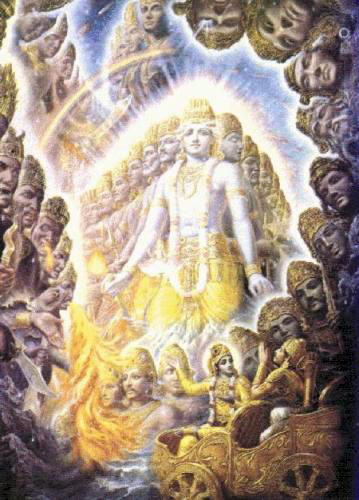 Answer: This is an appropriate question, and the answer begins with an analysis of the circumstances which led to the Mahabharata war. Duryodhana had not only usurped the kingdom of the Pandavas (Arjuna and his four brothers), but also ill-treated them in the most ignoble ways. In the basest of actions, he did what is unacceptable to Indian society at any level – tried to disrobe queen Draupadi, the wife of the Pandavas, in his huge assembly.
There were many veterans sitting in the assembly while the above ignominy was taking place. They all kept mum. Indeed people like Bhishma and Drona in the assembly were no doubt, very noble and were also fully aware of the heinous crimes of Duryodhana. They had the capacity to check him also but they did not. The reason for their inaction was that they were living off his food (as he was their king). So they even fought for him in the war. Gratitude to the one who feeds us is, of course, a great virtue. But it does not mean that he should be supported even in his Adharma. All of this gives us an indication of the depths to which the society had degraded under Duryodhana’s rule. If there were misconceptions about Dharma even in great people like Bhishma etc., it was no surprise that things were much worse with others. This is Adharma at its climax – a situation unacceptable to Lord Krishna.
Let us now return to Arjuna on the battlefield. Given such a situation in Duryodhana’s rule, it is absurdly wrong for anyone to adopt an attitude of negligence or a fear complex, more so for a Kshatriya who himself is a victim like Arjuna. His Dharma is towards the greater good, and in the context before him, it was to root out Adharma even if it necessitated a full-scale war.
Therefore, the mental state of Arjuna just before the war cannot at all be described as noble; at the best it was muddled. Bhagavan Krishna educated him about the purpose of life as a whole and then prompted him to fulfil it by waging the war.
Next is the question of the relative military merits of the forces of Dharma and Adharma – i.e. of the Pandavas and the Kauravas (family to which Duryodhana belonged). The latter’s army was very superior to that of the Pandavas – both quantitatively and qualitatively. In fact, the Kauravas’ army was one and half times bigger. The mighty Bhishma had the boon of choosing his own time of death; Drona was the teacher of Pandavas, who were only his pupils. Karna and Duryodhana were superior in valour to Arjuna and Bhima respectively. So how were they to be faced by the Pandavas? It was the fight of Dharma against Adharma. So, ethics, – though important by itself, becomes secondary in comparison to what is to be achieved.
Next is the question of the relative military merits of the forces of Dharma and Adharma – i.e. of the Pandavas and the Kauravas (family to which Duryodhana belonged). The latter’s army was very superior to that of the Pandavas – both quantitatively and qualitatively. In fact, the Kauravas’ army was one and half times bigger. The mighty Bhishma had the boon of choosing his own time of death; Drona was the teacher of Pandavas, who were only his pupils. Karna and Duryodhana were superior in valour to Arjuna and Bhima respectively. So how were they to be faced by the Pandavas? It was the fight of Dharma against Adharma. So, ethics, – though important by itself, becomes secondary in comparison to what is to be achieved.
Further Doubt: The same scriptures you swear by, also make it mandatory that conjugal pleasures be restricted to one’s own wife; how then did Lord Krishna indulge in amorous sports with the gopis of Vrindavana who were married to someone else?
Resolution: This is a gross misconception in vogue about Lord Krishna. Its clarification begins with a brief summary of the Rasa Lila as described in the great scripture Srimad Bhagavatam. It was in the dead of night that Krishna set forth the tune from his flute in the forest. The gopis who heard it became intensely attracted to it and ran to the forest, leaving aside anything they were doing then and there instantly. Some stopped cooking, some stopped feeding, some stopped eating, some stopped washing clothes, etc. and ran away.
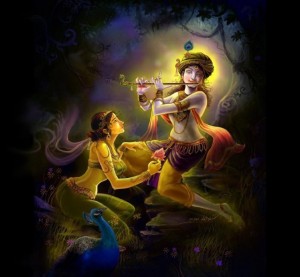 The moment the gopis reached the forest, Krishna asked: ‘What brings you here? What help do you need?’ They bent their heads without answering Him. Then He said: ‘Is it not wrong for noble ladies like you to meet anyone othet than your husbands at this odd hour?’ They cried and said: ‘Krishna! We have come with great difficulty to join you here. You should not reject us like this’. Then He condescended to play Rasa with them among bloomed lotuses.
At the end of the narration of this episode by sage Shukadeva, the listener Parikshit expressed the same doubt that has been expressed above. To which Shukadeva Ji replied: ‘Tejiyasam Na Doshaya – No fault in this for Tejiyans’, and concluded that indeed, the next morning their husbands saw the gopis just sleeping by their sides.
So the clarification hinges on the word Tejiyans and its meaning should be internally consistent with the description of Rasa. Notice that nobody will be washing clothes or doing cooking etc in the dead of night. Also the next morning their husbands saw the gopis just sleeping by their side. This gives us a clue that the Rasa was a dream. This is confirmed as follows:
Tejiyan means ‘more lustrous’ according to Panini’s grammar. Who is more lustrous than whom? The Upanishads call the wakeful Jiva as Vishwa and the dreaming Jiva as Taijasa. This Taijasa is more lustrous (tejiyan) than Vishwa. Therefore, Shukadeva’s reply means that there is no fault in the activities of the dreaming gopis. This is exactly what the Brhadaranyaka Upanishad says. For that matter, we all know it ourselves. Nobody deprecates anyone for the faults committed by him in his dreams. Why? The external world keeps our mind under leash when we are awake; but the mind becomes totally free during dreams and mixes the experiences of the real world with its imaginations creating the dream, where the little boy Krishna can behave like an adult, and lotuses can bloom in the night. Nevertheless, He has to first admonish the gopis for their conduct!
This article is based almost entirely on the teachings of Param Pujya Swami Paramanand Bharati Ji. However, any errors are entirely the author’s own.
By Nitin Kumar
[hr]
References & Further Reading:
- Bharati, Swami Paramananda. Foundations of Dharma: Bangalore, 2008.
- Pande, Shri Pandit Ramtej (ed.). Shridhar Swami’s Commentary on the Bhagvatam: Delhi, 2003.
- Saraswati, Swami Akhandananda (tr). Shrimad Bhagavata Purana (2 Volumes): Gorakhpur, 2004