Aarti is one of the most important aspect of prayers in Hinduism which symbolizes the removal of darkness by true spiritual enlightenment. It is performed by lighting a ghee lamp in front of the deity while praying.
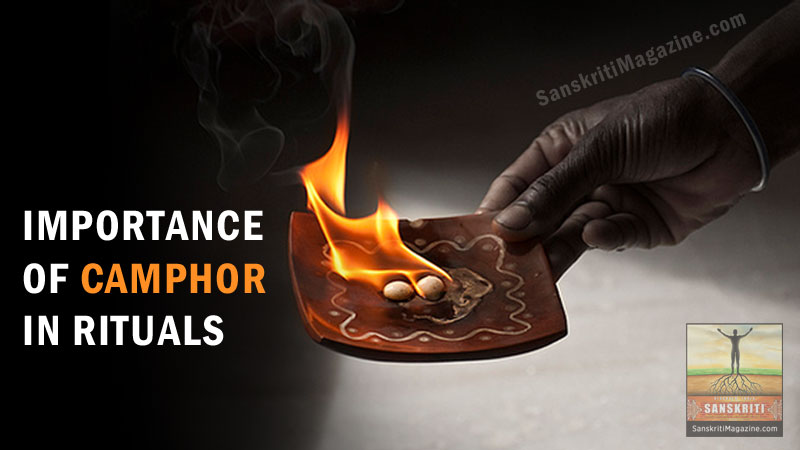
On many occasions, Hindus light a camphor or kapoor as an offering to God at the end of the aarti. Although we have probably all seen this act, many of us are not aware of the importance of this gesture.
When the camphor is lit, it burns itself out, fully evaporating until there is no residue left in the prayer utensil, leaving behind a sweet fragrance in the air instead. In the same manner, it symbolizes union with God and the promise of the devotee to burn their ego completely without leaving any residue while spreading the light of knowledge to other lives that touches theirs, no matter how brief a time. Just like the scent emanating from the camphor, the devotee, devoid of his ego and arrogance, spreads goodness around themselves.
The flame of the camphor also signifies the flame of consciousness of Lord Shiva where we can surrender all our egos to be burned under the influence of God, no longer to be seen within us. We close our eyes while performing the aarti as if to look within, to our very self or Atman. Self realization can be achieved by realizing ourselves with the flame of knowledge.
At the end of the prayer, the devotee places cupped hands over the flame and touches the eyes and top of the head, symbolizing the illumination of vision and purity of thought.
Camphor and Ayurveda
Camphor is made through an ancient Ayurvedic method by distilling the bark and wood of a coniferous tree called Camphor Laurel (Cinnamomum camphor) that is largely found in Asia, particularly in India, Sumatra, Indonesia and Borneo. White camphor is a crystalline substance with the chemical formula C10H16O, which is a fantastic anti-oxidant.
As an excellent germicide, camphor is burned to purify the atmosphere, it is also believed to remove negativity from the environment.
Absorbed through the skin, camphor produces a feeling of cooling similar to that of menthol and acts as a slight local anesthetic and anti-microbial substance. It is a decongestant and can be used as an essential oil for aromatherapy or topical application.
Used properly with medicinal understanding, it can decrease the harshness of nervous disorder as well as convulsions, epileptic episodes, nervousness, mental tension as well as chronic anxiety. It is believed to be toxic to insects and is sometimes used as a repellent and also to deter snakes and other reptiles due to its strong odor.
In this manner, camphor not only has a highly spiritual value in Hindu customs but can also be beneficial to the environment in which it is burned. Again, just like anything else, the use of camphor should be in moderation to avoid any side effects it may cause.