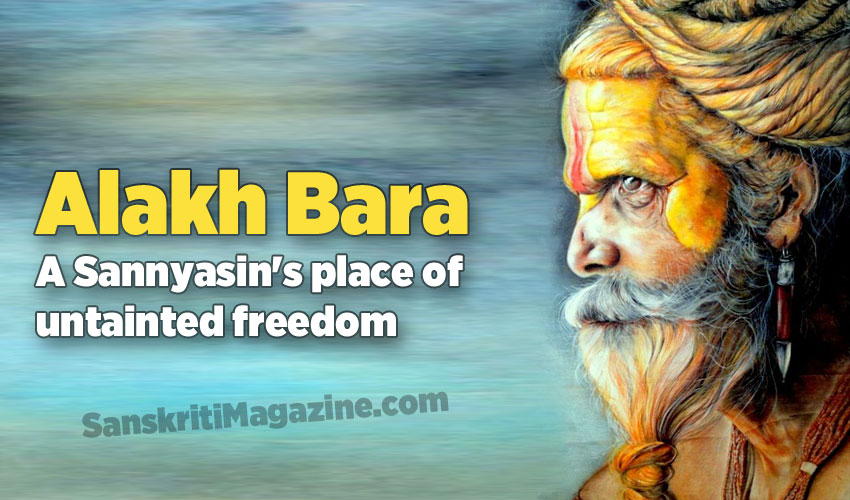
The structure of the sannyas tradition is ancient. Every organisation has its structure; whether it happens in a big or small way, the structure is always there. People define sannyas differently, and if you look at the real concept of sannyas, then the idea changes, because the ultimate aim of sannyas is to reach the state of “alakh”. “Alakh” means “freedom” from any kind of karmic bondage, and like “moksha”, “nirvana” or realisation, it is just a different name for the same thing. In the Nath tradition, whose founders were Gorakhnath and Matsyendranath, they use the greeting “Alakh Niranjan” just like we use “Hari Om”. It means “untainted freedom”. So sannyas also means freedom from karmic bondage.
There are many Upanishads which have touched on higher aspects of sannyas – the “Sannyas Upanishad” the “Hams Upanishad”, the “Paramahans Upanishad”. the “Avadhoot Upanishad”, and others. They establish the idea that sannyasins are to represent the final stage of sannyas – complete renunciation of everything, including clothes (the avadhoot stage when you become a child of nature once again). You came into this world in your birthday suit, and you will live and leave in your birthday suit.
There is a purpose in being a naga, as there is a purpose in being an avadhoot. If somebody were to ask us to become naked, our upbringing and programming would tell us it is not proper to remain naked in society. No matter how much you may want to, unless you have a different mentality, you cannot take off your clothes here – can you? So, what does it mean? There is an inner conditioning, instinct or samskara that is our self-image, self-identity, or ego which does not allow this image of life to manifest, and the moment you say, “Okay, to hell with these clothes!”, it simply represents a state of mind which has overcome that samskara.
Being a naga does not mean that you have to remain naked throughout life. If you wish to do so it is okay; if you do not wish to, go through the sadhana of remaining naked for three years and travel throughout the country observing your reaction to your body, other people’s reaction, the taunts you will receive and everything that the world can throw at you, by living in a particular way. If you can survive then you have achieved transcendence over that particular samskara of the mind. Then you can again wear clothes. This kind of lifestyle is part of your sadhana, it is not like a nudist beach where you go and take off your clothes and then come out and put your clothes back on. No, it has the purpose of self-observations and there are other aspects of sadhana incorporated.
The body is made strong like a vajra, (the thunderbolt of Indra) through sadhana – nothing can break it; nothing can influence it. In the summer there is a sadhana, to endure heat. The body should not be affected by heat. The natural system of air-conditioning in the body begins to function. In the winter the sadhana is, on freezing cold winter days, to spend your full day in the middle of a freezing cold river. Your physical endurance must grow, and along with that physical endurance there is a mental and psychic endurance also. So this sadhana is not only for the body, it is for the consciousness. There are many different kinds of sadhana like this, for one who has resigned or left behind desires, the idea of wanting something, or achieving something, of liking or disliking something.
There are different stages within Sannyasi bahudak, parivrajak, kutichak, hams, paramahams and avadhoot. Up to hams and paramahams you can be in society, you can even have a Rolls Royce, every comfort, name and fame, company, everything. Up to this point you are involved in the affairs of the world, but there comes a break. In the state of paramahams you live in the world but do not belong to the world, and in the state of avadhoot you stop living in the world. Already you do not belong to it; but now you also stop living in the world as a person with identity, with desire for name or fame, a person with ambition and desire for success. That was part of you as long as you were part of society. While you are living in society you can only perfect your sadhana to a point and not beyond, because the world has its own gravitational pull. Even for sannyasins, no matter how realised they are, the world will continue to have a gravitational pull. So the final detachment takes place when you do not even live in the world, but have renounced everything. You have renounced all your desires, ambitions, samskaras and karmas, then what do you have? Just the identity of spirit, and that is the promise that Paramahamsaji made: “Nothing – now I will just remember only You, the Divine, the Spirit, and become One with That”.
However, to experience that fiery awareness, that dynamic spirit, a further transformation needs to take place in the life of a sannyasin, and this is where an alakh bara comes in. An Alakh Bara is a place which does not have any kind of organised structure for the people in it.
You do not need success in an Akhara – just sadhana and you will reach a state which is dependent on your own personal effort, (and different people have different things to transcend in life).
There are four major instincts in life: nidra, sleep; bhava, fear of the unknown; ahamkara, self-identity; maithuna, the sexual urge. There are very few people in the world who have transcended all four basic vrittis.
Superficially, you may say that you are not afraid, but have you seen your vritti? Have you experienced the vritti of being fearful? Therefore in the Tantra system shmashan sadhana is emphasised for those who want to evolve – why? Sit down on top of a corpse and do meditation – experience the fear; face the fear. The fear has a form, it has a shape. It can manifest as a human person, as an animal, a spirit or as God. Suppose an ordinary person digs up a grave, brings out the body, sits on top of it, closes his eyes and begins to meditate. The air passes through a tree, the leaves rustle – my God, instantaneous heart attack! Or if his own body moves slightly, he thinks the corpse has come alive. Such things do happen. The force of the fear can make many things happen. That is the whole concept of the dakinis, rakinis and shakhinis. They are projections of the mind. So, ahamkara, bhaya, nidra, maithuna – these four basic states of life are transcended in an Alakh Bara.
Outside the Alakh Bara, as a sannyasin you try to deal with your mind and the system is very clear – through yoga, channel the forces of mind. The “Yoga Sutras” are full of such instructions. Inside the Alakh Bara, through sadhana, you come down to the nitty gritty, and once this happens, the grip of fear is no more, the grip of sleep is no more. Instead, one experiences a perpetual state of consciousness totally absorbed in itself. There is no fluctuation between internal and external; between light and darkness. The body sustains itself, changes and becomes divine. It transforms and begins to derive nourishment from everything in its surroundings, nourishment from the prana. The deep urges and instincts of the human personality, such as the sexual instinct, the instinct of preservation, are transformed. However, that is a totally different aspect of sadhana and not many people belong to that category of aspirant. With our present mentality we cannot belong to the Alakh Bara tradition.
~ Swami Niranjanananda Saraswati