IndianSanskriti
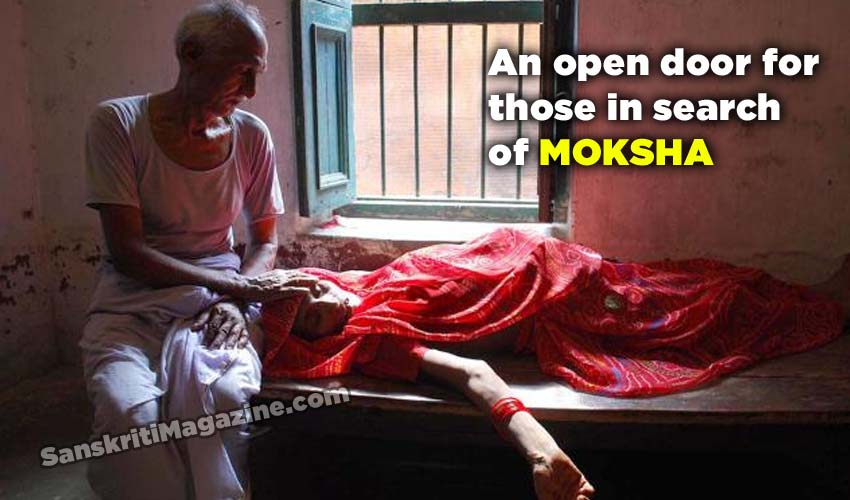
An open door for those in search of moksha

An open door for those in search of moksha

In one of the many narrow bylanes of the historic city of Varanasi is a special home where people come to die so that they can attain ‘moksha’ or salvation. “For over six decades now, thousands of people from across the country have come to this city of Lord Shiva where the entry of Yamraj or the God of death is not allowed … As per Hindu mythology, those who die here go to heaven. We at this ashram ensure that they die in peace,” says Mahant Bhairav Nath Shukla, priest and caretaker of ‘Moksha Sadan’.

Started by the industrialist Dalmia’s family in 1958 as a trust, ‘Moksha Sadan’ near the Goudoliya crossing in the heart of the city is now being run through a Delhi office, while Mahant Shukla takes care of the two-storey building comprising over a dozen rooms and also the needs of those who come to live here before leaving for their final journey.

Mostly it is the poor people of eastern Uttar Pradesh, Bihar, Jharkhand and West Bengal and even neighbouring Nepal who come here to spend last days of their lives. “People have come to know about this place through word-of-mouth publicity. They call us at 0542-2410984 to inform us before moving in,” Shukla adds.

On an average, the ashram records 10 deaths every month. “We have simple rules. We give people free space to live but they have to share electricity charges. A person should be above 60 years to live here and accompanied by his family members to take care of his/her daily chores. Generally we do not allow a person to stay after 15 days, but sometimes we have to make exemptions. We take care of all their needs, including medical care, if required. And after death, we also arrange for last rites, if so desired by the family of the deceased,” says Mahant Shukla, who has been serving at the ‘Moksha Sadan’ for almost 45 years now.

“Over the years I have seen many changes taking place in the ashram … Earlier, music cassettes used to play devotional songs, which were later replaced by CDs and now we have pen drives. But we still go to a dying person three times a day and sing bhajans in front of him/her, or read the Ramayana or other religious texts…We follow strict religious decorum at the place,” he adds.

All the Moksha Sadan’s activities are funded by a corpus set up by the Dalmia family.

~ Sandeep Joshi 

You may also like

Search the website

Like us on Facebook

Get daily updates via Email

Enter your email address:

Recent Posts

Jamai Shashthi 2026 — The Story of Maa Shashthi, the Cat, and the Wife Who Was Forgiven

Jamai Shashthi 2026 — The Story of Maa Shashthi, the Cat, and the Wife Who Was Forgiven

On Saturday, June 20, 2026, Bengali households across Bharata will welcome their married daughters and sons-in-law home for the legendary jamai-aador feast and perform the Shashthi Vrata. But behind the warmth lies a story most Bengalis know by heart and most non-Bengalis have never heard — the wife who stole the hilsa, blamed the cat, lost six sons to Maa Shashthi’s wrath, and was finally forgiven. The Vrat Katha, the vidhi, the mantras, and the deeper teaching.

Vat Purnima 2026 — The Wife Who Argued Yama Into Returning Her Husband’s Life

On Monday, June 29, 2026, women across Maharashtra, Gujarat, and southern Bharata will tie red thread around banyan trees and hear the story of Savitri — the wife who walked behind Yamaraja Himself when He came for her husband, and out-argued the Lord of Dharma into returning Satyavan’s life. The Mahabharata’s Pativrata Mahatmya Parva, the vrat vidhi, and why the banyan witnessed everything.

Purushottam Maas — The Month No Deity Would Claim, and the Lord Who Made It Supreme

Every month of the Hindu calendar has a lord — except the rare thirteenth, the Adhika Maas, born an orphan and shunned as the “impure month.” The Puranas tell how this rejected month went in grief to Bhagavan Vishnu, who claimed it, gave it His own name — Purushottam — and made it the most fruitful month of all. The origin story, the teaching, and what it means for Purushottam Maas 2026 (May 17 – June 14).

Padmini Ekadashi 2026 — The Ekadashi Even the Devas Descend to Keep

Padmini Ekadashi 2026 — The Ekadashi Even the Devas Descend to Keep

The rarest Ekadashi of the entire Hindu calendar is three days away. The Padma Purana preserves a conversation between Bhagavan Krishna and Yudhishthira about a single Ekadashi the great Rishis spend lifetimes waiting for — Padmini. The Vrat Katha of Queen Padmini of Mahishmati, the lotus teaching, and why May 27, 2026 is the morning Vaishnavas across Bharata are preparing for.

Varada Chaturthi 2026 — The Rare Ganesha Day of Purushottam Maas

Varada Chaturthi 2026 — The Rare Ganesha Day of Purushottam Maas

Once every 2.5–3 years — when the rare 13th month of Adhika Maas opens — a thirteenth Vinayaka Chaturthi appears. The Mudgala Purana calls it Varada Chaturthi, the “boon-giving” Chaturthi, and holds it as the most fruit-bearing Ganesha day of the entire calendar. Today, Wednesday May 20, 2026, is that day.

css.php