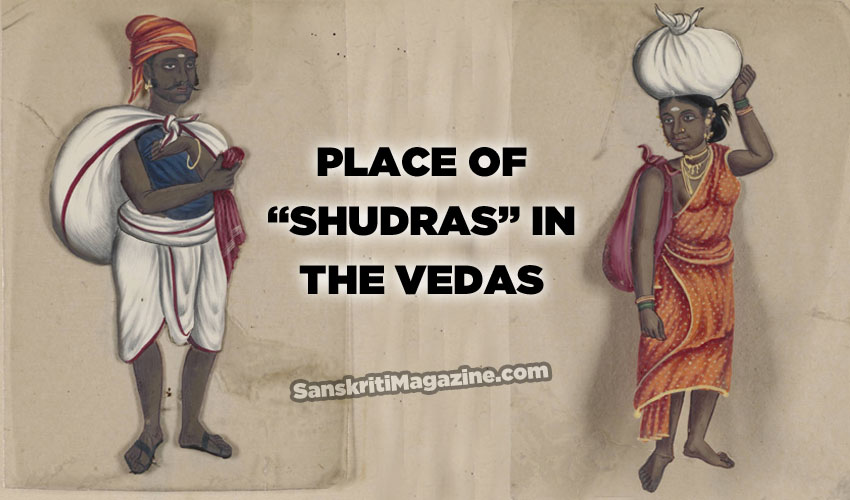
A commonly held perception regarding Vedas is their prejudice against Shudras. Vedas are accused of being Brahminical texts designed to subdue the Shudras. They are considered to be the source of caste-based discrimination that is touted as the primary characteristic of Hinduism/ Sanatan Dharma or Vedic Dharma. The entire pro-Dalit movement also has its foundation on this baseless notion.
Unfortunately, nothing could be far from truth and we will provide evidence from Vedas and related texts to establish the following:
a. The meaning of four Varnas and Shudra in particular is completely different from what the Macaulay inspired intellectuals would want us to believe.
b. There is absolutely no element of birth-based discrimination or denial of opportunity for any human being in Vedic way of life.
c. If there is one text that provides evidence of highest level of meritocracy and equal-opportunity, it is the Vedas. Even the most contemporary texts on human rights cannot come closer.
Before we begin our journey of solving the caste-puzzle through Vedas, let us start with certain worship mantras from Vedas that mention Shudras:
Yajurved 18.48:
O Lord! Provide enlightenment/ compassion to our Brahmins, Kshatriyas, Vaishyas and Shudras. Provide me also with the same enlightenment so that I can see the truth.
Yajurved 20.17:
Whatever crime we have committed against my village, forest or committee; whatever crime we have committed through our organs, whatever crime we have committed against Shudras and Vaishyas, whatever crime we have done in matters of Dharma, kindly forgive us relieve us from the tendency of the same.
Yajurved 26.2:
The way I gave this knowledge of Vedas for benefit of all humans, similarly you all also propagate the same for benefit of Brahmins, Kshatriyas, Shudras, Vaishyas, Women and even most downtrodden. The scholars and the wealthy people should ensure that they not deviate from this message of mine.
Atharvaved 19.32.8:
O Lord! May I be loved by everyone – Brahmin, Kshatriya, Shudra or Vaishya. May I be admired by everyone.
Atharvaved 19.62.1:
May all noble people admire me. May kings and Kshatriyas admire me. May all look at me with admiration. May the Shudras and Vaishyas admire me.
It is clear from these mantras that a Vedic person:
– seeks to be forgiven for crimes against all including Shudras
– seeks to propagate Vedas to all including Shudras
– considers all Varnas – Brahmin, Kshatriya, Vaishya and Shudra to be equal and respects them equally.
Thus it is clear that as per Vedas, Shudras deserve the same respect as other Varnas and as per Vedic prayer, Shudras are accorded great esteem.
It is also interesting that in all of these mantras, the word Shudra comes before Vaishya. So one cannot counter-argue that Shudras are given last mention or least preference.
These are sufficient evidence to conclude that Shudra, as per Vedas, imply something quite different from a caste or community that has to be discriminated against.
May the truth prevail!