[hr]
‘I, I am God’, ‘Yes, all is God,’ peals back Heaven’s deathless call.
~ Sri Aurobindo in Savitri (Book-6/Canto-2)
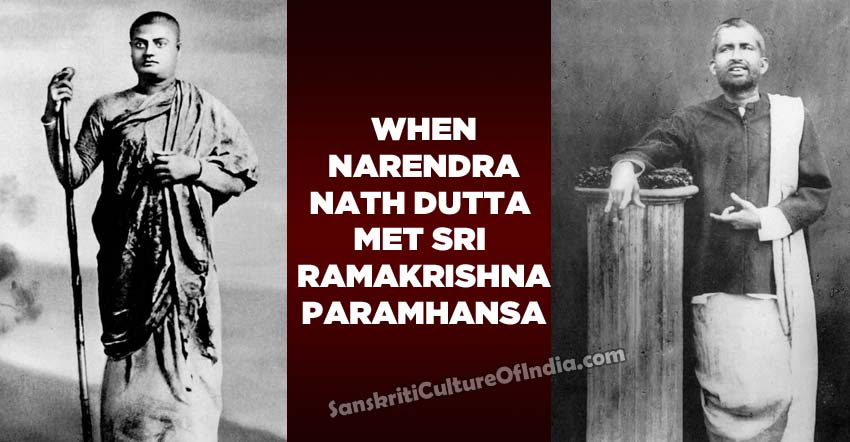
More than a century ago an adolescent boy of Calcutta, Narendra Nath Dutta was obsessed with the idea of seeing God. He was firmly grounded in the works of occidental philosophers, but none could fulfil his cherished aspiration. His search took him to the ghats of Ganges where atop an anchored barge sat the leader of Sadharan Brahmo Samaj, Maharshi Devendra Nath Tagore, a Guru in spiritual matters, father of the poet Tagore. But the ‘Great Seer’ was taken aback by Narendra’s question – ‘Sir, have you seen God?’ – and tried to assuage him by saying that his eyes resembled that of a yogi, and that he should spiritually prosper by meditation.
Disappointed and desperate the young man one day, along with his friends, went to meet Sri Ramakrishna Paramhansa, a somewhat eccentric priest of the Kali temple at Dakshineswar in Calcutta. At the first opportunity Narendra put him the same question – “Sir, have you seen God?” But this practically illiterate priest, unlike the erudite Maharshi, replied in rural dialect without mincing words – “Yes, I have seen God. I have seen Him more tangibly than I see you. I have talked with him more intimately than I am talking to you. But my child, who wants to see God! People shed jugs of tears for money, wife and children. But if they weep for God for only one day they would surely see Him.”
Narendra intuitively knew that here was a genuine man to whom God was a living reality and not at all a philosophical concept or an intellectual pastime. As we know it was under the ecclesiastical tutelage of Sri Ramakrishna (1836-86) that Narendra Nath Dutta graduated into a full-blossomed spiritual soul, later to be known as Swami Vivekananda(1863-1902).
According to Vivekananda, “My master was not learned but learning personified.” This inhibition of highest spiritual knowledge comes not from cramming spiritual texts but from attaining direct realisation of Divinity through various paths prescribed by the spiritual masters of yore. The boldness of ‘Sanatan Dharma’ we call Hinduism is that it emphasises nothing short of direct perception of Truth as the goal of human life.
The sage in Upanishad proclaims unequivocally “I know this great Person who is resplendent like the sun, and beyond darkness. By knowing him alone one can transcend death, there exists no other path (alternative)”. So it is by a first-hand perception of this effulgent truth – ‘Satchit Ananda’ (Existence-Consciousness-Delight) – whose amaranthine visage according to scriptures is covered with a lid of gold and one can cleave into the supreme secret of All-being which is also All-becoming. There lies the validity of religion in particular and life in general.
~ Soma Brahma