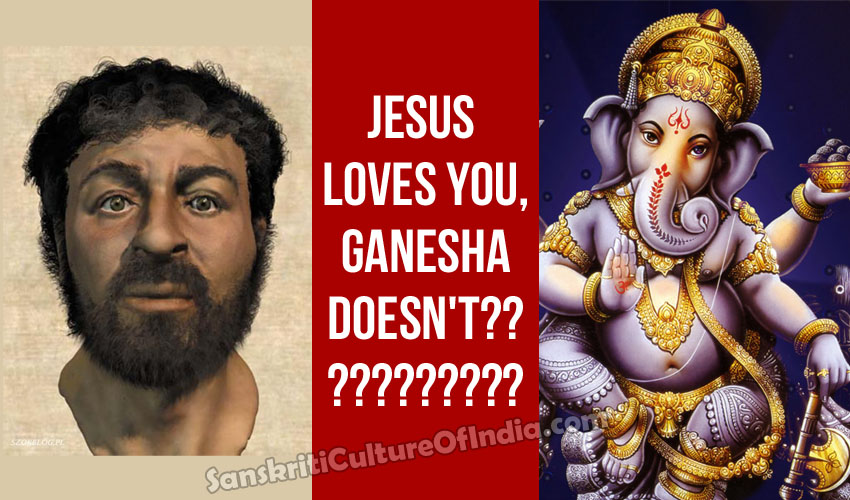
Picture on the left: **Using the latest forensic and historical discoveries and a computer, scientists have reconstructed the image of a first-century man who lived a life similar to and was around the age of Jesus. ~ Discovery channel**
Hinduism is generally associated with a multiplicity of Gods, and it does not advocate the worship of one particular deity. The Gods and Goddesses of Hinduism amount to thousands, all representing the many aspects of only one supreme Absolute called “Brahman”. However, people who don’t know this, misinterprets the fact that Hinduism has a multitude of Gods! What one should understand is that although there are many manifestations of Brahman in the forms of deities each deity is really an aspect of the Brahman or, ultimately Brahman itself.
Ignorance Is Bliss!
The other day, I received an email with the shocking subject – “Attack on Hinduism” – from one of our users Jim Wilson, who was appalled by what the children’s section of an “Objective” Christian site that his daughter was viewing, had to say. Jim forwarded me the link to the web page with a line saying that this was a blatant attempt to pass on personal bias and prejudicial attitude to younger generations.
Jesus Loves You, Ganesha Doesn’t!
You’ll be shocked at what this fundamentalist Christian site tells its kid users. About halfway down the page a box item entitled “Habu’s Corner” depicts a Ganesha-like figure answering the question: “How many gods do you have?”
Habu’s reply: “I don’t know… I have lost count!”
This is followed by the comment: “Wouldn’t you rather have just one God who loves you a bunch than a bunch of gods that don’t love you at all?” …then comes the more explicit advisory: “Jesus loves everybody, even the unsaved like Habu! Remember to pray for Habu and others like him that they may find Jesus and accept Him into their hearts!
What do you have to say of such acts by Christian fundamentalist propagandists? Catch them young…!
Here’re Jim’s comments: “I respect their right to believe whatever they wish to believe, but I am opposed to the aggressive manner in which they attempt to indoctrinate others and the manner in which they attempt to control the thinking of their children.”
Back to basic… let’s delve deeper into the issue of multiplicity of Gods in Hinduism.
What is Brahman?
In Hinduism, the impersonal Absolute is called “Brahman”. According to this pantheistic belief, everything in existence, living or non-living comes from it. Therefore, Hindus regard all things as sacred. We cannot equate Brahman with God, because God is male and is describable, and this takes away from the concept of the Absolute. Brahman is formless or “nirakara”, and beyond anything that we can conceive of. However, it can manifest itself in myriad forms, including Gods and Goddesses, the “sakara” form of the Brahman.
According to Prof. Jeaneane Fowler of the University of Wales College, Newport: “The relationship between the many manifest deities and the unmanifest Brahman is rather like that between the sun and its rays. We cannot experience the sun itself but we can experience its rays and the qualities, which those rays have. And, although the sun’s rays are many, ultimately, there is only one source, one sun. So the Gods and Goddesses of Hinduism amount to thousands, all representing the many aspects of Brahman”.
~ Subhamoy Das