IndianSanskriti

🌸 Chaitra Navratri Day 1: Worship of Maa Shailaputri – The Embodiment of Strength & New Beginnings

🕉️ Who is Maa Shailaputri?

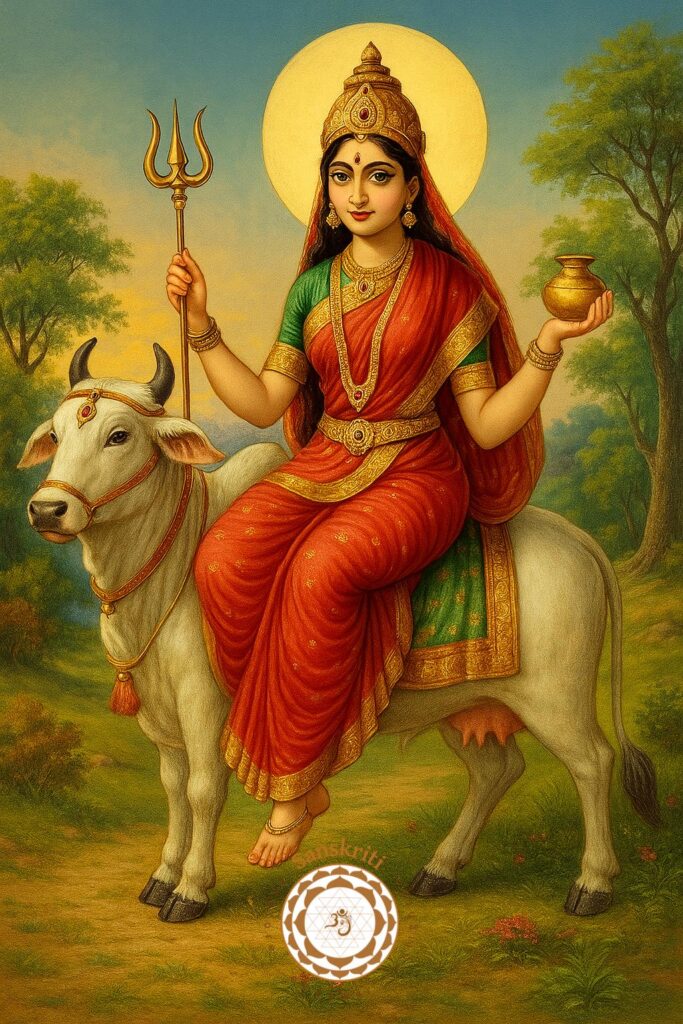
Maa Shailaputri, meaning “Daughter of the Mountain,” is the first manifestation of Goddess Durga and is believed to be a reincarnation of Sati, the first wife of Lord Shiva.


📜 The Story of Maa Shailaputri:

In her earlier birth as Sati, she was the daughter of King Daksha. Deeply devoted to Lord Shiva, Sati married him against her father’s wishes. When King Daksha organized a grand yagna (sacrifice), he intentionally did not invite Shiva. Sati, hurt by this insult, attended the yagna but was further humiliated. In her anguish, she immolated herself in the sacrificial fire.

Shiva, devastated and enraged, withdrew from the world in grief. Later, Sati was reborn as Shailaputri, the daughter of Himalaya, the king of the mountains. In this form, she performed intense penance and eventually reunited with Lord Shiva.

Thus, she symbolizes resilience, devotion, and fresh beginnings, and is worshipped on the first day of Navratri to ground the soul and prepare it for spiritual ascension.


🔮 Symbolism:

  • Bull (Nandi): Dharma and devotion
  • Trident (Trishul): Mastery of body, mind, and spirit
  • Lotus: Growth amid worldly challenges
  • Yellow attire: Light, clarity, and vibrance

🟡 Color of the Day: Yellow

Wearing yellow invites divine energy and spiritual clarity. It’s also associated with happiness, intelligence, and healing.


🕯️ Puja Ritual for the Day:

  1. Place a picture or idol of Maa Shailaputri on a clean altar.
  2. Offer yellow marigolds, a diya of ghee, and some fresh fruits.
  3. Chant:

“ॐ देवी शैलपुत्र्यै नमः॥
*Om Devi Shailaputryai Namah”

  1. Close your eyes and visualize her serene form riding the bull, calming and strengthening your spirit.

🧒 Family/Kid-Friendly Activity:

Mountain of Strength Craft – Invite children to draw or craft a mountain using paper, clay, or even play dough. On top, place a tiny figure representing the goddess. Share the story of Sati and how her devotion transformed into divine strength.


💬 Message to Share:

May the strength of Maa Shailaputri help you rise above challenges and begin this Navratri with grounded positivity.
Share this blessing with your family and friends.
#MaaShailaputri #ChaitraNavratri2025 #NavratriVibes #SanskritiCulture
You may also like

Search the website

Like us on Facebook

Get daily updates via Email

Enter your email address:

Recent Posts

Jamai Shashthi 2026 — The Story of Maa Shashthi, the Cat, and the Wife Who Was Forgiven

Jamai Shashthi 2026 — The Story of Maa Shashthi, the Cat, and the Wife Who Was Forgiven

On Saturday, June 20, 2026, Bengali households across Bharata will welcome their married daughters and sons-in-law home for the legendary jamai-aador feast and perform the Shashthi Vrata. But behind the warmth lies a story most Bengalis know by heart and most non-Bengalis have never heard — the wife who stole the hilsa, blamed the cat, lost six sons to Maa Shashthi’s wrath, and was finally forgiven. The Vrat Katha, the vidhi, the mantras, and the deeper teaching.

Vat Purnima 2026 — The Wife Who Argued Yama Into Returning Her Husband’s Life

On Monday, June 29, 2026, women across Maharashtra, Gujarat, and southern Bharata will tie red thread around banyan trees and hear the story of Savitri — the wife who walked behind Yamaraja Himself when He came for her husband, and out-argued the Lord of Dharma into returning Satyavan’s life. The Mahabharata’s Pativrata Mahatmya Parva, the vrat vidhi, and why the banyan witnessed everything.

Nija Jyeshtha 2026 — The Real Jyeshtha Begins, and the Calendar Resumes

Nija Jyeshtha 2026 — The Real Jyeshtha Begins, and the Calendar Resumes

With Adhik Maas now closed on the Somvati Amavasya of June 15, the long-postponed festivals of Jyeshtha return — Vat Purnima (June 29, the Savitri-Yamaraja katha), Jamai Shashthi (June 20, the Bengali festival of Maa Shashthi), Sankashti Chaturthi (June 28), Yogini Ekadashi (July 10), and Devshayani Ekadashi (July 16, opening the four-month Chaturmas of Bhagavan Vishnu’s yoga-nidra). A guide to what the next four weeks hold and what the household that kept Purushottam Maas now carries forward.

The Closing of Purushottam Maas 2026 — Adhik Amavasya and the Sealing of the Month-Long Vrat

On Monday, June 15, 2026 — a rare Somvati Amavasya — the intercalary month that bears Bhagavan Vishnu’s own name comes to its close. The Acharyas teach that a vrat is not measured by its duration but by its closing. Here are the Padma Purana’s instructions for sealing the month-long Purushottam Maas vrat: the morning snan, the closing puja with the Vishnu Sahasranama, the day of dana, the Somvati Amavasya gift, and the final sarva-arpana — the offering of all merit at the feet of the Lord.

Parama Ekadashi 2026 — The Other Rare Ekadashi of Purushottam Maas, and the Poor Brahmin Who Kept It

Two weeks ago, Vaishnavas across Bharata kept Padmini Ekadashi — the rare Shukla Paksha Ekadashi of Adhik Maas. Padmini has a twin. On Thursday, June 11, 2026, the Krishna Paksha Ekadashi of the same intercalary month appears: Parama — the Supreme Ekadashi. The Padma Purana names it the rarer and more secret of the two, and reserves it for those whose poverty or sorrow has refused to lift in spite of every other vrat already kept. The story of Sumedha and Pavitra of Kampilya, the rishi Kaundinya, the prince sent by Bhagavan Brahma — and the vidhi for the day.

css.php