IndianSanskriti

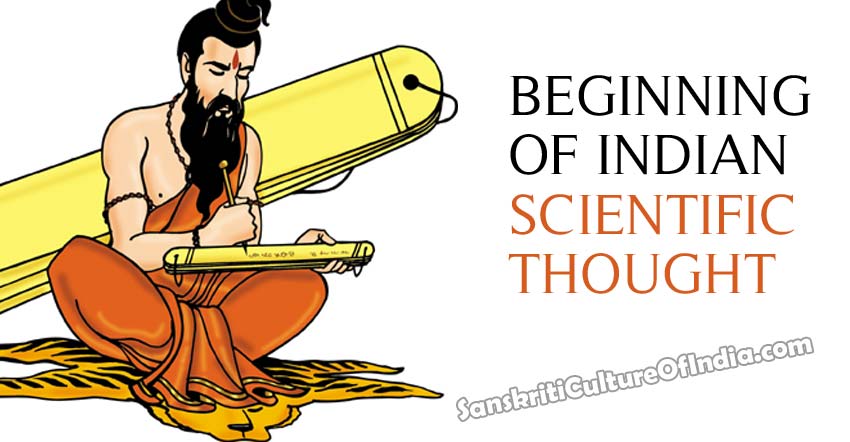
The birth of Indian Scientific Thought!

The beginning of Indian scientific thought are traced to the same source as those of Indian metaphysics and religion, the Rig Veda. The Vedas, being essentially works of poetic imagination, cannot be expected to contain much spirit of scientific inquiry, yet there are remarkable flashes of intuitive conjecture and reason.

They explain the nature of the universe, of life, while admitting that Creation itself is the one unknowable mystery.

To the Vedic sages, creation indicated that point before which there was no Creator, the line between indefinable nothingness and something delineated by attributes and function, at least. Like the moment before the Big Bang Theory. These concepts preoccupy high wisdom, the Truth far removed from mere religion.

Indeed, in one of the most remarkable of the Vedic hymns – In the Hymn of Creation (Rig Veda 10.129.3) a searching inquiry as to the origin of the world is made; it is certainly the earliest known record of philosophic doubt.

There was not non-existent nor existent;
There was no realm of air, no sky beyond it.
What covered it, and where? and what gave shelter?
Was water there, unfathomed depth of water?

Yet the Vedas go further, being philosophy, or really spiritual sciences, rather than myth. The hymn goes to say that in the beginning there was neither death nor immortality, nor day nor night. All that existed was void and formless. Then arose, desire, the primal seed and germ of spirit. But,

Who verily knows and who can declare it,
Whence it was born and whence comes this creation?

The gods are later than this world’s production
Who knows, then, whence it first came into being?

Vedas are the most sophisticated, most profoundly beautiful, and most complete presentations of what Aldous Huxley termed the “perennial philosophy” that is at the core of all religions. In modern academia, of course, there is not supposed to be any “ancient wisdom”. In this hymn, which contains the essence of monism, can be seen a representation of the most advanced theory of creation. The germ of free speculation and skepticism were already present in the Rig Veda.

(source: The Empire of the Soul: Some Journeys into India – By Paul William Roberts published by Riverhead Books).

The statue of Nataraja (dance pose of Lord Shiva) is a well known example for the artistic, scientific and philosophical significance of Hinduism.

Freedom was born in India. Doubt, the mother of freedom, was born with the Rig Veda, the most sacred scripture of the Hindus which has the following:

What are words, and what are mortal thoughts!
Who is there who truly knows and who can say,
Whence this unfathomed world, and from what cause!

Freedom of the mind created the wondrous world of the intellect — the world of Hindu rishis, philosophers, poets and dramatists. It was the freedom of the mind and freedom of the senses which led to India’s diversity and contributed to the richness of its civilization. No other civilization, not even that of the Greeks, could have enjoyed the freedom that we had. We have to remember, Socrates was forced to drink hemlock! The Inquisition burnt the Christian apostates at the stake and Islam beheaded dissenters.
Carl Sagan on Hindu Cosmology:

You may also like

Search the website

Like us on Facebook

Get daily updates via Email

Enter your email address:

Recent Posts

Jamai Shashthi 2026 — The Story of Maa Shashthi, the Cat, and the Wife Who Was Forgiven

Jamai Shashthi 2026 — The Story of Maa Shashthi, the Cat, and the Wife Who Was Forgiven

On Saturday, June 20, 2026, Bengali households across Bharata will welcome their married daughters and sons-in-law home for the legendary jamai-aador feast and perform the Shashthi Vrata. But behind the warmth lies a story most Bengalis know by heart and most non-Bengalis have never heard — the wife who stole the hilsa, blamed the cat, lost six sons to Maa Shashthi’s wrath, and was finally forgiven. The Vrat Katha, the vidhi, the mantras, and the deeper teaching.

Vat Purnima 2026 — The Wife Who Argued Yama Into Returning Her Husband’s Life

On Monday, June 29, 2026, women across Maharashtra, Gujarat, and southern Bharata will tie red thread around banyan trees and hear the story of Savitri — the wife who walked behind Yamaraja Himself when He came for her husband, and out-argued the Lord of Dharma into returning Satyavan’s life. The Mahabharata’s Pativrata Mahatmya Parva, the vrat vidhi, and why the banyan witnessed everything.

Nija Jyeshtha 2026 — The Real Jyeshtha Begins, and the Calendar Resumes

Nija Jyeshtha 2026 — The Real Jyeshtha Begins, and the Calendar Resumes

With Adhik Maas now closed on the Somvati Amavasya of June 15, the long-postponed festivals of Jyeshtha return — Vat Purnima (June 29, the Savitri-Yamaraja katha), Jamai Shashthi (June 20, the Bengali festival of Maa Shashthi), Sankashti Chaturthi (June 28), Yogini Ekadashi (July 10), and Devshayani Ekadashi (July 16, opening the four-month Chaturmas of Bhagavan Vishnu’s yoga-nidra). A guide to what the next four weeks hold and what the household that kept Purushottam Maas now carries forward.

The Closing of Purushottam Maas 2026 — Adhik Amavasya and the Sealing of the Month-Long Vrat

On Monday, June 15, 2026 — a rare Somvati Amavasya — the intercalary month that bears Bhagavan Vishnu’s own name comes to its close. The Acharyas teach that a vrat is not measured by its duration but by its closing. Here are the Padma Purana’s instructions for sealing the month-long Purushottam Maas vrat: the morning snan, the closing puja with the Vishnu Sahasranama, the day of dana, the Somvati Amavasya gift, and the final sarva-arpana — the offering of all merit at the feet of the Lord.

Parama Ekadashi 2026 — The Other Rare Ekadashi of Purushottam Maas, and the Poor Brahmin Who Kept It

Two weeks ago, Vaishnavas across Bharata kept Padmini Ekadashi — the rare Shukla Paksha Ekadashi of Adhik Maas. Padmini has a twin. On Thursday, June 11, 2026, the Krishna Paksha Ekadashi of the same intercalary month appears: Parama — the Supreme Ekadashi. The Padma Purana names it the rarer and more secret of the two, and reserves it for those whose poverty or sorrow has refused to lift in spite of every other vrat already kept. The story of Sumedha and Pavitra of Kampilya, the rishi Kaundinya, the prince sent by Bhagavan Brahma — and the vidhi for the day.

css.php