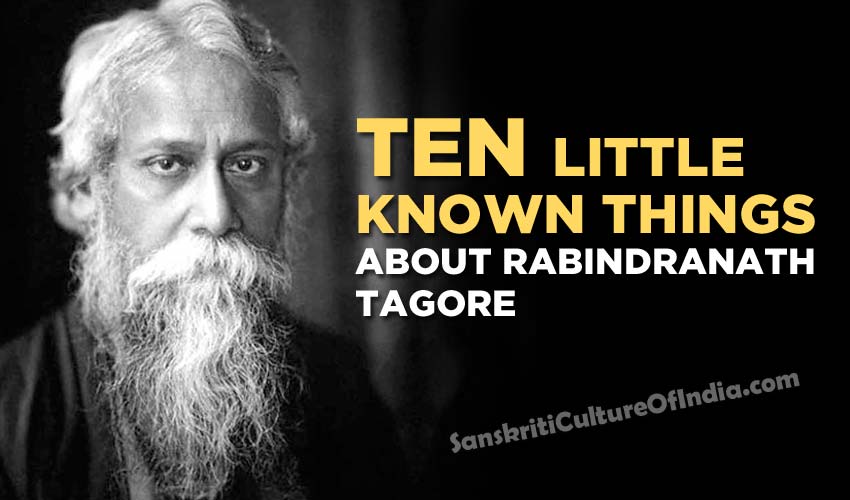
Rabindranath Tagore, or Gurudev as he was popularly known, was born in Calcutta on May 7, 1861. A renowned polymath, Tagore singlehandedly reshaped the region’s literature and music. In 1913, he became the first Indian to win the Nobel Prize in Literature. As part of his works, Tagore introduced new prose and verse forms into Bengali literature and freed from the traditional models that were based on classical Sanskrit.
[hr]
Here are 10 things you should know about the man who gave India its national anthem:
Rabindranath Tagore is the only known person to have written the national anthems for two different countries. He wrote Jana Gana Mana, the national anthem for India, and Amar Sonar Bangla, the national anthem for Bangladesh.
[hr]
In March 2004, the Nobel medal that had been awarded to Rabindranath Tagore, along with other valuables and citations, were stolen from a museum in the Uttarayan complex in Santiniketan. On Tagore’s 100th birth anniversary, the Nobel Foundation issued a new Nobel medal to Tagore.
[hr]
Rabindranath Tagore loved going on holidays in the Himalayas. On one of his trips to Ramgarh in 1903, after the doctors prescribed clean fresh air for his daughter Renuka who was suffering from tuberculosis, Tagore wrote poems for his collection Shishu, here. Though Tagore was moved by the beauty of the mountains, his daughter’s condition deteriorated forcing him to take her back to Bengal. She died in September the same year. In 1914, Tagore returned to Ramgarh. Atop what is today known as the Tagore Top in Ramgarh, he wrote parts of his famous Gitanjali, for which he won the Nobel Prize.
[hr]
Tagore began writing poetry when he was all of eight years old. He was 16-years-old when he released his first collection of poems under the name Bhanusimha, or Sun Lion. By 1877, he was writing short stories and dramas under his own name at the age of 16.
[hr]
The youngest of 13 siblings, Tagore resented and avoided classroom schooling. His elder brother Hemendranath tutored and physically conditioned him through various sporting activities such as gymnastics, judo and wrestling apart from trekking. “Rabi” loathed formal education so much that he went to college, the local Presidency College, only for a single day.
[hr]
Tagore began as a poet who blended spiritual and romantic notions in his quest to understand the human soul and the divine, he soon moved on to give voice to the minds of the colonised and oppressed people. This transformation is even reflected in his later works, so much so that WB Yeats who had propagated his works as that of a mystic poet in the West found it difficult to relate to them.
[hr]
Tagore’s aversion to the concept of a nation and nationalism is historic. According to Tagore, National is not “a spontaneous self-expression of man as social being,” but a great menace which is “supremely dangerous to humanity”. During a lecture on Nationalism in the West that he delivered in America during 1916-17, Tagore openly denounced the “fierce self-idolatry of nation worship”. He slammed the West for keeping their “neatly compressed bales of humanity. . . bound in iron hoops, labeled and separated off with scientific care and precision,” and argued that the Nation with his “magnificent power and surprising appetite” is nothing but an “organization of politics and commerce” which is “incessantly growing into vast stature, out of proportion to all our needs of society – and the full reality of man is more and more crushed under its weight.”
[hr]
Tagore loved travelling and as a widely travelled man, he was a curious and keen observer of socio-political life in the countries he visited from 1916 onwards. In his book The Discovery of India, Jawaharlal Nehru wrote, “He (Tagore) has been India’s internationalist par excellence, believing and working for international co-operation, taking India’s message to other countries and bringing their message to his own people.”
[hr]
Rabindranath Tagore took up drawing and painting at the age of 60 and held many successful exhibitions of his works. His works – mostly inspired by the works of scrimshaw from northern New Ireland, Haida carvings from British Columbia and Max Pechstein’s woodcuts – usually had strange colour schemes and off-beat aesthetics that led to the belief that he was probably red-green colour blind.
[hr]
On the occasion of Tagore’s 154th birth anniversary, Slovenia, a country of just two million people in Central Europe, has planned multifarious ceremonies in honour of Tagore from May 7-12.
[hr]