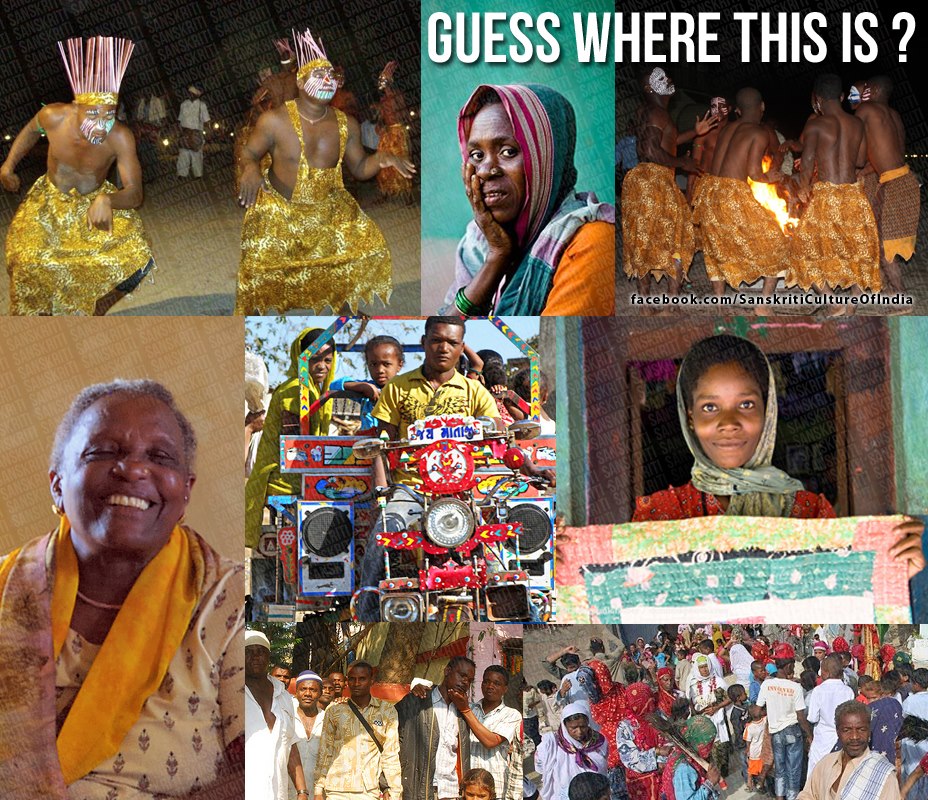
Their faces are painted in shades of red, blue and green with designs symbolising traditional African body art, they wear bright orange tiger print skirts, straw caps and breathe fire. We are not talking about a circus troop, but of the Siddi tribe who don different avatars at different times of the day.African by origin, Indian by nationality with Gujarati as their lingua franca – the Siddi tribe lives in a village called Jambur in the heart of Gujarat. Just like any other village, Jambur has red mud by lanes, houses with thatched rooftops and a few small local shops. Located approximately hundred kilometres from Junagadh, the village is surrounded by the forest of Gir, which is home to the last of the remaining Asiatic lions. “We have completed 300 years in Gujarat and this is our fourth generation in Jambur,” said 60- year-old Siddique, speaking in heavily accented Afro-English.
BROUGHT BY NAWAB’S WIFE
This settlement did not happen out of choice but by force. According to the tribals, there is a long history to their presence in India. “The Nawab of Junagadh had once visited Africa where he fell in love with an African woman. They got married and she moved to India with him,” said Siddique. “She came to India with a hundred slaves and since then we have been based in Gujarat only,” he added. Their claim to fame is their origin and they cash-in very well on this. They have a dual profession – although they do small time jobs in the day, they dance to the African beats at night. “There are many tourists visiting Gir and we entertain them with our performance. This helps us make some extra money,” said a member from the tribe in fluent Gujarati. The Siddi tribe has seen much stardom. They have been a part of the Gujarat tourism video called “Khushboo Gujarat Ki.” “The peak tourist season is from October 16 to June 15. We get several invitations from resorts and hotels in this region to come and perform the African dance.
We had been invited to Iraq to perform but the event got cancelled,” said Siddique. On a daily basis, the tribals are engaged in various occupations. They work on the fields, in the forest department, and some as tourist guides and truck drivers. “With the meagre salary it is very difficult to manage. This extra money helps us tremendously,” said Rasheed who is a truck driver. While many members of the tribe work in the forest, there are some who are in government jobs, earning up to Rs 5,000 a month. And as the night sets in, the Siddis once again dress up in their tiger prints and set out to perform another spectacular tribal tradition.
Language of Siddi Tribe
The language of the Siddi tribe is actually a blend of both Siddi Konkani, and Siddi Marathi languages. Quite a few are there who also talk in the Gujarati language and Kannada language.
Culture of Siddi Tribe Although Siddi tribes have adopted the native customs of the region, some African traditions and practices have also been preserved. The tribal community of Siddi is one of the primitive tribes, with almost three hundred years old heritage. However, with the passage of time their ancient tradition and culture have also got a modernised shade. Various cultural forms, namely dance, music, folklores, etc are quite exquisite. Dhamal dance is one such dance form. However, today under the influence of the modern day trend and customs, maximum of these Siddi tribes have forgotten their original customs, thus nicely imbibing new things and beliefs. Apart from working as labourers many of these Siddi tribes have taken up the occupation of farming and lead a more settled life. With all the restrictions and prohibitions, the Siddi tribes maintain a uniqueness that is apparent and that distinguish them separately from the other tribal groups.
Religion of Siddi Tribe
The Siddi tribes are inclined towards religion and spiritualism. Today, these Siddi tribes have adapted to several religions like Hinduism, Christianity and also Islam. Apart from these religions, this Siddi tribal community follows the age old practice of worshipping their ancestors. In case of marriages, these Siddi tribes have got some reservations. Intermarriages are strictly prohibited among the Siddis. Apart from working as labourers many of these Siddi tribes have taken up the occupation of farming and lead a more settled life. With all the restrictions and prohibitions, the Siddi tribes maintain a uniqueness that is apparent and that distinguish them separately from the other tribal groups.