The Vedas are the core scriptures of Hinduism and the Upanishads are texts which form the philosophical essence of the Vedas. The Upanishads are collectively called the Vedanta. The Vedantic world-view permeates all aspects of Indian culture and way of thinking.
Literally, Vedanta means ‘end of the Vedas’ and indeed, many of these texts are found at the end of each of the four Vedas. The Upanishads are also the end or culmination of the Vedas in the sense that they embody the highest philosophical knowledge of the Vedas. ‘The essence of the knowledge of the Vedas was called by the name of Vedanta, which comprises the Upanishads.’
We hear of 108 Upanishads, ten of which are especially important because they were selected for commentary by Adi Shankaracharya. There is a traditional shloka which lists these major Upanishads:
‘Isha-Kena-Katha-Prashna Munda-Mandukya Tittirih
Aitereyam cha Chhandogyam Brhadaryankam tatha’
Often these Upanishads are in the form of dialogues between sages and truth-seekers. For example in the Mundaka Upanishad, the enquirer, Shaunaka asks the sage Angiras, ‘Sir, what is that, which becoming known, everything here becomes known?’ In the Katha Upanishad, a little boy, Nachiketa asks about what, if anything, survives death—and he asks this to none other than Yama, Lord of Death!
Let us go straight into the heart of the Upanishads. What is their central message to us?
You Are Pure Existence
In the sixth chapter of the Chhandogya Upanishad, we find a dialogue between a sage and his son, Shvetaketu. The enquiry here is, ‘What is that knowledge by which everything becomes known?’ And to grasp the answer to this bold question, we must appreciate the concept that by knowing the cause one can know the effects. Thus if you know clay, you know all pots made of clay (you know that all such pots are nothing but clay), by knowing iron one understands all implements made of iron, by knowing gold, all gold ornaments are understood as nothing but gold and so on.
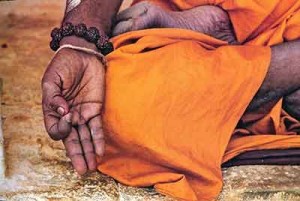 In the same way, if we enquire deeply enough, the Upanishad claims, we shall see that all existent things are nothing but existence itself or pure existence. Sat is the term used for pure existence.
To explain further, take the traditional example of a pot—the pot is nothing but its cause, clay; clay is nothing but its cause prithvi or the earth element, prithvi is nothing but its cause ap or the water element, and in this way we trace everything back to the primeval cause, pure existence or Sat. It is Sat appearing as this world through the mysterious agency of maya.
And ‘Thou, O Shvetaketu,’ says the sage, ‘art That!’
By ‘That’ of course, he means, Sat, pure existence. You, your mind and body, and indeed, everything you see around you, are essentially nothing but pure existence, appearing in multifarious forms, courtesy of maya. Ignorance means being unaware of your Sat nature, and consequently being identified with the body-mind complex with all its attendant problems and sufferings. Enlightenment is just the reverse— being aware of yourself as Sat and being free of the body, mind and all samsara. You are the immortal, unchanging Sat and the world is a mere shadow, the projection of maya, passing over you. This does not actually destroy the body or the world—rather you begin to see things as they really are.
Your true Self, Sat, is not a thing, an object, among other objects of the universe. Rather It is the very existence of all things and they are not apart from It. To a jnani, each object reveals Sat.
You are Pure Consciousness
In the Kena Upanishad, we find a very interesting question. We see, hear, speak and think—but what power impels our mind to think, our tongue to speak, our eyes to see and ears to hear? In other words, what are we in the deepest, most profound depths of our being? Like most deep questions, it appears deceptively simple.
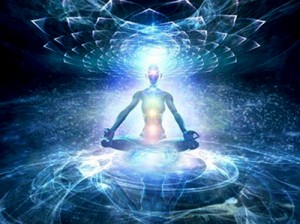 Consider our bodies. They are made of matter. Yet, we have a first-person experience in our bodies. There is something like experiencing the redness of a rose or ‘being myself’. In modern philosophy, these are called qualia. Modern neuroscience is unable to account for the vivid living conscious experiences which we have all the time. This vivid first person experience cannot be captured by a materialistic account like the firing of neurons. This is the so-called ‘hard problem’ of modern consciousness studies.
The Kena Upanishad begins with this question about consciousness—the inner experience of thinking, hearing, seeing, speaking. What is that shining within us which enables all these conscious experiences and functions? Who is that Being or what is that mechanism which makes these possible?
The Guru’s answer is extraordinary and profound (and, at first, rather enigmatic). ‘It is the Ear of the ear, Mind of the mind, Eye of the eye …’! Let us try to understand this. The answer, simply put, is pure consciousness—Chit. The moment we use a term like consciousness, we have to be very careful because the immediate temptation is to understand it in the sense of thoughts and feelings. This is how consciousness is usually understood by modern psychology. But when the Upanishads speak of pure consciousness we must carefully distinguish it from the ordinary understanding of consciousness.
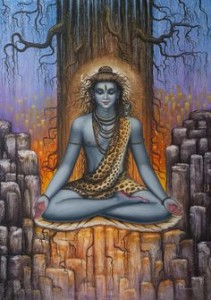 Science says consciousness is a product of the body (the brain to be specific). But the Upanishads hold that Chit or consciousness is not a product of the body or even the mind. Our bodies are made of matter and our minds too are made of matter, albeit of a subtle kind, while Chit is radically different from matter. Chit pervades and illumines the mind and body enabling all functions—thinking, seeing, hearing, feeling, speaking and so on. Chit is ‘known’ only through its manifestations in the various functions of the mind, organs and body. Without the body and mind, as in deep sleep, Chit cannot be known or experienced— yet, It continues to exist.
Now we are in a position to understand the Guru’s enigmatic reply: ‘Since It is the Ear of the ear, the Mind of the mind, the Speech of speech, the Life of life, and the Eye of eye, therefore (realizing It) the jnanis transcend the world and become immortal.’
Since Chit enables each organ to perform its specific function, it is appropriate to call It the essence of all organs—Ear of the ear, Mind of the mind, etc.
Chit is what you really are—pure consciousness. It is unchanging and undying and if you realize yourself as Chit, you become immortal (rather, you realize that you are immortal and always were). Chit identified with body and mind appears to be mortal. Note that the bodies are mortal—equally for the jnani and ajnani. Ramakrishna, Christ and Buddha—all had physical bodies and those bodies are gone, just as our bodies will perish one day. But as Chit we are immortal. This is to be realized and this is the Upanishadic ideal of moksha or freedom.
Our true Self, Chit, is not an experience, yet all experiences shine in Chit. Chit is the consciousness illumining every thought, every experience. To the jnani, Chit is experienced in each experience.
We Are Pure Bliss
In the final analysis, what we all want is happiness. What is happiness? And more importantly, how can we be truly happy? The search after happiness forms the field of enquiry in a remarkable section of the Taittiriya Upanishad. What exactly is studied about happiness? The answer is: whether happiness is born of sense contacts between subject and object (as is usually understood) or whether happiness is the very nature of the Self. The Upanishad starts by looking at sense enjoyments as the source of happiness.
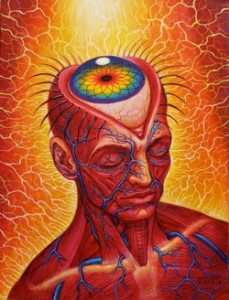 If we want to study happiness scientifically, it would be helpful to actually measure happiness and for this we need a unit of happiness. The Upanishad proceeds to construct a model of maximum human happiness. Imagine a young man, physically strong, bursting with vitality and energy. He is highly educated and morally upright. Old age, physical weakness, ignorance and moral corruption—all causes of misery—are ruled out. Poverty, of course, is one of the greatest barriers to the fulfillment of desires and so the Upanishad endows this fortunate young man with plenty of cash—all the wealth of the world, in fact. Now imagine the happiness of this person—young, vital, energetic, noble, very highly educated and extremely wealthy. This is the unit of human happiness: ‘ekah manusha ananda’.
Is it possible to get even greater happiness? Yes, but not in this human existence. For this earthly existence, these material objects of enjoyment and the very human frame itself, all have their limitations. Beyond this familiar plane of existence there are superior worlds, finer objects of enjoyment and powerful bodies designed for greater enjoyment. Such is the manushya-gandharva-loka where happiness is one hundred times the maximum happiness possible in a human body! Even this is by no means the end. The Upanishad speaks of an ascending ladder of lokas, or worlds, of truly cosmic proportions. As one ascends to these higher heavens, happiness is multiplied by a hundred times at each level. In the highest heavens, happiness is millions and billions of times greater than the maximum of human happiness!
How does one reach these lokas? By the merit earned through the religious rituals prescribed in the Vedas. Of course, one has to wait till death to travel to these higher lokas.
Then comes the real point of this analysis. The Upanishad says that all happiness is only a reflection of the happiness of the Self, atmananda. The bliss of the Self is reflected in the serene mind and experienced as happiness. Man, in his ignorance, feels that happiness is due to the enjoyment of a variety of sense objects and spends all his life trying to get happiness out of sense enjoyment. If one can actually make the mind calm enough, it will be filled with happiness—without need of external objects. What a great discovery— finding the joy within!
How can we make the mind calm? By renunciation of desire, says the Upanishad. One who has the deepest conviction of the Vedantic truth—that one’s own Self is of the very nature of bliss—and does not hanker after sense pleasures, will get a hundred times the maximum human happiness in this very life, right now! He doesn’t have to earn merit and wait for death to go to the higher heavens. Whatever happiness the worldly man gets out of sense enjoyments here and hereafter, the all renouncing sage of the Upanishad gets here and now, by the very virtue of his renunciation.
 Finally the Upanishad makes a startling statement. The very pinnacle of happiness, billions of times greater than the unit human happiness, available in the highest heaven to the man of extraordinary merit, or here and now to the all-renouncing sage—that ultimate happiness of Brahmaloka, the ‘world’ of Highest Brahman, and the unit happiness in man of manushyaloka, are virtually one and the same! It is the Self, which is reflected as varying degrees of happiness in man and in the highest deva. The difference is in the reflecting medium, not in the Self.
Just as you can see the reflection of your face in different mirrors and the quality of the mirrors determines the quality of the reflection. Yet in all mirrors, fine or poor, it is the very same face being reflected. Just as these varied reflections do not affect your face, the Self is not affected by the variations in happiness in all these mediums, human and celestial. Indeed, just as you would not be particularly interested in seeing your reflection in a mirror all the time, an enlightened soul wouldn’t care to experience various degrees of happiness in various bodies. Upon realization, the difference of subject and object disappears and all is known to be Bliss Itself—ananda swarupa, the quintessence of bliss. This is the Ananda Mimamsa—an enquiry into bliss, described in the Taittiriya Upanishad.
In fact, all worldly happiness is a particle of the ocean of your own ananda swarupa, your true Self. To the jnani, all experiences, apparently pleasant or unpleasant, reflect Bliss.
You are Sat Chit Ananda
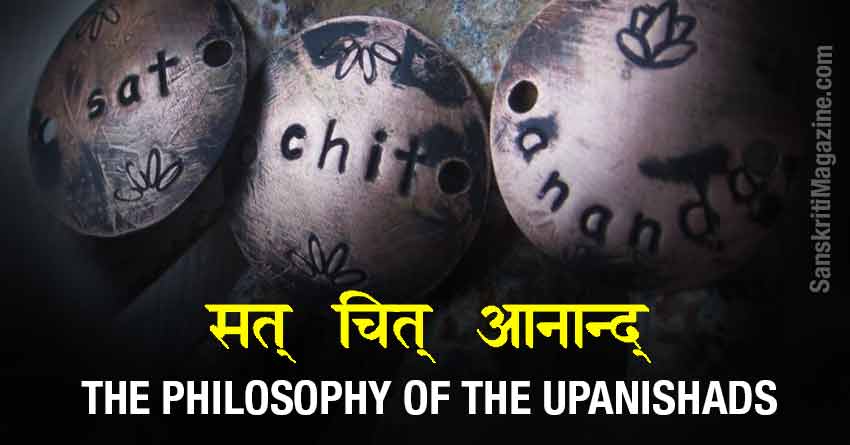
 So we see how the ultimate reality expounded in the Upanishads, Brahman, is Pure Existence–Consciousness–Bliss, Sat Chit Ananda. Existence, consciousness, and bliss are not qualities or properties of Brahman. It is not that Brahman exists, but that It is existence itself. Not that Brahman is a conscious entity, rather It is consciousness itself. And not that Brahman is happy, It is bliss itself. It is the source of all happiness.
All the Upanishads consistently proclaim that you are one with Brahman, that you are verily Sat Chit Ananda. And everything else, all other living beings, the whole universe is Brahman. All beings are in you, and you are in all beings—the real you, of course.
This is to be made a living realization. ‘The one central idea throughout all the Upanishads is that of realization.’ The way to realization consists of Shravanam, (lit. ‘hearing’) meaning repeated and systematic study of the Upanishads, Mananam, clarifying all doubts with rigorous logical reasoning and Nididhyasanam, assimilating the Upanishadic truth by meditation.
The result is freedom—ultimate and permanent. ‘Freedom, physical freedom, mental freedom and spiritual freedom are the watch words of the Upanishads.’
~ Swami Sarvapriyananda. A monk of the Ramakrishna Order, the author teaches at the Monastic Probationers’ Training Centre at the Belur Math, Howarh, West Bengal.