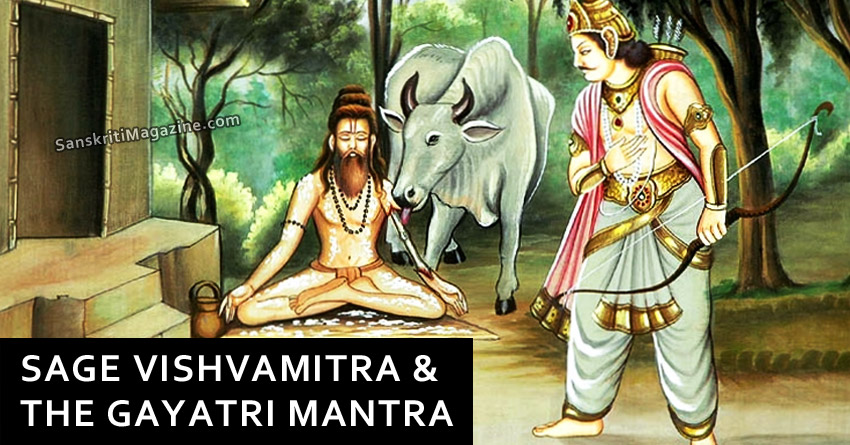
Vishvamitra, who was king of India, once went for hunting in the Himalayan jungles with a big retinue of solders. His troops felt hungry & weak after the long hunt was over. While returning back they a saw a hermit & on enquiry found it to be that of Brahmarshi, Vashishta, a sage of cosmic consciousness. The king met with the Sage & saluted him. Finding them fatigued & run down, the Sage asked the King if he could be of some help. The king said his troops were hungry & were in need of rest as they had no food since the time they entered the dense jungle in the morning. The Sage immediately called Kamadhenu, the cow of plenty & asked her to feed the troops & the King. The wish-cow produced the food by her mere will in a plentiful manner. She fed them all to their hearts content.
The King was amazed at the wish-fulfilling powers of the Cow. He requested the Sage to give the cow to him, as he had a large population to feed & this cow would be useful to him for the benefit of the people of his country. He argued that its utility remained highly underutilised as it served just a handful of persons living in the hermitage. The King was prepared to give in exchange a thousand cows & take the cow of plenty with him.
The Sage told him that this cow was specially given to him by God & he cannot give it even in exchange of king’s whole kingdom. He told him emphatically that only those who have realised Truth (Brahman in Vedanta) are given this wish fulfilling cow. At the Sage’s refusal, the King got enraged & stated that he was insulted as no one could refuse a king’s request. He ordered that the cow be removed by force. As soon as troops tried to seize the cow, thousands of celestial men appeared with their weapons & the troops were forced out. Thereafter, with uncontrolled anger, Visvamitra began the fight with Sage Vashista, who held his bramah-danda (monks staff) in the forefront & the challenge started. All the arrows & weapons fired by Vishvamitra, were destroyed by the monk’s staff & he was left defenceless. The bramah- danda was now ready to strike the king, who immediately realised that time was over for him. Finally, king realising the power of a Brahmarshi, sought for forgiveness. Being kind & compassionate, Sage Vashista withdrew & forgave him.
The king still felt insulted & secretly he vowed revenge. For this he must have more powers than the Sage. The kingdom, rulership, wealth & power & his vast possessions, were nothing before the effulgence (tejas) of a Brahmarshi. It dawned on him that nothing was greater than the knowledge of Truth. He renounced queen, sons & kingdom & retired to Himalayas to practise tapasya. He was in an unchartered area knowing nothing about yoga, pranayama, meditation & austerity. Bereft of comforts, he felt despondent & miserable. But his ego prevented him from seeking guidance of Sage Vashista. It was the powerful urge to succeed & acquire knowledge that sustained him.
Vishvamitra proceeded to practise meditation intensely on Cosmic self, like Lord Shiva, in the serene upper reaches of Himalayas & never gave up. He was able to separate mind stuff from the body & developed a deep sense of detachment. Ultimately he stilled his thoughts & the yogic fire burst forth in him touching upper spheres of consciousness. Indira, the celestial God, panicked as Vishvamitra could be a threat to his throne. He sent a celestial beauty, Menaka to disrupt his tapasys. Visvamitra was bewitched by her smile & charm which disturbed his tapasya. He lived with Menaka for some time in the forest & begot her a daughter who is well know in Sanskrit literature as Shakuntala. After her, successful mission, Menaka returned to her celestial abode. The daughter was brought up in the forest by a sage called Kanva.
Vishvamitra now fully realised the power of Maya & he moved to another forest. He now renounced food, drink & was determined to achieve the goal. He is reported to have stood on one leg with uplifted arms, & meditated in this way on Brahman for a number of years. He reached the three worlds by austerity & yogic power. Indira again panicked, & this time he sent Rambha, another celestial nymph, to spoil his penance. No doubt Visvamitra’s meditation was shaken, but he realised his earlier mistake when he fell because of lust. Knowing that she had come to create a problem, he opened his eyes & uttered a curse that turned her into a rock. True Knowledge was now dawning upon him: he realized that earlier it was lust that disturbed him in penance, now it was anger. Although he now understood that spiritual path is like walking on razor’s edge, he vowed to push ahead with greater zeal & determination. He moved on to a new Himalayan peak, where he held his breath for a number of years & acquired great spiritual powers.
King Trishanku was ruler of India at that time. He was in the midst of organizing, a great yagnya, to help him to ascend to savrgalokain the human form. Sage Vashista, who was his ‘kul-guru’, refused to conduct the fire sacrifice as it was against divine law. He approached Vishvamitra, who was only willing to be the chief priest as it was a godsend opportunity to display his yogic powers. The yagnya was successfully performed in the king’s palace & by Vishvamitra’s spiritual powers the king was sent to savargaloka in the human form. Indira & other celestials finding Trishanku entering heaven in earthly body, sent him back. With legs up & head down, Trishanku came crashing down to earth & cried for help saying ”Vishvamiter, Vishvamiter please protect me”. With enormous yogic power, Sage Vishvamitra stopped his fall from heaven & created a new celestial world for him. Trishanku even today is shinning as a star in the sky. To us, today, Trishanku means that one is neither here nor there (latka hua manush).
This was one more fall for Vishvamitra & he lost all his yogic powers as he used them for ulterior gain. Because his spirit was indomitable, he took a final decision not to give up meditation. He selected a new place in the Himalayas & new effort began earnestly. Seasons rotated; years passed. He sat motionless fixing his gaze between the eyebrows. This time his yogic power was so intense that it woke up Brahma in Satyaloka. Brahma told him that he had attained great yogic powers of a maharshi. But to become a Brahmarsi, Sage Vashista must bless him. He was asked to go & meet him.
Sage Vishvamitra was frustrated as he could not tolerate to seek blessings of his foe. He felt that so long as Sage Vashista was alive, he could never become a Brahmarshi. Therefore he must kill him. Vishvamitra collected a big rock & went to the hermitage of Sage Vashista at midnight. He waited for the time the Sage would come out to the river for morning meditations, when he would hurl the big rock on his head. As he was standing close to the door of the hermitage, he heard Vashista speaking to his wife, Arundhati that Visvamitra was a great man & he was close to attaining the status of a Brahmarshi. But this could happen only if Vashista comes to meet him. “But will you bless him?” Arundhati asked. ”Of course, I will”, said Sage Vashishta.
On hearing this Visvamitra felt ashamed of himself, rushed inside & prostrated himself before Sage Vashista. “Now you have become a Bramarshi. You have conquered anger, lust, greed, attachment & arrogance one by one. The last barrier you crossed was jealousy. You have also shown that human spirit is invincible & accepts no defeat”, said Vashishta to Visvamitra. Thereafter as Vashista touched his brow centre, Visvamitra’s third eye opened & he saw the seven rhythms with which cosmos was created. The sacred Gayatri Mantra, was revealed to him at that time, thus:
The shorter form of the Gayatri is practiced far more commonly:
“OM BUHR, BHUVA, SWAHA
OM TAT SAVITUR VARENYAM
BHARGO DEVASYA DHEEMAHI
DHIYO YONAHA PRACHODAYAT”
We meditate on the glory of the Creator;
Who has created the Universe;
Who is worthy of Worship;
Who is the embodiment of Knowledge and Light;
Who is the remover of Sin and Ignorance;
May He open our hearts and enlighten our Intellect.
The longer version is more profound.
“OM BHUR, OM BHUVAHA, OM SWAHA,
OM MAHAHA, OM JANAHA, OM TAPAHA, OM SATYAM
OM TAT SAVITUR VARENYAM
BHARGO DEVASYA DHEEMAHI
DHIYO YONAHA PRACHODAYAT”