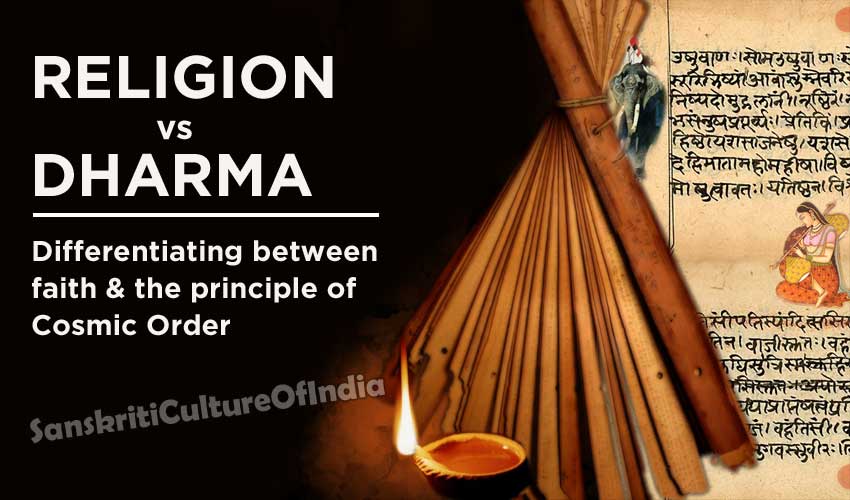
Are the two words synonymous and interchangeable? Religion literally means that which leads one to God. “Dharma” is derived from the root Sanskrit word “dhri” which means “to hold together”. It has a wider meaning than the word “religion”. There is no equivalent word for Dharma either in English or in any other language. In this sense, Hinduism is not a religion; it’s a “Dharma”. Those who profess the Hindu Dharma and seek to follow it, are guided by spiritual, social and moral rules, actions, knowledge and duties which are responsible for holding the human race together.
Hindu Dharma is also known by the names “Sanatana Dharma” and “Vaidik Dharma”. “Sanatana” means eternal and all-pervading and “Vaidik Dharma” means the Dharma based on the Vedas. In simple terms, one can say that Dharma means code of conduct, i.e. doing the right thing, in thought, word and deed, having always in mind that behind all our deeds there is a Supreme Being. This is the teaching of the Vedas, which are the original source of our Dharma – “Vedo – Khilo Dharma Moolam.”
Dr. S. Radhakrishnan, the great philosopher, statesman and former President of India has described what is Dharma in these words: “Dharma is that which binds society together. That which divides society, breaks it up into parts and makes people fight one another is Adharma (non-religion). Dharma is nothing more than the realization of the Supreme and acting in every small act of your life with that Supreme present in your mind. If you are able to do so, you are performing Dharma. If other interests pervade you, and you try to translate your mind into other regions, even though you may think you are a believer, you will not become a true believer. The real believer in God has his heart always lifted to Dharma”.
According to Swami Sivananda, “Hinduism allows absolute freedom to the rational mind of man. It never demands any undue restraint upon the freedom of human reason, the freedom of thought, feeling and will of man. Hinduism is a religion of freedom, allowing the widest margin of freedom in matters of faith and worship. It allows absolute freedom of human reason and heart with regard to such questions as to the nature of God, soul, form of worship, creation, and the goal of life. It does not force anybody to accept particular dogmas or forms of worship. It allows everybody to reflect, investigate, enquire and cogitate.”
Hence all manner of religious faiths, various forms of worship or spiritual practices, diverse rituals and customs have found their place, side by side, within Hinduism, and are cultured and developed in harmony with one another. Hinduism, unlike other religions, does not dogmatically assert that the final emancipation or liberation is possible only through its means and not through any other. It is only a means to an end, and all means that ultimately lead to the final goal are approved of.
The religious hospitality of Hinduism is proverbial. Hinduism is extremely liberal and catholic. This is its fundamental feature. It pays respect to all religious and does not revile any other religion, accepting and honoring truth from wherever it may come and in whatever garb it is presented.
“Yato Dhrmah Tato Jayah” – Where Dharma exists victory is guaranteed.
~ Shri Gyan Rajhans, CIH, ROH, P.Eng.