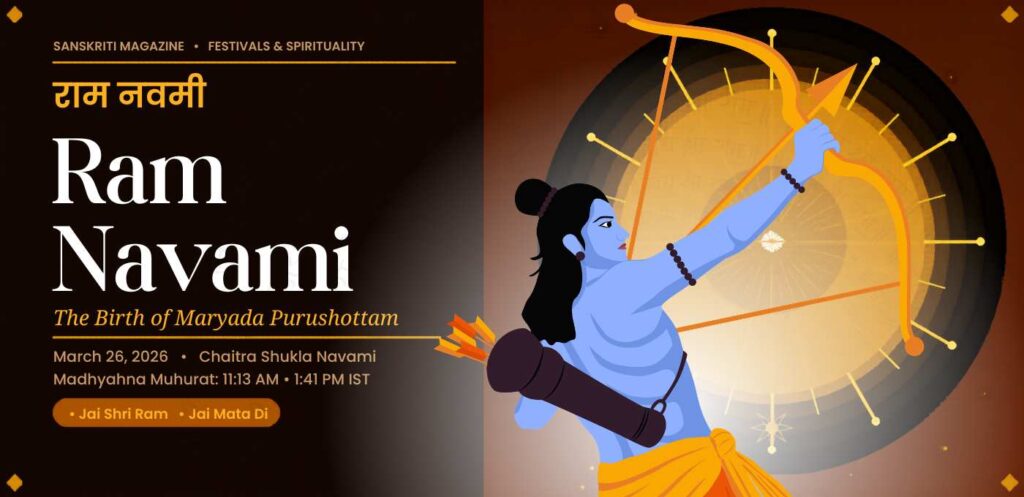
🏹 Ram Navami 2026
The Birth of the Lord of Dharma
There is a name that has been on the lips of India for thousands of years — whispered in the dark before dawn, chanted in temple courtyards at noon, sung by grandmothers over sleeping children, written on the foreheads of the dying as their final sacred breath. Two syllables. Two sounds. A name so complete in itself that the sages of the Vedic tradition called it the Taraka Mantra — the mantra that carries you across the ocean of existence.
Ram.
Today, on the ninth day of Chaitra Shukla Paksha — the day the sun reaches its highest point of the midday sky — we celebrate the birth of the one who bore that name in human form. Ram Navami, the birth anniversary of Lord Rama, the seventh avatar of Vishnu, the prince of Ayodhya, the husband of Sita, the ideal son and ideal king, the being whom the entire tradition of Sanatana Dharma holds up as the highest model of what it means to be human.
Today is simultaneously the final day of Chaitra Navratri 2026 — a confluence of extraordinary auspiciousness. The nine-day journey through the nine forms of the Divine Mother concludes at the birth of her greatest devotee. Shakti and Rama, the mother and her son, the feminine and the masculine principles of the cosmos — together, complete.
The Birth of Lord Rama: The Divine Story from Valmiki Ramayana
The story of Rama's birth begins not with Rama himself, but with a crisis — and a prayer. The earth, according to the Valmiki Ramayana, was suffering under the weight of unprecedented evil. Ravana, the ten-headed demon king of Lanka, had obtained a near-invincible boon from Brahma: he could not be killed by any god, demon, or divine being. In his arrogance, he had forgotten to include humans in his list of threats. And so Vishnu, who sees the opening that pride creates, chose to descend as a human being.
The Putrakameshti Yajna
In Ayodhya, the great king Dasharatha — ruler of the Solar Dynasty (Suryavansha), a righteous and beloved king — was growing old without an heir. On the counsel of his guru Maharishi Vashishtha, he performed the Putrakameshti Yajna — a sacred fire ceremony specifically for the blessing of children — under the guidance of the great sage Rishyashringa.
The yajna was performed with complete devotion and perfect ritual precision. As the sacred fire blazed, a divine being emerged from the flames bearing a golden vessel of payasam (sacred rice pudding). He offered it to Dasharatha with the words: "O King, the gods are pleased with you. Distribute this payasam among your queens, and sons will be born to you."
Dasharatha distributed the payasam among his three queens: Kaushalya received half, Kaikeyi received a quarter, and Sumitra received the remaining quarter (some accounts say she received two portions at different times, which is why she bore twins).
The Birth — Chaitra Shukla Navami, Madhyahna
Nine months later, on the ninth day of the bright fortnight of Chaitra — when the sun stood at the peak of the midday sky, when five of the seven planets were exalted, when the constellation Punarvasu shone auspiciously — Kaushalya gave birth to Lord Rama.
The Valmiki Ramayana describes the moment with breathtaking precision: the entire cosmos rejoiced. The gods rained flowers. The celestial musicians played. The atmosphere filled with fragrance. And in Ayodhya, people danced in the streets, unable to name why they were so happy — only that the world felt, in that moment, irrevocably and completely right.
श्री राम जय राम जय जय राम
Shri Ram, Jai Ram, Jai Jai Ram
रामाय रामभद्राय रामचन्द्राय वेधसे ।
रघुनाथाय नाथाय सीतायाः पतये नमः ॥
Ramaya Ramabhadraya Ramachandraya Vedhase
Raghunathaya Nathaya Sitayah Pataye Namah
"Salutations to Rama, to the auspicious Rama, to the moon-like Rama, to the creator of the universe, to the lord of the Raghus, to the lord of Sita."
Who Is Lord Rama? The Fourteen Qualities of Maryada Purushottam
Lord Rama is known across the Hindu tradition by one of his most beloved epithets: Maryada Purushottam — the best of men who upholds the boundaries of righteousness. He is not worshipped despite being human; he is worshipped precisely because he was human, and yet lived at such an extraordinary level of integrity, courage, compassion, and devotion that he became the model for all of human civilization.
The Valmiki Ramayana opens with the sage Narada describing the fourteen essential qualities of Rama that Valmiki was searching for in the ideal human being. These qualities read today as a complete portrait of moral greatness:
These are not aspirational qualities that Rama occasionally displayed. They were the consistent, daily, lived reality of his existence — even in the most extreme circumstances. When his father exiled him unjustly, he obeyed without bitterness. When Sita was taken, he grieved but acted. When he had the chance to destroy his enemies entirely, he offered them mercy first. He was, in the truest sense, the human form of the divine.
Rama as the Seventh Avatar of Vishnu: Why He Descended
In the Dashavatara — the ten principal avatars of Lord Vishnu — Rama is the seventh, appearing in the Treta Yuga. Each avatar of Vishnu comes in response to a specific crisis in the cosmic order, and each brings the precise quality that the moment requires.
Parashurama (the sixth avatar) came with an axe to eliminate a corrupt warrior class. Rama came with a bow — and more importantly, with his character — to demonstrate that the highest power is not force but dharma. He did not merely defeat Ravana; he showed the world that a man of complete integrity, walking the path of complete righteousness, cannot ultimately be defeated — not by demons, not by exile, not by personal tragedy, not by the cruelty of fate.
This is why Rama's story resonates so deeply across so many centuries and so many cultures: because it is not really a story about a god. It is a story about what a human being becomes when they choose, in every moment and every circumstance, to be fully, completely, courageously themselves.
Ram Navami in Ayodhya: The Birthplace Celebrates
No Ram Navami blog would be complete without a moment of contemplation on Ayodhya — the city where Rama was born, where the Ram Mandir now stands on the banks of the sacred Sarayu river, and where today the entire nation turns its heart.
Ram Navami in Ayodhya in 2026 is a spectacle of devotion unlike almost anything else on earth. Hundreds of thousands of pilgrims arrive in the days before, filling every dharamshala, every ghat, every street corner with the continuous hum of "Jai Shri Ram." The Sarayu river is lit with thousands of diyas at sunrise. The Ram Mandir, consecrated in January 2024, receives lakhs of devotees who have waited lifetimes for this moment — to offer their prayers in person to Ram Lalla in his own home, in his own city, in the most magnificent temple India has built in centuries.
At the precise moment of the Madhyahna Muhurat — 12:27 PM — the ritual of Ram Janm (the birth celebration) is enacted in temples across India. Conch shells are blown, bells are rung, flowers are showered, and the air fills with the sound of the most ancient celebration on earth: the birthday of the ideal man.
Ram Navami Puja Vidhi: How to Celebrate at Home Today
- Rise at Brahma Muhurta. Wake before sunrise, bathe, and wear clean clothes — ideally yellow or saffron, the colours associated with Lord Rama and the solar dynasty.
- Decorate the home altar. Set up a clean wooden platform covered with yellow or saffron cloth. Place images or idols of Lord Rama, Sita, Lakshmana, and Hanuman together. Decorate with yellow marigolds and tulsi leaves.
- Offer Surya Arghya. Offer water to the rising sun in a copper vessel, reciting the Aditya Hridayam or simply the Gayatri Mantra. The Sun is Rama's ancestor — the Solar Dynasty (Suryavansha) traces its lineage to Surya himself.
- Bathe the idol. Bathe the Ram Lalla idol or image with Gangajal, milk, and honey (panchamrit). Dress with fresh yellow flowers.
- Offer prasad. Traditional Ram Navami prasad: kheer (rice pudding), panjiri (a wheat-based sacred sweet), fruits, and tulsi leaves. Tulsi is non-negotiable — it is Rama's most sacred plant.
- Perform the main puja at Madhyahna Muhurat (11:13 AM – 1:41 PM). This is the most important window. Light incense and a ghee lamp. Recite the Ram Raksha Stotra, Ramcharitmanas (at least the Bal Kanda passages describing the birth), or simply chant Shri Ram Jai Ram Jai Jai Ram 108 times on a tulsi mala.
- Perform the Ram Janm aarti at 12:27 PM. At the moment of the Madhyahna (12:27 PM), perform the special Ram Janmotsav aarti, shower flowers on the idol, blow the conch if available, and ring the bell. This is the birthday moment.
- Read or listen to Ramayana. Spend part of the day reading the Valmiki Ramayana, Ramcharitmanas (Tulsidas), or listening to a Ram Katha. Even one hour of sincere listening on this day is considered extraordinarily meritorious.
- Distribute prasad. Share the kheer and panjiri with family, neighbours, and if possible, with those in need. Charity on Ram Navami is said to be especially blessed.
Ram Navami Prasad: The Sacred Panjiri Recipe
Panjiri is one of the most ancient and distinctive prasad dishes of Ram Navami — a dense, nourishing sweet made from whole wheat flour roasted in ghee, mixed with sugar and dry fruits. It is not a fancy preparation; it is the food of straightforwardness and substance, perfectly suited to the god who embodied both.
- 2 cups whole wheat flour (atta)
- ¾ cup pure ghee
- ¾ cup powdered sugar (or to taste)
- 2 tablespoons each: chopped almonds, cashews, pistachios
- 1 tablespoon melon seeds (magaz)
- 1 tablespoon white poppy seeds (khus khus)
- ½ teaspoon cardamom powder
- A pinch of saffron (optional)
Method: Heat ghee in a heavy pan on medium-low heat. Add whole wheat flour and roast slowly, stirring constantly, for 15–20 minutes until deeply golden and fragrant. Remove from heat. Add all dry fruits and seeds, stir well. When slightly cooled, add powdered sugar and cardamom and mix thoroughly. The panjiri should be crumbly, fragrant, and dense. Offer to the Lord, then distribute as prasad. Panjiri keeps well for a week and is also considered deeply nourishing — traditionally given to new mothers and those recovering from illness.
Hanuman: The Devotee Who Became the Mirror of Ram
No celebration of Ram Navami is complete without a moment of contemplation on Hanuman — the divine monkey who is simultaneously the most ardent devotee of Rama and the embodiment of everything devotion can make a person become.
Hanuman is, in a sense, the answer to the question that Ram's life raises: if Rama is the ideal being, what does a human being become when they dedicate themselves completely to him? The answer is Hanuman: possessed of superhuman strength, boundless loyalty, perfect wisdom, absolute fearlessness, and a love so complete that when someone once asked him to describe his relationship to Rama, he said: "When I think of myself as a body, I am your servant. When I think of myself as a soul, I am a part of you. When I think of myself as the Atman, you and I are one."
This is not just devotion. This is the entire map of the spiritual path, delivered in three sentences by a monkey-god to a room full of sages.
बरनउँ रघुबर बिमल जसु, जो दायकु फल चारि ॥
Barnau Raghubar Bimal Jasu, Jo Dayaku Phal Chari
"Cleansing the mirror of my mind with the dust of the lotus feet of the Guru, I recite the pure glory of Raghuvara (Rama), which bestows the four fruits of life."
Why Does Navratri End on Ram Navami? The Sacred Confluence
The fact that Chaitra Navratri — the nine-day celebration of the Divine Mother — concludes on Ram Navami is one of the most theologically beautiful confluences in the Hindu calendar. It is not coincidental. It is a teaching.
In the Adhyatma Ramayana and other texts, Rama is described as the greatest devotee of Shakti — the Divine Mother. Before the battle of Lanka, when Rama was struggling against the dark power of Ravana, the sage Agastya descended from heaven and advised him to perform the Aditya Hridayam — the sacred hymn to the Sun — and also to worship the Goddess. This worship was the autumn Navratri, after which Rama received the Goddess's blessing and emerged victorious.
The mother and her devotee. Shakti and Rama. The nine forms of the divine feminine — each embodying a different aspect of cosmic power — find their culmination and their purpose in the birth of the one who would wield all of those qualities in human form: the rootedness of Shailputri, the discipline of Brahmacharini, the courage of Chandraghanta, the creative joy of Kushmanda, the motherly protection of Skandamata, the righteous fury of Katyayani, the fearlessness of Kalaratri, the purity of Mahagauri, and the complete perfection of Siddhidatri. All of this is Rama.
The Timeless Relevance of Rama: What He Offers the Modern World
There are those who ask: in an age of complexity and moral ambiguity, what does a figure like Rama — with his unwavering code of conduct, his absolute commitments, his refusal to compromise on dharma — have to offer us? Is he not too perfect to be relatable? Too idealistic for a world that runs on compromise and calculation?
The answer the tradition gives is: exactly the opposite. In a world of complexity and compromise, Rama is not an unreachable ideal. He is a compass. Not a destination to be reached perfectly, but a direction to be kept in view. The question is not whether you will be Rama — you will not, and neither will anyone else. The question is whether, when you face the moment of choosing between what is easy and what is right, you choose what is right. Whether, when your word is tested, you keep it. Whether, in the hardest moments of your life, you act from your deepest values rather than your immediate fears.
This is what Rama offers the modern world. Not a perfect performance, but a perfect intention. Not a flawless life, but an unwavering direction. Jai Shri Ram is not just a salutation. It is a declaration: I am trying to walk in that direction. I am choosing dharma. Today, on this most auspicious of birthdays, I renew that choice.
🙏 Jai Shri Ram! Happy Ram Navami 2026!
Perform puja at the Madhyahna Muhurat: 11:13 AM – 1:41 PM IST (Ram Janm moment: 12:27 PM). Offer kheer, panjiri, and tulsi. Chant ॐ श्री रामाय नमः or Shri Ram Jai Ram Jai Jai Ram 108 times. Read or listen to Ramayana. Distribute prasad. And today, in even one small moment, choose what is right over what is easy. That is the truest celebration of Rama's birth.
🏹 Jai Shri Ram · Jai Mata Di · Jai Hanuman 🙏
Published by Sanskriti Magazine — India's largest digital platform for Hindu heritage, culture, and spirituality.
Read more at sanskritimagazine.com · Follow us on Instagram & Facebook: @indian_sanskriti
May the grace of Lord Rama fill your home and heart on this most auspicious day. 🏹 Jai Shri Ram!