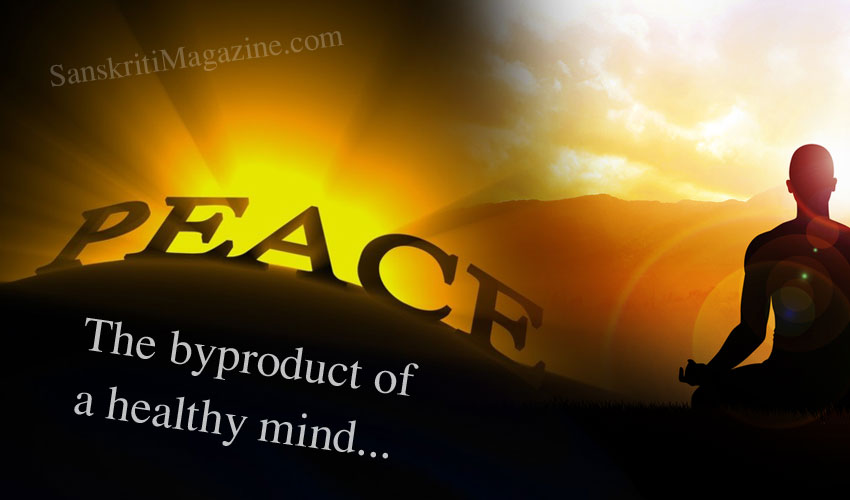
The mind is considered to be the prime cause of bondage, as well as misery and liberation, enmity and friendship. Mind is our link to the world outside as well as a link to inner peace. By itself, mind is neither friend or foe, nor good or bad. It all depends on how we make use of it. A mind attached to sense pleasures is our greatest enemy. We do not need to fight an enemy outside in the world as we are carrying it with us, no matter where we go.
Sometimes, people think that they can find peace in a solitary place, in the forest, on top of a mountain, at some holy place, or in a monastery. But, this is a myth. If the mind is restrained, peace can be found even in our own living room.
In the Bhagavad Gita, Lord Krishna gives the formula for peace very succinctly. He says, “He who lives devoid of all attachment, giving up desires, egoism, and sense of I and mind attains peace.”
Peace is not an object outside of ourselves that we need to attain. It is already there within us. But, we have created disturbances by innumerable material desires. We work day and night only to give rise to anxiety, tension, and frustration because we are chasing the chimera of material desires. What we don’t understand is that material desires are endless, like a bottomless pit; they never come to an end. As soon as one of our desires is fulfilled, it gives birth to the next desire. Then, we begin chasing these new desires and this goes on for all of our existence. It is just like a mirage in the desert. As soon as you reach close to it, you find it has moved further up ahead. You can keep running after it until you drop dead from thirst. Trying to satisfy material desires is like trying to quench our thirst by seeking water from a mirage or by trying to put out a fire by pouring fuel into it.
Mind is considered as the king of all senses. Therefore, it should rule over the senses. But if it becomes attached to material desires, it becomes a slave to the senses. When this happens, the mind loses its potency. For example, if a master has some weakness and the servant knows it, then the servant will take advantage of the master by exploiting his weakness. The master also fears that if he does not submit to the will of the servant, the latter can expose his weakness. Therefore, the master always dreads his servant.
A mind attached to material desires and sense pleasures is in a similar position. Instead of controlling the senses, it gets pulled in different directions by them. This is the cause of disturbance. Disturbance is nothing other than the senses or material desires pulling the mind all around. Peace is realized when the mind is not agitated by such desires.
If a person is walking and says, “What do I have to do to be stationary,” the simple answer is that he should just stop walking. He does not have to do anything extra to become stationary. Rather, he has to give up the activity of walking. Similarly, nothing special has to be done to gain peace. The peace is already there; we have to merely stop creating disturbances. And this is possible only by renouncing all material desires. This will bring an immediate end to all agitation of the mind.
Lord Krishna advises us to forsake all material desires. Even if there is one desire, it will be disturbing and might give rise to other desires. So, desires must be renounced completely. The next thing he says that we should do is to give up our material ego. We should not identify with our ‘designation’ based upon these material bodies. This will bring peace in the whole world. There are wars between people, family members, religions, organizations, states and nations because of ego-based material identifications. Unless we give up the thought that we are a person of a certain caste, creed, gender, color, or nation, we will remain sectarian and thus have biased feelings for those who have a different designation.
The last requirement for peace, according to Krishna, is to renounce the feeling of possessiveness over the body, people, and things related to the body. This includes insentient things such as a house, car, etc., and sentient beings such as mate, children, etc. Does this mean that one should not possess anything? No! The problem is not with the body or possessions, but with our attachment to them. Attachment to anything will bring bondage, distress, and loss of peace and happiness.
Without peace there can be no happiness. Thus, if we want happiness, we should follow the principles of the Bhagavad Gita, which are universally applicable to people of all nations and religions.
~ Satya Narayana Dasa