Paramesvara was an Indian astronomer and mathematician who wrote many commentaries on earlier works as well as making many observations. Although his father has not been identified, we know that Paramesvara was born into a Namputiri Brahmana family who were astrologers and astronomers. The family home was Vatasseri (sometimes called Vatasreni) in the village of Alattur. This village was in Kerala and Paramesvara himself gives its coordinates with respect to Ujjain. This puts it at latitude 10° 51′ north. It is on the north bank of the river Nila at its mouth.
From Paramesvara’s writing we know that Rudra was his teacher, and Nilakantha, who knew Paramesvara personally, tells us that Paramesvara’s teachers included Madhava and Narayana. We can be fairly confident that the dates we have given for Paramesvara are roughly correct since he made eclipe observations over a period of 55 years. We will say a little more about these observations below. He played an important part in the remarkable developments in mathematics which took place in Kerala in the late 14th and early part of the 15th century.
The commentaries by Paramesvara on a number of works have been published. For example the Karmadipika is a commentary on the Mahabhaskariyam, an astronomical and mathematical work by Bhaskara I. In the text of Paramesvara’s commentary on the Laghubhaskariyam of Bhaskara I is given. Munjala wrote the astronomical work Laghumanasam in the year 932 and Paramesvara wrote a commentary. It is a work containing typical topics for Indian mathematical astronomy works of this period: the mean motions of the heavenly bodies; the true motions of the heavenly bodies; miscellaneous mathematical rules; the systems of coordinates, direction, place and time; eclipses of the sun and the moon; and the operation for apparent longitude.
Aryabhata gave a rule for determining the height of a pole from the lengths of its shadows in the Aryabhatiya. Paramesvara gave several illustrative examples of the method in his commentary on the Aryabhatiya.
Like many mathematicians from Kerala, Madhava clearly had a very strong influence on Paramesvara. One can see throughout his work that it is teachings by Madhava which direct much of Paramesvara’s mathematical ideas. One of Paramesvara’s most remarkable mathematical discoveries, no doubt influenced by Madhava, was a version of the mean value theorem. He states the theorem in his commentary Lilavati Bhasya on Bhaskara II’s Lilavati. There are other examples of versions of the mean value theorem in Paramesvara’s work which we now consider.
The Siddhantadipika by Paramesvara is a commentary on the commentary of Govindasvami on Bhaskara I’s Mahabhaskariya. Paramesvara gives some of his eclipse observations in this work including one made at Navaksetra in 1422 and two made at Gokarna in 1425 and 1430. This work also contains a mean value type formula for inverse interpolation of the sine. It presents a one-point iterative technique for calculating the sine of a given angle. In the Siddhantadipika Paramesvara also gives a more efficient approximation that works using a two-point iterative algorithm which turns out to be essentially the same as the modern secant method.
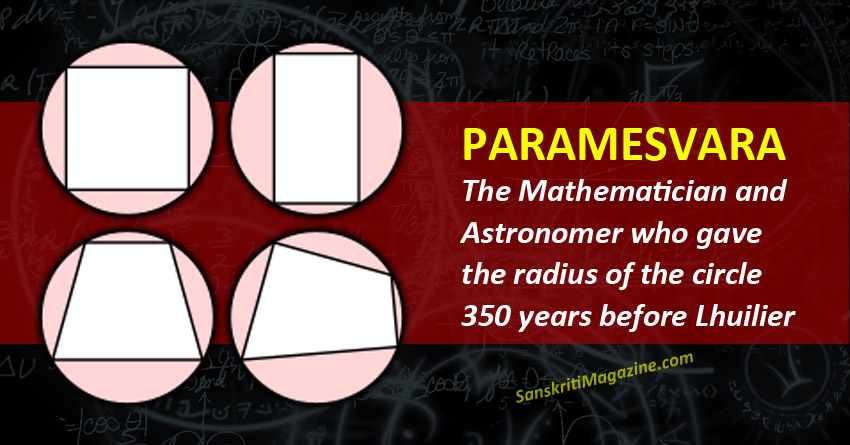
The expression for the radius of the circle in which a cyclic quadrilateral is inscribed, given in terms of the sides of the quadrilateral, is usually attributed to Simon Antoine Jean L’Huilier in 1782. However, Paramesvara described the rule 350 years earlier. If the sides of the cyclic quadrilateral are a, b, c and d then the radius r of the circumscribed circle was given by Paramesvara as:
r2 = x/y where
x = (ab + cd) (ac + bd) (ad + bc)
and y = (a + b + c – d) (b + c + d – a) (c + d + a – b) (d + a + b – c).
Paramesvara made a series of eclipse observations between 1393 and 1432 which we have referred to above. The last observation which we know he made was in 1445 but Nilakantha quotes a verse by Paramesvara in which he claims to have made observations spanning 55 years. The known observations by Paramesvara do not quite square with this statement, there being a discrepancy of three years. Although we do not know when Paramesvara died we do know, again from Nilakantha, that the two knew each other personally. Since we have a definite date for Nilakantha’s birth of 1444 it is hard to believe that Paramesvara died before 1460.
Using his observations, Paramesvara made revisions of the planetary parameters and, like many other Indian astronomers, he constantly attempted to compare the theoretically computed positions of the planets with those which he actually observed. He was keen to improve the theoretical model to bring it into as close an agreement with observations as possible.
~ J J O’Connor and E F Robertson