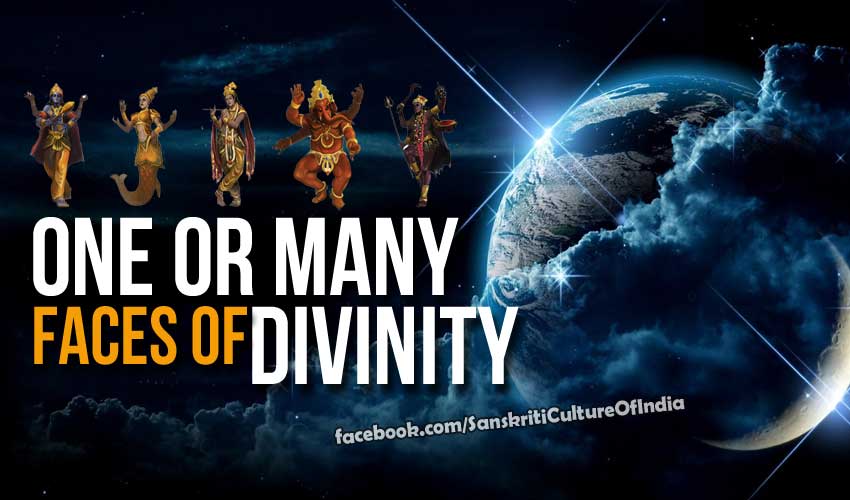
In the 19th century, when European Orientalists first translated Vedic hymns, they noticed that each hymn of the Veda evoked different gods. Naturally they assumed Hindus were polytheists like the Greeks. Then they noticed each time a deity was being invoked he was being treated as the supreme god, suggesting Hindus were monotheists like the Christians. This confused them. Were Hindus polytheistic or monotheistic? Monotheism was seen as superior then and the British rules did not lose a single opportunity to embarrass Indians about their many gods.Some suggested Hindus were henotheistic; they worshipped only one god but acknowledged the existence of others. Max Mueller came up with the term kathenotheistic, which means every god was treated as the supreme god turn-by-turn at the time of invocation. In other words, context determined the status of the god. In drought, Indra who brought rains was valued. In winter, Surya, the sun, was admired. In summer, Vayu, the wind, was worshipped.
So it is in business. Everybody we deal with in business is important. But importance soars as our dependence on them increases. Importance is a function of context.In the puja-ghar, the gods are classified as personal gods called ishta-devata, household gods called griha-devata, family gods called kula-devata, village gods called grama-devata, forest gods called vana-devata. Thus there are different gods for different contexts: the personal, the departmental, the regional, the market. Each one plays a role in our life. Individually or collectively, they bring fulfilment to our existence.This is very unlike major religions of the world such as Judaism, Christianity and Islam where there is only one deity worthy of reverence in each and every context, no other.
The modern practice of aligning everyone in the organization – from salesman to director – to a common organizational goal has its roots in this monotheism: one God of religion becomes the single goal in a secular workplace. So modern business is just one yagna, not several, with a single leader as yajaman, and everyone else as assistants to that leader.When Indian scholars started rewriting Hinduism in the 19th century, they were well aware of the imperial burden to prove Hinduism was also monotheistic. The Upanishads with its monistic Vedanta philosophy came to the rescue. The myriad gods were manifestations of the same divine principle. Hindus were at once, polytheistic and monotheistic. But this confuses people. So is Ganesha different from Krishna? And the Indian answer, “Yes, no, actually it depends on how you see it!” can be quite irritating, if not exasperating. For those who belong to a monotheistic template, this kathenotheistic way of seeing things can be very annoying. It comes across as opportunistic and even hypocritical. But in a world that is increasingly realizing the value of diversity, there needs to be diversity in how one is allowed to approach the divine. It can be outside, or inside, with form or without, singular or plural, masculine or feminine. Or as the great Tamil poet, Nammalvar, said, “even in between”.
The modern practice of aligning everyone in the organization – from salesman to director – to a common organizational goal has its roots in this monotheism: one God of religion becomes the single goal in a secular workplace. So modern business is just one yagna, not several, with a single leader as yajaman, and everyone else as assistants to that leader.When Indian scholars started rewriting Hinduism in the 19th century, they were well aware of the imperial burden to prove Hinduism was also monotheistic. The Upanishads with its monistic Vedanta philosophy came to the rescue. The myriad gods were manifestations of the same divine principle. Hindus were at once, polytheistic and monotheistic. But this confuses people. So is Ganesha different from Krishna? And the Indian answer, “Yes, no, actually it depends on how you see it!” can be quite irritating, if not exasperating. For those who belong to a monotheistic template, this kathenotheistic way of seeing things can be very annoying. It comes across as opportunistic and even hypocritical. But in a world that is increasingly realizing the value of diversity, there needs to be diversity in how one is allowed to approach the divine. It can be outside, or inside, with form or without, singular or plural, masculine or feminine. Or as the great Tamil poet, Nammalvar, said, “even in between”.