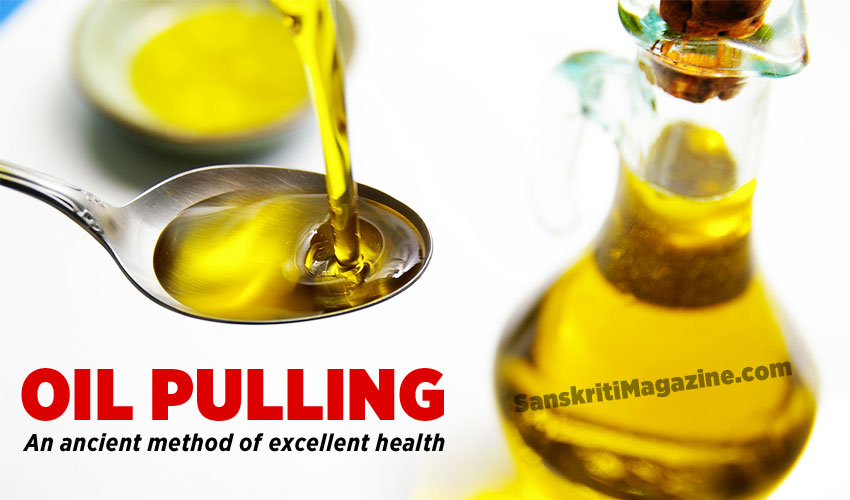
Oil pulling is an ancient Indian folk remedy first mentioned in the early Ayurvedic text, the Charaka Samhita, which was believed to have been written approximately 1500 years ago.
One oil pulls by simply swishing a tablespoon of oil (sesame, coconut and sunflower are commonly recommended) in one’s mouth for approximately 15-20 minutes on an empty stomach and then spitting it out.
The Charaka Samhita describes oil pulling as effective for improving more than just oral health, but also 30 other systemic diseases ranging from headache, migraine to diabetes and asthma.
Modern scientific inquiry increasingly confirms oil pulling’s benefit to oral health:
- Proven to be as effective as the chemical chlorhexidine (as in Oral B mouthwash) for chronic bad breath (halitosis),[i] but without the side effects
- Proven to be beneficial in patients with gingivitis[ii] and can result in whiter teeth and pinker gums
- Proven to reduce the cavity-linked Streptococcus mutans bacteria in plaque and saliva of children[iii]
- Proven to exert antibacterial actions through emulsification and saponification[iv]
Because oil pulling positively affects the composition of bacteria in the mouth by killing pathogenic microorganisms, it makes sense that it would be beneficial in other seemingly related health conditions. When the gums or teeth are infected, bacterial cells and/or their highly immunogenic components, e.g. lipopolysaccharide, can more easily enter the blood wreaking widespread inflammation. Insofar as oil pulling nips the bacteria-associated cascade of harmful, inflammatory reactions in the bud, it may reduce the toxic load on the entire body.
Root Causes: How Infected Teeth Damage Your Overall Health
One common cause of this ongoing bacteria-mediated inflammation is the presence of a root canal. There are many reasons to avoid root canals, and common sense would dictate keeping a dead piece of your body attached to living tissue is a bad idea, but millions undergo this procedure under the advice of their dentist or endodontic specialist without fully being informed of the deleterious health consequences.
The reality is that there are miles of maze-like microtubules within the dead tooth, a perfect breeding ground for anaerobic oral microorganisms that secrete potent endotoxins. It is simply impossible to completely fill these voids with dental compounds.
Case in point, a 1998 study published in the journal Annuals of Periodontology titled “Anaerobic bacteremia and fungemia in patients undergoing endodontic therapy: an overview,” found that endodontic therapy (root canal) is associated with high rates of infection (up to 54%) with anaerobic bacteria. More recent research confirms this finding. A 2005 study in the Journal of Dentistry also found “Detection of bacteraemias during non-surgical root canal treatment.”
Unfortunately, root canals lead to the secretion of endotoxins directly into the blood, and while oil pulling may reduce some of the fall-out from having an infected tooth, it will not resolve the underlying issue. Often, removal of the canaled tooth is the only permanent solution.
The good news is that oil pulling is an easy to perform intervention with a high margin of safety. Many report significant mitigation of seemingly unrelated health issues following its regular practice. Often the best proof is first-hand experience.
~ Sayer Ji
Article Sources
[i] Sharath Asokan, R Saravana Kumar, Pamela Emmadi, R Raghuraman, N Sivakumar. Effect of oil pulling on halitosis and microorganisms causing halitosis: a randomized controlled pilot trial. J Indian Soc Pedod Prev Dent. 2011 Apr-Jun;29(2):90-4. PMID: 21911944
[ii] Sharath Asokan, Pamela Emmadi, Raghuraman Chamundeswari. Effect of oil pulling on plaque induced gingivitis: a randomized, controlled, triple-blind study. Indian J Dent Res. 2009 Jan-Mar;20(1):47-51. PMID: 19336860
[iii] S Asokan, J Rathan, M S Muthu, Prabhu V Rathna, P Emmadi, ,. Effect of oil pulling on Streptococcus mutans count in plaque and saliva using Dentocult SM Strip mutans test: a randomized, controlled, triple-blind study. J Indian Soc Pedod Prev Dent. 2008 Mar;26(1):12-7. PMID: 18408265
[iv] Sharath Asokan, T K Rathinasamy, N Inbamani, Thangam Menon, S Senthil Kumar, Pamela Emmadi, R Raghuraman. Mechanism of oil-pulling therapy – in vitro study. Indian J Dent Res. 2011 Jan-Feb;22(1):34-7. PMID: 21525674