
IndianSanskriti
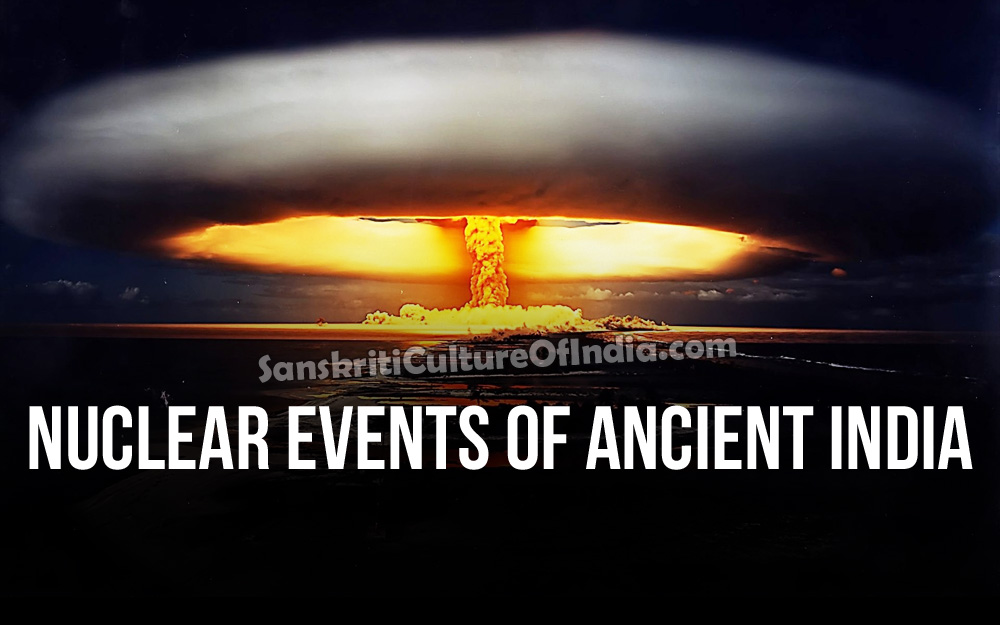
nuclear events

Nuclear Events in Ancient India?

Julius Robert Oppenheimer, the principle developer of the atomic bomb, stated that “The Vedas are the greatest privilege of this century.” During the explosion of the first atomic bomb, Oppenheimer quoted several Bhagavad-Gita verses from the 11th chapter, such as:

“Death I am, cause of destruction of the worlds…”

When Oppenheimer was asked if this is the first nuclear explosion, he significantly replied: “Yes, in modern times,” implying that ancient nuclear explosions may have previously occurred.

A Nuclear Bomb in the Ancient Hindu Text, the Mahabharata?

This is from the ancient Hindu text the Mahabharata.

“Gurkha, flying a swift and powerful vimana [fast aircraft],
hurled a single projectile [rocket]
charged with the power of the Universe [nuclear device].

An incandescent column of smoke and flame,
as bright as ten thousand suns,
rose with all its splendour.

It was an unknown weapon,
an iron thunderbolt,
a gigantic messenger of death,
which reduced to ashes
the entire race of the Vrishnis and the Andhakas.

The corpses were so burned
as to be unrecognizable.

Hair and nails fell out;
Pottery broke without apparent cause,
and the birds turned white.

…After a few hours
all foodstuffs were infected…
…to escape from this fire
the soldiers threw themselves in streams
to wash themselves and their equipment.”

A second passage

“Dense arrows of flame,
like a great shower,
issued forth upon creation,
encompassing the enemy.
A thick gloom swiftly settled upon the Pandava hosts.
All points of the compass were lost in darkness.
Fierce wind began to blow
Clouds roared upward,
showering dust and gravel.

Birds croaked madly…
the very elements seemed disturbed.
The sun seemed to waver in the heavens
The earth shook,
scorched by the terrible violent heat of this weapon.

Elephants burst into flame
and ran to and fro in a frenzy…
over a vast area,
other animals crumpled to the ground and died.
From all points of the compass
the arrows of flame rained continuously and fiercely.”
— The Mahabharata

From the Ramayana

”(It was a weapon) so powerful
that it could destroy the earth in an instant–
A great soaring sound in smoke and flames–
And on it sits death…” .
— The Ramayana
You may also like

Search the website

Like us on Facebook

Get daily updates via Email

Enter your email address:

Recent Posts

Purushottam Maas — The Month No Deity Would Claim, and the Lord Who Made It Supreme

Every month of the Hindu calendar has a lord — except the rare thirteenth, the Adhika Maas, born an orphan and shunned as the “impure month.” The Puranas tell how this rejected month went in grief to Bhagavan Vishnu, who claimed it, gave it His own name — Purushottam — and made it the most fruitful month of all. The origin story, the teaching, and what it means for Purushottam Maas 2026 (May 17 – June 14).

Padmini Ekadashi 2026 — The Ekadashi Even the Devas Descend to Keep

Padmini Ekadashi 2026 — The Ekadashi Even the Devas Descend to Keep

The rarest Ekadashi of the entire Hindu calendar is three days away. The Padma Purana preserves a conversation between Bhagavan Krishna and Yudhishthira about a single Ekadashi the great Rishis spend lifetimes waiting for — Padmini. The Vrat Katha of Queen Padmini of Mahishmati, the lotus teaching, and why May 27, 2026 is the morning Vaishnavas across Bharata are preparing for.

Varada Chaturthi 2026 — The Rare Ganesha Day of Purushottam Maas

Varada Chaturthi 2026 — The Rare Ganesha Day of Purushottam Maas

Once every 2.5–3 years — when the rare 13th month of Adhika Maas opens — a thirteenth Vinayaka Chaturthi appears. The Mudgala Purana calls it Varada Chaturthi, the “boon-giving” Chaturthi, and holds it as the most fruit-bearing Ganesha day of the entire calendar. Today, Wednesday May 20, 2026, is that day.

Padmini Ekadashi 2026 — The Rare Ekadashi That Comes Only in Purushottam Maas

Padmini Ekadashi 2026 — The Rare Ekadashi That Comes Only in Purushottam Maas

Padmini Ekadashi 2026 falls on Wednesday, May 27 — the Shukla Paksha Ekadashi of Adhika Maas, the rarest Ekadashi in the entire Hindu calendar (it appears only every 2.5–3 years). The Padma Purana conversation between Bhagavan Krishna and Yudhishthira, the Vrat Katha of Queen Padmini, complete vrat vidhi with jagrana, mantras, and the lotus symbolism that gives the Ekadashi its name.

Ganga Dussehra 2026 — The Day Maa Ganga Came Down to Bhagiratha

Ganga Dussehra falls on Monday, May 25, 2026 — commemorating the day Maa Ganga descended from Vaikuntha to the earth through the millennia-long tapasya of King Bhagiratha. The full account from the Valmiki Ramayana, snan vidhi, dana traditions, mantras, and the teaching of sustained sincerity.

css.php





