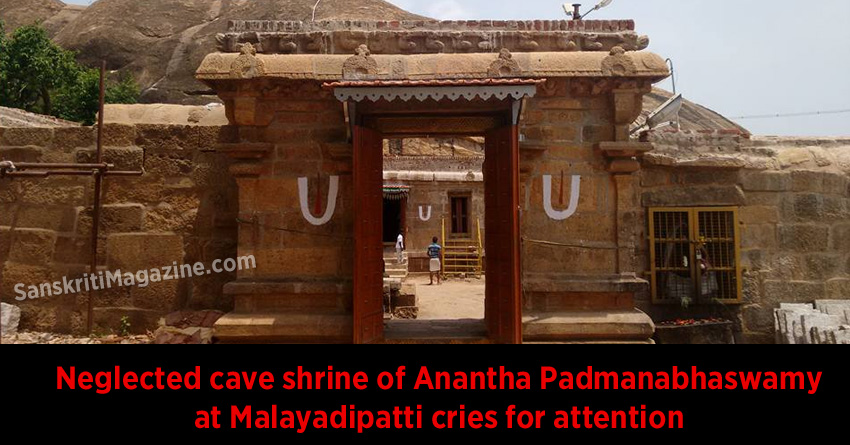
The neglected shrine of Anantha Padmanabhaswamy at Malayadipatti, one of the rock cut Perumal cave temples of Tamil Nadu, needs to be refurbished.
Located 45 km from Tiruchi in Malayadipatti, a remote village in the Kulattur Taluk of Pudukottai district is a rock cut cave temple (facing North) for Anantha Padmanabhaswamy. The temple dates back to around 1200 years to the late eighth century A.D./early ninth century A.D.
In the centuries gone by, Malayadipatti was also referred to as Thiru Valattur Malai and was known for two rock cut temples – one dedicated to Siva and the other to Vishnu- both hewn out of the same rock.
Elegant architecture
While the rock cut style is more reminiscent of the temple at Thirumaiyyam (also in Pudukottai district) and the stucco decorations there, the Perumal temple at Malayadipatti is more of the Mamalla style with elegant pillars. The pillared hall contains large panels cut in the side walls filled with scriptures including those of Narasimha and Varaha.
The 15ft Moolavar is a beautifully carved image of Lord Anantha Padmanabha in a sthala sayana posture lying on the serpent Adisesha and is similar to the one seen in Thiruvananthapuram divyadesam. While his right hand is hanging down in a posture of blessing the devotees, the Lord’s feet rest on a lotus. Performing pujas with Lotus flowers is a speciality in this temple. One can find interesting paintings on the ceiling above the Anantha Padmanabhaswamy idol.
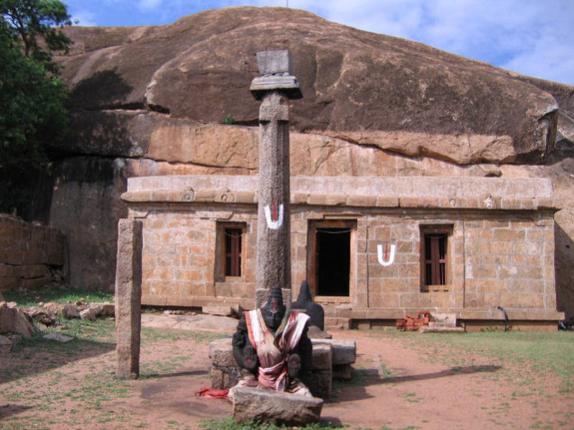
Inside the sanctum are Pundareekaksha, in a standing posture, with the Gandharvas seen performing puja. Malola Narasimha in a sitting posture, Lord Vaikunta Natha with Sridevi and Bhoodevi and Chaturbhuja Hayagriva also in a sitting posture are found inside the sanctum. On the wall are two demons, Madhu and Kaitabha, who threatened to kill Brahma – but were slain in the process. The two Dwarapalakas, Jaya and Vijaya, at the entrance are not conventional sculptures and are more in the form of portrait sculptures.
Legend has it that Diwakara Rishi, who in a fit of rage tried to disrupt the yagna of King Indradyumna, was cursed to lose his powers. He is believed to have undertaken penance here invoking the blessings of Lord Vishnu, who, pleased with the rishi’s sincerity, appeared as Anantha Padmanabhan in the sayana posture and blessed him to get back his lost yogic powers and knowledge. The temple is an abhimana sthalam.
Interesting insights
There are several inscriptions that provide interesting insights about the temple. An eighth Century A.D. inscription refers to Danti Varma Pallava and the Siva temple which is adjacent to the Perumal temple. The structure of the Malayadipatti cave temple and the Lord have similarities to the Sthala Sayana Perumal Divya Desam at Thiru Kadal Malai (Mahabalipuram).
Inscriptions also refer to the renovation undertaken in 960 A.D. by Raja Kesari Sundara Chozhan.
A 16th Century AD inscription relating to the period of Achuthappa Nayaka of Thanjavur refers to gifts of villages and other grants made to this temple describing the Lord as ‘Kan Niraintha Perumal’ and to this place as Thiruvai Malai. Another inscription dating back to the same period refers to the Lord as Thiru Vaazha Vantha Perumal.
The temple appointed a full time Bhattar recently. But for a temple with such rich inscriptions and being part of the select rock cut Perumal temples of Tamil Nadu and given that this has been classified as a heritage monument, it would be good to give both the temple and the village a complete face lift. Accessibility to the temple must also be improved too.