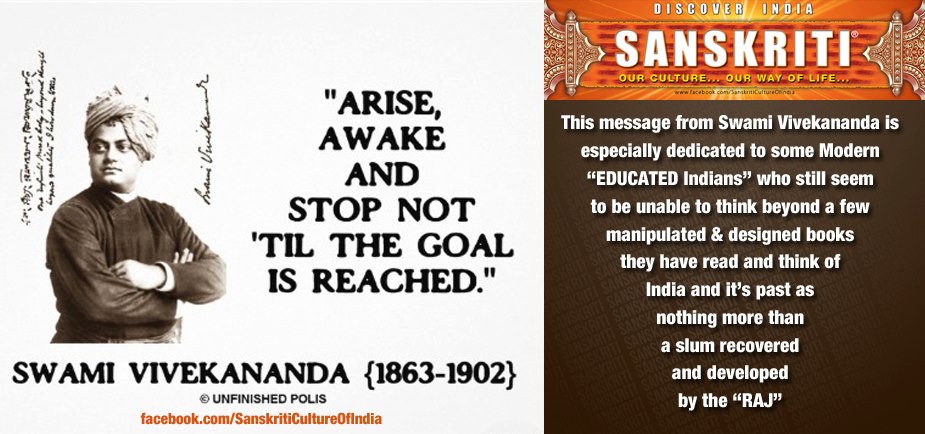
After receiving a few crude comments about how BRITISH “saved and educated” India from “INDIANS” we think it is necessary to address this Issue. We don’t think ourselves qualified enough to comment on such vast topic of discussion so we are posting a small write-up by one of the greatest minds and thinker of India to address this mindset…PLEASE read and SHARE as much as you can!!
“The child is taken to school, and the first thing he learns is that his father is a fool, the second thing that his grandfather is a lunatic, the third thing that all his teachers are hypocrites, the fourth, that all the sacred books are lies! By the time he is sixteen he is a mass of negation, lifeless and boneless…
Out of the past is built the future. Look back, therefore as far as you can drink deep of the eternal fountains that are behind and after that look forward, march forward and make India brighter, greater, much higher than she ever was. Our ancestors were great. We must first recall that. We must learn the elements of our being, the blood, that courses in our veins; we must build an India yet greater than what she has been.
Nowadays everybody blames those who constantly look back to their past. It is said that so much looking back to the past is the cause of all India’s woes. To me, on the contrary, it seems that the opposite is true. So long as they forgot the past, the Hindu nation remained in a state of stupor and as soon as they have begun to look into their past, there is on every side a fresh manifestation of life. It is out of this past that the future has to be molded, this past will become the future.
The more, therefore, the Hindus study the past, the more glorious will be their future and whoever tries to bring the past to the door of everyone, is a great benefactor to his nation. The degeneration of India came not because of the laws and customs of the ancients were bad but because they were not allowed to be carried to their legitimate conclusions.
Study Sanskrit, but along with it study Western sciences as well. Learn accuracy, my boys, study and labour so that the time will come when you can put our history on a scientific basis… The histories of our country written by English writers cannot but be weakening to our minds, for they talk only of our downfall. How can foreigners, who understand very little of our manners and customs, or our religion and philosophy, write faithful and unbiased histories of India? Naturally many false notions and wrong inferences have found their way into them. Nevertheless they have shown us how to proceed making researches into our ancient history. Now it is for us to strike out an independent path of historical research for ourselves, to study the Vedas and Puranas and the ancient annals (Itihasas) of India, and from them make it your sadhana to write accurate, sympathetic and soul-inspiring history of India. It is for Indians to write Indian history.
We must compile some books in Bengali as well as in English with short stories from the Ramayana, the Mahabharata, and the Upanishads etc., in very easy and simple language, and these are to be given to our little boys to read.
… You never cease to labour until you have revived the glorious past of India in the consciousness of the people. That will be the true national education, and with its advancement, a true national spirit will be awakened.”
–Swami Vivekananda