IndianSanskriti
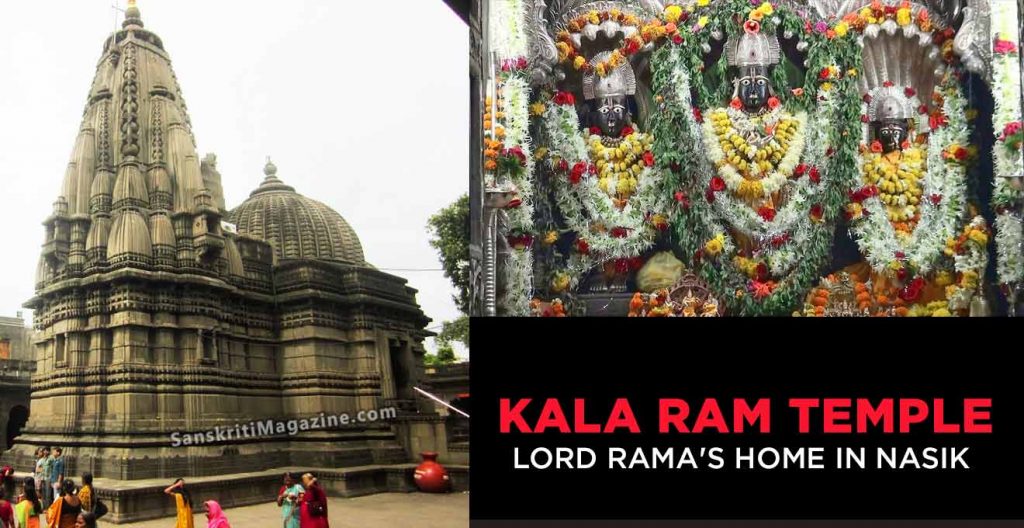
Kala Ram Temple, Lord Rama's Home in Nasik

Kala Ram Temple, Lord Rama’s Home in Nasik

Nasik is an important holy city located approximately five hours northeast of Mumbai. Lord Rama stayed here for some time during his exile, and several pastimes depicted in Sri Ramayana took place here. Every twelve years, the Kumbha-mela is held in Nasik, alternating with the Kumbha-melas held at Allahabad, Haridwar, and Ujjain.

Residing on the banks of the holy Godavari River, which flows to the Bay of Bengal, Nasik is one of the holy dhamas where drops of nectar fell when the demigods and demons fought during the churning of the Milk Ocean. It is said that if one takes sacred bath in the Godavari River while the nectar is falling, he accumulates merit equal to bathing in the Ganges for 60,000 years. Over 3.5 million people attended the 1991 mela. The previous Kumbha-mela in Nasik was held in August-September, 2015.

Nasik is also famous for the pastimes of Lord Rama, the King of Ayodhya, who made Nasik his abode during his 14 years in exile. It is the same place where Laxman, by the wish of Lord Rama, cut the nose of Shurpnakha. Consequently, this place was named “Nasik” (from the Sanskrit word nasika). Also found here are the Sita Gumpha caves, from which Sita was abducted by Ravana.
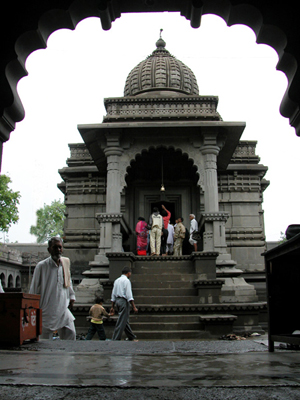
kalaram-mandirThe surrounding area is known as Panchavati in Dandakaaranya (Panchavati is the place in the forest Dandakaranya). Found here is the birthplace of Lord Hanuman, and two of the 12 Shiva temples (Dwadasha Jyotirlingas).

In 150 BC, Nasik was believed to be India’s largest marketplace. From 1487-1818 the city was under Mughal rule, and was known as Gulshanabad (the City of Gardens). The city got its present name in 1818 when the Peshwas got control of the city. The Peshwa rule did not last long, however, as the British captured Nasik the very same year.

Sita-Rama Deities reside in the Sita Gumpha, a small cave by the Kala Rama temple. This is the cave where Ravana abducted Sita. Devotees must crawl into the cave entrance to see the Deities. The nearby Kala (black) Rama Temple is the domicile of the very beautiful Sita-Rama-Lakshman Deities pictured above. A great tower stands over this temple, at a height of 83 feet. — with Srilan Srisukumaran.
You may also like

Search the website

Like us on Facebook

Get daily updates via Email

Enter your email address:

Recent Posts

Purushottam Maas — The Month No Deity Would Claim, and the Lord Who Made It Supreme

Every month of the Hindu calendar has a lord — except the rare thirteenth, the Adhika Maas, born an orphan and shunned as the “impure month.” The Puranas tell how this rejected month went in grief to Bhagavan Vishnu, who claimed it, gave it His own name — Purushottam — and made it the most fruitful month of all. The origin story, the teaching, and what it means for Purushottam Maas 2026 (May 17 – June 14).

Padmini Ekadashi 2026 — The Ekadashi Even the Devas Descend to Keep

Padmini Ekadashi 2026 — The Ekadashi Even the Devas Descend to Keep

The rarest Ekadashi of the entire Hindu calendar is three days away. The Padma Purana preserves a conversation between Bhagavan Krishna and Yudhishthira about a single Ekadashi the great Rishis spend lifetimes waiting for — Padmini. The Vrat Katha of Queen Padmini of Mahishmati, the lotus teaching, and why May 27, 2026 is the morning Vaishnavas across Bharata are preparing for.

Varada Chaturthi 2026 — The Rare Ganesha Day of Purushottam Maas

Varada Chaturthi 2026 — The Rare Ganesha Day of Purushottam Maas

Once every 2.5–3 years — when the rare 13th month of Adhika Maas opens — a thirteenth Vinayaka Chaturthi appears. The Mudgala Purana calls it Varada Chaturthi, the “boon-giving” Chaturthi, and holds it as the most fruit-bearing Ganesha day of the entire calendar. Today, Wednesday May 20, 2026, is that day.

Padmini Ekadashi 2026 — The Rare Ekadashi That Comes Only in Purushottam Maas

Padmini Ekadashi 2026 — The Rare Ekadashi That Comes Only in Purushottam Maas

Padmini Ekadashi 2026 falls on Wednesday, May 27 — the Shukla Paksha Ekadashi of Adhika Maas, the rarest Ekadashi in the entire Hindu calendar (it appears only every 2.5–3 years). The Padma Purana conversation between Bhagavan Krishna and Yudhishthira, the Vrat Katha of Queen Padmini, complete vrat vidhi with jagrana, mantras, and the lotus symbolism that gives the Ekadashi its name.

Ganga Dussehra 2026 — The Day Maa Ganga Came Down to Bhagiratha

Ganga Dussehra falls on Monday, May 25, 2026 — commemorating the day Maa Ganga descended from Vaikuntha to the earth through the millennia-long tapasya of King Bhagiratha. The full account from the Valmiki Ramayana, snan vidhi, dana traditions, mantras, and the teaching of sustained sincerity.

css.php