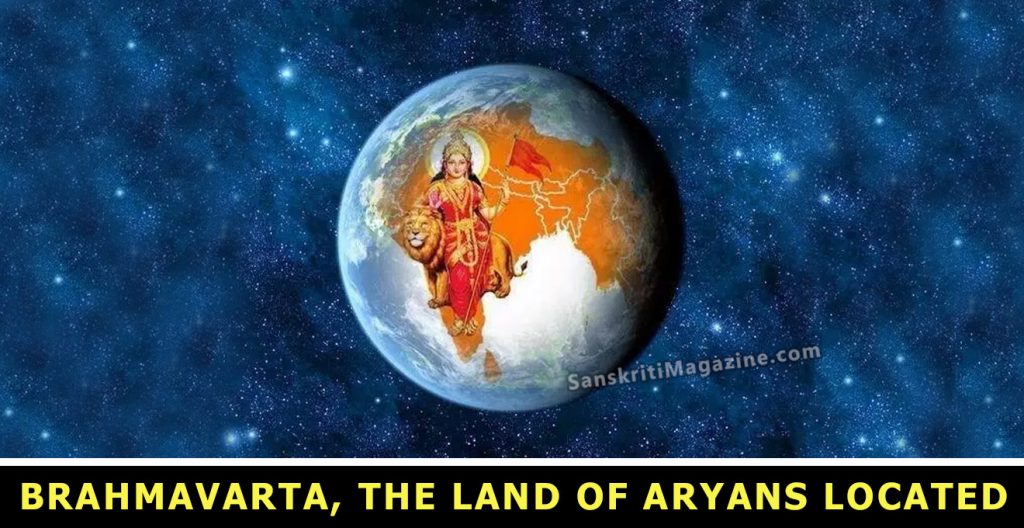
For centuries Aryans living in India were told by British that Aryans had invaded India, were nomadic from central Asia and captured north India 2000 to 3000 years ago pushing the locals to south India. They were also told that the Aryans had brought their culture along with their Vedic scriptures from abroad. But now with the location of the route of the Harappan Saraswati river which had flown some 5000 years ago and proof of habitations around them, the theory of ‘Aryan Invasion’ is proved baseless.
However, the moot question that still lingers on is “Which is the original place of Aryans and site of compilation of all important ancient Sanskrit scriptures such as Vedas and Upanishads; in other words the state called Brahmavarta”
A research organisation based at Rewari in Haryana, ‘Brahmavarta Research Foundation’, in collaboration with INTACH, has released a map of ‘Brahmavarta’ the original land of Aryans, and Bharatas. This was the Vedic state where Rishis of those times conceived and compiled the Vedic philosophies prevalent at that time and composed the scriptures after the last ice-age floods, some 10000 years ago.Scriptures were transmitted orally to next generations for centuries before jotting down.
The map is prepared on the basis of description of Brahmavarta given in various Vedic scriptures and additionally based on location of the Ashrams of the Vedic seers who contributed to the works of Vedas and Upanishads. The area has ‘roots’ of Vedic Sanskriti and Spiritualism that is important part of present day Hinduism. Research has scientific support of satellite images, paleo-botanical, geo-morphological and metallurgical studies, weather reports, seismic activities and Ayurvedic preparations among others, covering that period.
Fact remains that for many centuries, flood time Saraswati and Drishadwati rivers that had flown 10,000 years ago during Manu’s period and formed the boundaries of Vedic state of Brahmavarta as per scriptures could not be located. There are reasons for that.
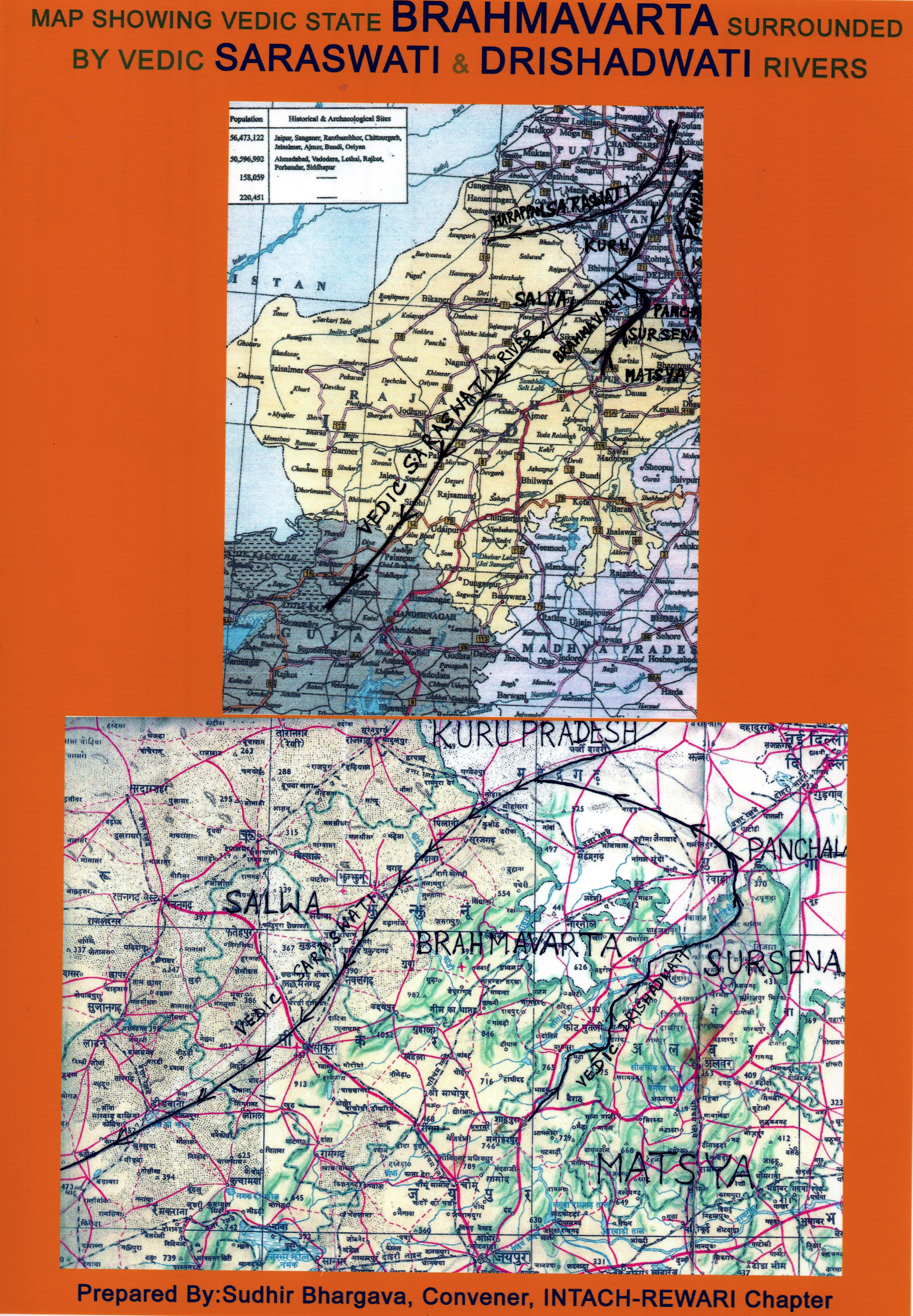 Incorrect identification of Drishadwati River by Alexander Cunningham the first Director General of Archaeological Survey of India, about a hundred and fifty years earlier to this day further complicated the matter. Now that the satellite images of paleo-channels of these rivers and several scientific evidences from different sciences are available, these corroborate the descriptions that are a part of scriptures like Manusmriti, Rigveda, Mahabharata, Shatapath Brahmana, Puranas and Upanishads. These inputs facilitate efforts to draw the boundaries of the all important Vedic state of Brahmavarta.
Area also shows the continuity of Vedic knowledge and rituals being adopted and followed by the old and present generations of Hindus since 10,000 years. Major exodus of people from Brahmavarta to different parts of India and abroad had occurred after the seismic activities in the region some 6500 years ago, when many rivers in north India changed their courses.
These findings also negate the theories perpetuated by western indologists that modern Hindus are different from the Vedic people. Ashrams in the area need excavations and further research to unearth the mysteries of Vedic times. Visit to some Ashrams in Brahmavarta reveal that Vedic seers who contributed to Upanishads and described Atma and Param Atma had significant knowledge about human brain. Interestingly these seers, in the scriptures gave maximum respect to those involved in jobs that called for use of the mental faculty.
Foundation has requested the Govts at Centre, and the states of Haryana and Rajasthan to develop this area for promotion of Vedic tourism. The site of Brahmavarta has the appealed of being the original place of the ‘Spiritual Heritage’ of India.
There is need to save the ancient Ashrams in this area, and particularly those in the Dhosi Hill, the Chyavan Rishi’s ashram, known for ‘Chyavanprash’, the popular Ayurvedic health related formulation. Chyavan Rishi’s ashram, that finds mention in Sanskrit scriptures, has been the centre of many activities during early Vedic period.
Attachments;
- Map of India showing Vedic state Brahmavarta between Vedic Saraswati and Drishadwati rivers
- Satellite images of palaeo-channels of Saraswati and Drishadwati rivers b) Close-up of Brahmavarta with Vedic states of that period surrounding it.
Sudhir Bhargava 01-01-2017
sudhirkbhargava@gmail.com #9416064894
Convener – Brahmavarta Research Foundation, Rewari, HRY
Convener – INTACH-Rewari Chapter