IndianSanskriti
Bhut Jolokia - One of World's Hottest Chilli

Bhut Jolokia – One of World’s Hottest Chilli

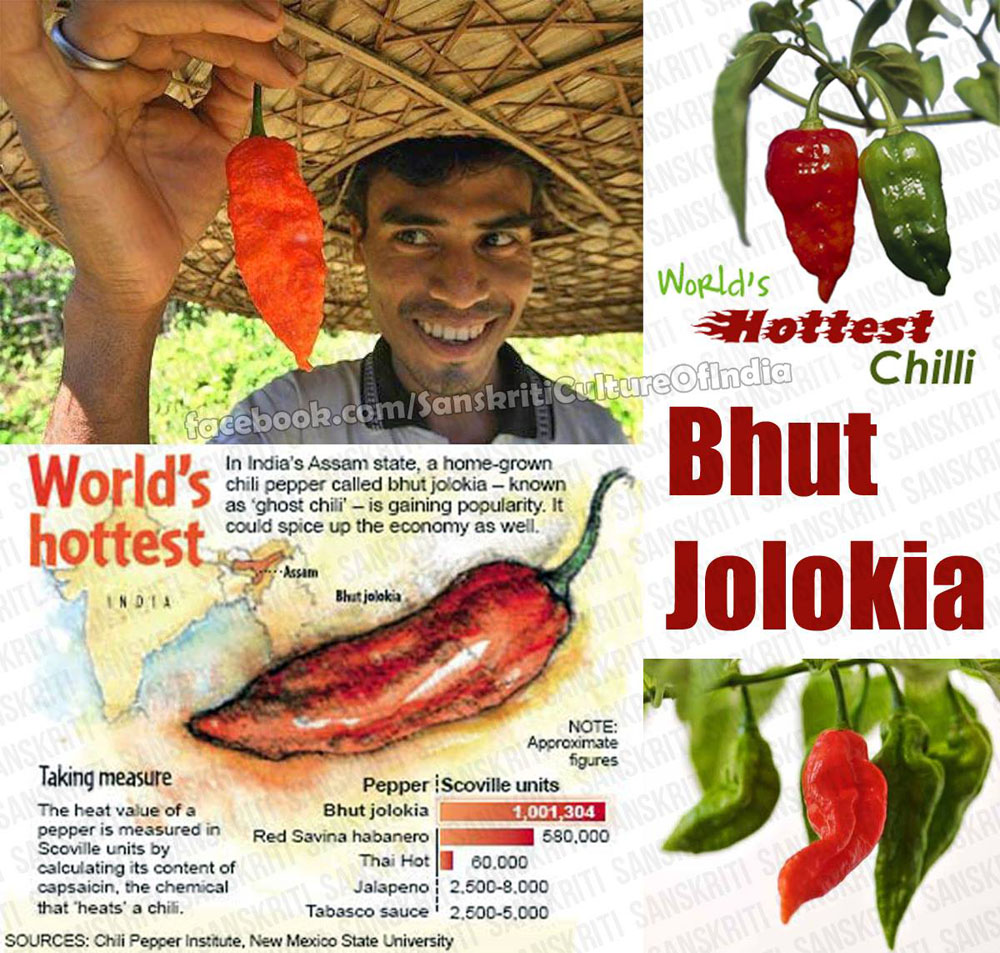
The Naga Jolokia Chili Pepper is also known as Bhut Jolokia, Ghost Chili, Ghost Pepper or Naga Morich – this is a chili pepper recognized as the hottest in the world. In 2007, the Guinness World Records held it to be the hottest chili, replacing the Red Savina strain of habanero chili. It is a naturally occurring interspecific hybrid originating from the northeast of India, particularly Assam, Nagaland and Manipur.

The name Naga Jolokia means in English (King Cobra Chili) due to the extreme heat of the Chili being compared to the deadly poison in the venomous snake, Bhut translated into English is ghost and is probably used as a name to its ghostly bite.

In 2000, India’s Defence Research Laboratory (DRL) reported a rating of 855,000 units on the Scoville scale, and in 2004 a rating of 1,041,427 units was made using HPLC analysis.

One seed from a Bhut Jolokia (Hottest Chilli in the World) can sustain intense pain sensations in the mouth for up to 30 minutes before subsiding. Ripe Bhuts measure 60 mm (2.4 in) to 85 mm (3.3 in) long and 25 mm (1.0 in) to 30 mm (1.2 in) wide with an orange or red color.

The pepper is used as a cure for stomach ailments. It is also used as a spice as well as a remedy to summer heat, presumably by inducing perspiration in the consumer. In northeastern India, the peppers are smeared on fences or incorporated in smoke bombs as a safety precaution to keep wild elephants at a distance.

In 2009, scientists at India’s Defence Research and Development Organisation announced plans to use the chillies in hand grenades, as a less lethal way to control rioters.

However, current hottest chilli is the Trinidad Scorpion “Butch T” which was grown by The Chilli Factory (Australia) and rated at 1,463,700 Scoville Heat Units (SHU) according to tests conducted by EML Consulting Services in Morisset, New South Wales, Australia, on 1 March 2011. The chilli is of the Capsicum genus and a hybrid of the Chinese and frutescens species.


You may also like

Search the website

Like us on Facebook

Get daily updates via Email

Enter your email address:

Recent Posts

Purushottam Maas — The Month No Deity Would Claim, and the Lord Who Made It Supreme

Every month of the Hindu calendar has a lord — except the rare thirteenth, the Adhika Maas, born an orphan and shunned as the “impure month.” The Puranas tell how this rejected month went in grief to Bhagavan Vishnu, who claimed it, gave it His own name — Purushottam — and made it the most fruitful month of all. The origin story, the teaching, and what it means for Purushottam Maas 2026 (May 17 – June 14).

Padmini Ekadashi 2026 — The Ekadashi Even the Devas Descend to Keep

Padmini Ekadashi 2026 — The Ekadashi Even the Devas Descend to Keep

The rarest Ekadashi of the entire Hindu calendar is three days away. The Padma Purana preserves a conversation between Bhagavan Krishna and Yudhishthira about a single Ekadashi the great Rishis spend lifetimes waiting for — Padmini. The Vrat Katha of Queen Padmini of Mahishmati, the lotus teaching, and why May 27, 2026 is the morning Vaishnavas across Bharata are preparing for.

Varada Chaturthi 2026 — The Rare Ganesha Day of Purushottam Maas

Varada Chaturthi 2026 — The Rare Ganesha Day of Purushottam Maas

Once every 2.5–3 years — when the rare 13th month of Adhika Maas opens — a thirteenth Vinayaka Chaturthi appears. The Mudgala Purana calls it Varada Chaturthi, the “boon-giving” Chaturthi, and holds it as the most fruit-bearing Ganesha day of the entire calendar. Today, Wednesday May 20, 2026, is that day.

Padmini Ekadashi 2026 — The Rare Ekadashi That Comes Only in Purushottam Maas

Padmini Ekadashi 2026 — The Rare Ekadashi That Comes Only in Purushottam Maas

Padmini Ekadashi 2026 falls on Wednesday, May 27 — the Shukla Paksha Ekadashi of Adhika Maas, the rarest Ekadashi in the entire Hindu calendar (it appears only every 2.5–3 years). The Padma Purana conversation between Bhagavan Krishna and Yudhishthira, the Vrat Katha of Queen Padmini, complete vrat vidhi with jagrana, mantras, and the lotus symbolism that gives the Ekadashi its name.

Ganga Dussehra 2026 — The Day Maa Ganga Came Down to Bhagiratha

Ganga Dussehra falls on Monday, May 25, 2026 — commemorating the day Maa Ganga descended from Vaikuntha to the earth through the millennia-long tapasya of King Bhagiratha. The full account from the Valmiki Ramayana, snan vidhi, dana traditions, mantras, and the teaching of sustained sincerity.

css.php