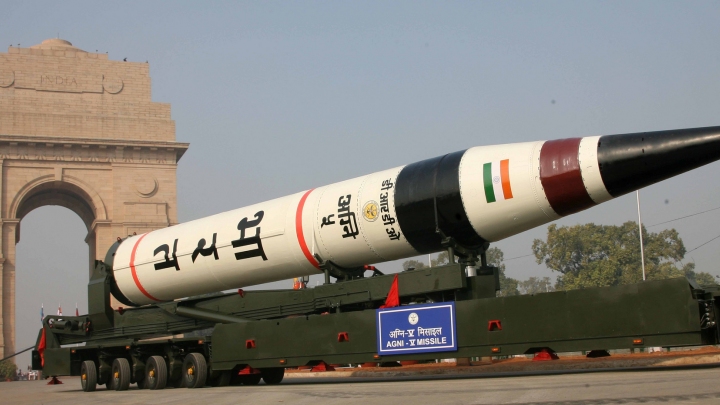
Bhubaneswar: India on Monday successfully test-fired its indigenously developed intercontinental surface-to-surface nuclear capable ballistic missile Agni-V from the Abdul Kalam Island off the Odisha coast in Balasore district.
This is the fourth and final test of the missile, developed and successfully tested by the Defence Research and Development Organisation (DRDO) under the Integrated Guided Missile Development Programme.
It was launched around 11.05 a.m. from a mobile launcher complex-4 of the Integrated Test Range (ITR), defence sources said.
“We are analysing the test launch after collecting information from radars. The report suggests it is a successful launch,” said an official source.
On January 31, the canisterised version of the missile was successfully test fired.
The Agni-V missile, in its operational form is designed to be stored and launched from the canister, enhancing its storage, operational readiness, transportability, response time and shelf life.
The missile employs Ring Laser Gyro-based Inertial Navigation System (RINS) and Micro Navigation System (MINS) for navigation, which support the missile to reach the target point within a few metres of accuracy.
With the success of the final development test, Agni-V is now ready for the induction into the strategic arsenal of India.
President Pranab Mukherjee congratulated the Defence Research and Development Organisation (DRDO) for the successful launch.
“Congratulations DRDO for successfully test firing Agni-V. It will enhance our strategic and deterrence capabilities,” Mukherjee said in a tweet.
“Successful test firing of Agni-V makes every Indian very proud. It will add tremendous strength to our strategic defence,” Prime Minister Narendra Modi also tweeted.
The Inter-Continental Ballistic Missile (ICBM) Agni-V has the capability to strike targets anywhere in all of Asia and parts of Africa and Europe.
Agni-V is one of the most advanced missiles, which is capable of striking a target more than 5,000 km away. It is about 17 metres long, 2-metre wide and has launch weight of around 50 tonnes.
The missile can carry a nuclear warhead of more than one tonne.
Once the Agni-V is inducted in the Indian military, India would join the super exclusive club of countries with ICBMs alongside the US, Russia, China, France and Britain.
The first test of Agni-V was conducted on April 19, 2012, while the second test was launched on September 15, 2013.