IndianSanskriti

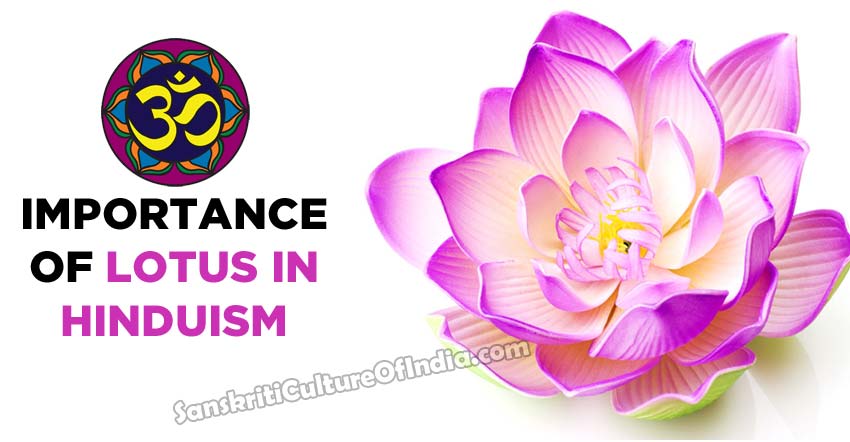
Importance of lotus in Hinduism

In Hindu spiritual contemplation the lotus has a special place. It is not only considered pure and beautiful, but also a symbol of goodwill, peace, prosperity and happiness. It helps get rid of unpleasant things and is referred to as the king of flowers.

According to the Puranas, it is said that a lotus emerged from the navel of Lord Vishnu. Brahma was seated on the lotus. Thereafter, he proceeded to create mankind. Brahma, Saraswait, Lakshmi and other Gods and Goddesses have used the lotus as a seat. When it was important to them, could it be any less to others?

The symbol of Lakshmi and prosperity, it is customary to offer the lotus in prayer to several Gods. In many instances, the number of flowers to be offered is also mentioned as a condition for conducting certain yagyas and ceremonies.

The lotus grows in mud and water, yet it is untouched or affected by either of them. This quality motivates one to live a life and is symbolic of the fact that undesirable elements can be refined and converted into superior and useful items. The blossoming of the lotus is considered auspicious and blesed.

Temples are given the shape of a closed lotus bud. The shape of the eart too is similar to a closed lotus flower. To awaken the kundalini, yogis suggest the division of the eight discs into sections. Each division is referred to as a kamal (lotus). Only through this division can one attain knowledge of Brahman.

In the Shatpat Brahman, the forepart of the uterus in a woman has been equated with the lotus. Both are symbols of creation. In the Lalit Vistar Granth, Buddhists have equated the lotus to a combination of eight important things. It is indeed a unique flower and Hindu religious texts have given it an extraordinary place for use as an offering to God.

~ Prem Bhalla

You may also like

Search the website

Like us on Facebook

Get daily updates via Email

Enter your email address:

Recent Posts

Jamai Shashthi 2026 — The Story of Maa Shashthi, the Cat, and the Wife Who Was Forgiven

Jamai Shashthi 2026 — The Story of Maa Shashthi, the Cat, and the Wife Who Was Forgiven

On Saturday, June 20, 2026, Bengali households across Bharata will welcome their married daughters and sons-in-law home for the legendary jamai-aador feast and perform the Shashthi Vrata. But behind the warmth lies a story most Bengalis know by heart and most non-Bengalis have never heard — the wife who stole the hilsa, blamed the cat, lost six sons to Maa Shashthi’s wrath, and was finally forgiven. The Vrat Katha, the vidhi, the mantras, and the deeper teaching.

Vat Purnima 2026 — The Wife Who Argued Yama Into Returning Her Husband’s Life

On Monday, June 29, 2026, women across Maharashtra, Gujarat, and southern Bharata will tie red thread around banyan trees and hear the story of Savitri — the wife who walked behind Yamaraja Himself when He came for her husband, and out-argued the Lord of Dharma into returning Satyavan’s life. The Mahabharata’s Pativrata Mahatmya Parva, the vrat vidhi, and why the banyan witnessed everything.

Purushottam Maas — The Month No Deity Would Claim, and the Lord Who Made It Supreme

Every month of the Hindu calendar has a lord — except the rare thirteenth, the Adhika Maas, born an orphan and shunned as the “impure month.” The Puranas tell how this rejected month went in grief to Bhagavan Vishnu, who claimed it, gave it His own name — Purushottam — and made it the most fruitful month of all. The origin story, the teaching, and what it means for Purushottam Maas 2026 (May 17 – June 14).

Padmini Ekadashi 2026 — The Ekadashi Even the Devas Descend to Keep

Padmini Ekadashi 2026 — The Ekadashi Even the Devas Descend to Keep

The rarest Ekadashi of the entire Hindu calendar is three days away. The Padma Purana preserves a conversation between Bhagavan Krishna and Yudhishthira about a single Ekadashi the great Rishis spend lifetimes waiting for — Padmini. The Vrat Katha of Queen Padmini of Mahishmati, the lotus teaching, and why May 27, 2026 is the morning Vaishnavas across Bharata are preparing for.

Varada Chaturthi 2026 — The Rare Ganesha Day of Purushottam Maas

Varada Chaturthi 2026 — The Rare Ganesha Day of Purushottam Maas

Once every 2.5–3 years — when the rare 13th month of Adhika Maas opens — a thirteenth Vinayaka Chaturthi appears. The Mudgala Purana calls it Varada Chaturthi, the “boon-giving” Chaturthi, and holds it as the most fruit-bearing Ganesha day of the entire calendar. Today, Wednesday May 20, 2026, is that day.

css.php