IndianSanskriti
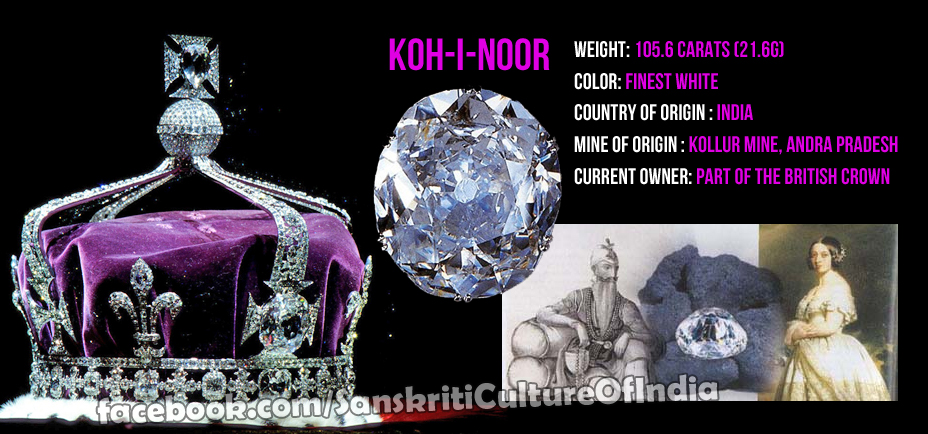
Kohinoor

Koh-i-noor – Mountain of Light!

Once known as the largest diamond in the world, the Koh-i-noor is a 106 carats diamond. Previously it had belonged to various rules in India but today lies in the hands of the British royal family and is part of the Crown Jewels.Legend has it that Koh-i-noor is 5000 years old and is the Syamantaka jewel that is referred to in Sanskrit writings. This jewel is supposed to have originally belonged to the Sun god, who wore it around his neck. It is said that any land it that possessed it would never encounter any calamities in the form of natural disasters and would always be full of prosperity and plenitude.

Current name of the diamond, Koh-i-noor is in Persian and means `Mountain of Light`. Up until 1304, the diamond was in the possession of the Rajas of Malwa but was not called by its current name.

First document that verifies the existence of Koh-i-noor dates back to 1526 when it came into the possession of the Indian conquerer, Babur, mentioning the previous ownership by the Raja of Gwalior in the 13th century.

The diamond continuously changed hands between Indian and Persian rulers as they fought bitter battles throughout history.
The diamond ended up being mounted on the Mughal throne of India – the Peacock Throne. It is said that when Shah Jahan , the ruler who commanded the building of this throne and the Taj Mahal, was imprisoned by his son, that he could only ever see the Taj Mahal again through the reflection of this diamond.

The diamond once again was lost to India when it was stolen to Nadir Shah and made its way to Persia in 1739, again making its way back to Punjab in 1813 when Shuja Shah Durrani, the deposed ruler of Afghanistan, took it to India and made a deal to surrender the diamond in exchange for help in winning back the Afghan throne.

The diamond was 186 carats before the British acquired it by conquering Punjab and the stone was given to Queen Victoria by the then British Colonial Governor-General of India. Prince Albert carefully searched for a diamond cutter and gave the missions to a certain Mr. Cantor in Netherlands, who began the difficult task of cutting it which took 38 days to accomplish. Cut into an oval shape, the diamond lost its lustre and was reduced to its current form and weight of 108.93 carats. Apparently, Prince Albert wasn`t too happy with the end results.

The Koh-i-noor was mounted on the Royal Crown along with over 2000 other diamonds.

There is apparently a curse on the diamond that affects all men who wear it but women are immune. The Crown was used by Queen Victoria, Queen Alexandra, Queen Mary and Queen Elizabeth and is only worn by the female members of the British Royal Family as per Queen Victoria`s last will and testament.
Both India and Pakistan each claim the diamond be handed back to them by the British. However, as of February 21, 2013 British Prime Minister refused to hand it over, saying `I certainly don`t believe in “returnism”, as it were. I don’t think that’s sensible`.
The Crown is currently on display at the Tower of London and it looks like it is going to remain there indefinitely.
You may also like

Search the website

Like us on Facebook

Get daily updates via Email

Enter your email address:

Recent Posts

Jamai Shashthi 2026 — The Story of Maa Shashthi, the Cat, and the Wife Who Was Forgiven

Jamai Shashthi 2026 — The Story of Maa Shashthi, the Cat, and the Wife Who Was Forgiven

On Saturday, June 20, 2026, Bengali households across Bharata will welcome their married daughters and sons-in-law home for the legendary jamai-aador feast and perform the Shashthi Vrata. But behind the warmth lies a story most Bengalis know by heart and most non-Bengalis have never heard — the wife who stole the hilsa, blamed the cat, lost six sons to Maa Shashthi’s wrath, and was finally forgiven. The Vrat Katha, the vidhi, the mantras, and the deeper teaching.

Vat Purnima 2026 — The Wife Who Argued Yama Into Returning Her Husband’s Life

On Monday, June 29, 2026, women across Maharashtra, Gujarat, and southern Bharata will tie red thread around banyan trees and hear the story of Savitri — the wife who walked behind Yamaraja Himself when He came for her husband, and out-argued the Lord of Dharma into returning Satyavan’s life. The Mahabharata’s Pativrata Mahatmya Parva, the vrat vidhi, and why the banyan witnessed everything.

Nija Jyeshtha 2026 — The Real Jyeshtha Begins, and the Calendar Resumes

Nija Jyeshtha 2026 — The Real Jyeshtha Begins, and the Calendar Resumes

With Adhik Maas now closed on the Somvati Amavasya of June 15, the long-postponed festivals of Jyeshtha return — Vat Purnima (June 29, the Savitri-Yamaraja katha), Jamai Shashthi (June 20, the Bengali festival of Maa Shashthi), Sankashti Chaturthi (June 28), Yogini Ekadashi (July 10), and Devshayani Ekadashi (July 16, opening the four-month Chaturmas of Bhagavan Vishnu’s yoga-nidra). A guide to what the next four weeks hold and what the household that kept Purushottam Maas now carries forward.

The Closing of Purushottam Maas 2026 — Adhik Amavasya and the Sealing of the Month-Long Vrat

On Monday, June 15, 2026 — a rare Somvati Amavasya — the intercalary month that bears Bhagavan Vishnu’s own name comes to its close. The Acharyas teach that a vrat is not measured by its duration but by its closing. Here are the Padma Purana’s instructions for sealing the month-long Purushottam Maas vrat: the morning snan, the closing puja with the Vishnu Sahasranama, the day of dana, the Somvati Amavasya gift, and the final sarva-arpana — the offering of all merit at the feet of the Lord.

Parama Ekadashi 2026 — The Other Rare Ekadashi of Purushottam Maas, and the Poor Brahmin Who Kept It

Two weeks ago, Vaishnavas across Bharata kept Padmini Ekadashi — the rare Shukla Paksha Ekadashi of Adhik Maas. Padmini has a twin. On Thursday, June 11, 2026, the Krishna Paksha Ekadashi of the same intercalary month appears: Parama — the Supreme Ekadashi. The Padma Purana names it the rarer and more secret of the two, and reserves it for those whose poverty or sorrow has refused to lift in spite of every other vrat already kept. The story of Sumedha and Pavitra of Kampilya, the rishi Kaundinya, the prince sent by Bhagavan Brahma — and the vidhi for the day.

css.php