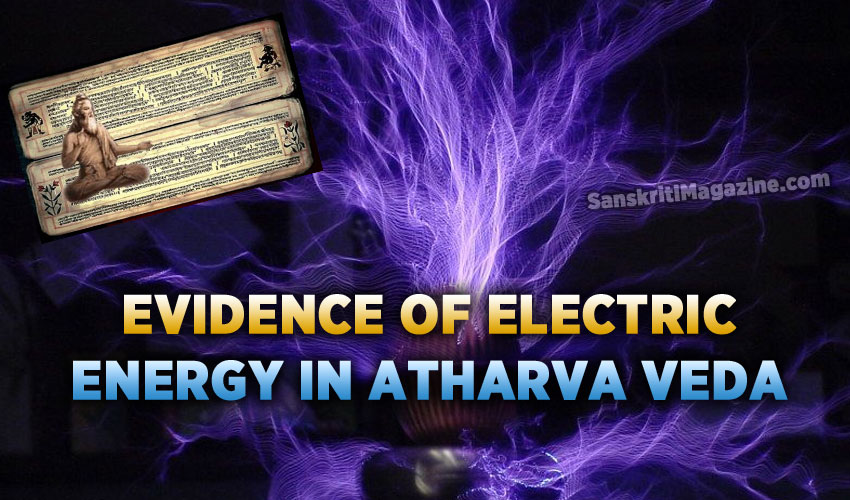
Electricity and energy can be used in daily life apart from military usage and this was described in Atharvana Veda. General impression created about this 4th Veda is that it is only used for designing and usage of weapons in warfare, or used as a manual for ‘black and white magick‘ in ancient india.
But, it can be utilized in many useful applications such as creation of powerful engines, illumination, agricultural machinery, hydroelectric power plants, manufacturing plants, biomedical engineering, extraction of medicines, etc. and thus serve to greatly enhance the quality of our daily lives.
Chapter 1: Hymn VII
Verse 2: Nav Yo Navati Puro bibhed bahvotjasaa
Ahi Cha vritrahaavadheet
Translation: Electricity, which breaks, by the energy of its arms the 99 cities, destroys the cloud, which covers the rays of the sun, the source of all energy and power.
Verse 3: Sa na Indrah Shivah sakhashwavad gomadvavama
Urudhaarev dohate
Translation: That very electric power may be our peaceful friend, providing us with the horse-power to drive our machines, light to light up our houses, and power to produce grains in the fields. Let it bring on prosperity and well-being for us by flowing into numerous currents.
Verse 4: Indra Kratuvidang sutang somang harya purushtut
Piba vrishaswa taatripim
Let electricity, so highly spoken of by many learned people, help extract the essence of medicines, thus produced by those, who are well-versed in manufacturing things. Let it keep safe and shower, on us the rain, satisfying all.
Chapter 3 :Hymn XXXI
Verse 1: Taa Vajrinam Mandinam Stomyam mad indram rathe vahato haryataa haree
Purunyasmay savanaani haryata indraaya somaa harayo dadhanwire
Translation: Those two speedily moving forces of attraction and repulsion propel the electric current, powerful like the thunderbolt, pleasant and praiseworthy, in this pleasant plane or car. Manifold are the generating powers for the refulgent electricity borne by speedy moving Somas – various kinds of liquid fuels.
Verse 2: Arang Kaamaay Haryo dadhanwire sthiraay hinvanharayo Haree tura
Arvadbhiyor Haribhijorshameeyate so asya kaamam harivantamaanashe
Translation: The above mentioned speedy forces of two kinds set in motion strong currents, capable of maintaining steady progress in the attainment of one’s objective in plenty. Whatever complex is attained by these fast moving horsepowers, is enough to achieve the beautiful objective of his, the manufacturer.
Chapter 2: Hymn XV
Verse 2: Adha te vishwamanu haasadishtaya aapo nimneva savanaa havishmatah
Yatparvate na samasheeta haryata indrasya vajrah shnathita hiranyayah
Translation: Just as all productive works of the manufacturer depend upon waters flowing down with speed, so do all the desired objects of him depend upon you (Electricity), as its powerful striking force cannot be obstructed by any cloud, or mountain in the way. It smashes all impediments, with its radiant energy.
Verse 3: Asmay Bheemaaya namasaa samadhwara usho na shubhra aa bharaa paneeyase
Yasya dhaam shravase naamendriyam jyotirkaari harito naayase
Translation : O well-versed engineer make use of this terrible electric power fit to be utilized for useful purposes by controlling it, for non-violent, brilliant light like the dawn. It has the potentiality to help hearing, control energy and spread light in all quarters.
Military / Warfare usage of Electrical Energy in Atharva Veda
Chapter 2: Hymn XV
Verse 6: Twam tamindra parvatam mahaamurum vajrena vajrinparvshashchakartitha
Avaasrijo nivritaah satarvaa apah satraa vishwam dadhishe kevalam sahah
Translation: Just as the thundering electricity reduces the vast cloud to nothing by its thunderbolt, so do you, O King, equipped with piercing weapons like the thunderbolt, smash into pieces the vast armies of the enemy, consisting of various units, by your striking power like the thunderbolt. Just as the waters of the cloud released by the electricity, fall down and flow over the earth, similarly the well-equipped armies of the enemy; being subdued by the might of the king are duly regulated by him. Truly do you alone, O King, hold all the power to subdue the foes.
Verse 5: Indra Idhyorah sacha sangmishal aa vachoyuja
Indro vajri Hiranyah
Translation: Electricity is well mixed up with Prana and Apana, the 2 horsepowers, yoked to power of speech. Electric power has the striking power of a deadly weapon and is full of brilliance.
Verse 1: Pra te mahe vidathe shansisham hari pra te vanve vanusho haryatam madam
Dhritam na yo haribhishcharu sechat aa tva vishantu harivparsang girah
Translation: O electricity, I fully praise thy two forces of protection and destruction in this great universe, which is a great sacrificial place or battlefield of life. I highly cherish your beautiful exhilaration, destroying the evil forces of the enemy. You shower various forms of fortunes through your blessing powers of speedy action, like waters from the clouds. Let all praises find their abode in you of charming splendor.
Verse 3: So asya vajro harito ya aayso harinirkaamo harira gabhastyoh
Dhumni sushipro harimanyusayaka indre ni roopa harita mimikshire
Translation: Here is the blue-green colored thunderbolt of iron of the king. There is also the beautiful horse of iron of high speed. Here is also the horsepower of the rays of electricity. There is also the shining arrow, capable of destroying the pride of the enemy and having a very high speed. In short many kinds of weapons have been made through electric power for the king.
Verse 4: Divi na keturadhi dhaayi haryato vivayachadvajro harito na ranghaya
Tudadahi harishipro ya aayasah sahastrashokaa abhavadharibharah
Translation : Like a radiant spot, it is well placed in the heavens, then with a high speed, the terribly destructive missile, made of iron, possessing speed of electric power, crushing the serpent natured enemy, becomes lit up with thousands of lights and loaded with destructive ray of various kinds.
Chapter 3: Hymn:XXI
Verse 7: Yudha yudhmup ghedeshi dhrishnuya pura puram samidam hansyojasa
Namya yadindra sakhya paraavati nibrahyo namuchi naam maayinam
Translation: O mighty King, you can easily get at the striking power of the enemy by your overwhelming striking force. Being well-entrenched in your sheltered place of defense, you can thoroughly break the defenses of the enemy to smithereens. Completely crush the deceitful enemy, unfit to be left alive, through your faithful ally, although stationed at a distance.
Verse 8: Tvam karnyajmut parnayam vadhistejisthayaatithigvasya vartani
Tvam shata vaddagridasyaabhintpuronaanudah parishuta rijishvana
Translation: O mighty electricity, you kill the violent enemy, equipped with speedy means of communication like cars or airships, a hindrance in the way of people who are worthy of respect, cows or land by your consuming and splendorous power. You shatter the 100 forts of the adversary who obstructs your communications or breaks your regulations and does not pay tribute to you established by straightforward negotiations.
Verse 9: Tvametam janrajyo dwidarshaabandhuna sushrvasopajagmushah
Pashisht sahastra navati nava shruto ni chakrena rathya dushpadavrinak
Translation: O electricity, you can by your circular motion like the wheel of a chariot, which is too powerful to be checked, well keep under control all these 20 basic elements, 6099 organic and inorganic bodies, by a single transmitter of high quality, with no other force to help it.
Verse 10: Tvamaavitha sushravasam tavotibhistava traambhirindra tuvrayaanam
Tvamasmay kutsamatithigvamaayum mahe raagye yoone arndhanaayah
Translation: O electricity, you keep in safety this good listening set, by your means of safety and protect the commander, with speedy mobile forces by your strong means of defense. You control the sharp weapons, equipped with the striking power of limitless time and speed for this great, youthful king.
Chapter 4: Hymn XXXVII
Verse 4: Tvam nibhinirmano devavitao bhooreeni vritraa haryashava hansi
Tvam ni dasyum chumuri dhuni chasvaapyo dabhitaye suhantu
Translation: O electrical currents of high voltage, safely carried by electric wires, you kill many enemies in the war, waged by learned persons or through the help of natural forces. To keep all the evil forces under control, you, being well-equipped with good means of destruction completely lay down to lasting sleep (death) the evil forces that rob and harass the general public.
There are many more such references to electricity and its potential usage mentioned in Atharva Veda and this proves that ancient seers in india knew much more than what modern scientsts know.
Atharva Veda was spread by travellers towards west during past 2000 years and most of its knowledge now lies in Europe.
~ Excerpts taken from Atharva Veda by Devi Chand