Matsyagandhi, the Fisher Princess
Sadhguru: Once, Uparichara, the king of Chedi, was in the forest, hunting for weeks on end. During this time, he begot a child upon a fisher girl. She delivered twins, who were named Matsyaraja and Matsyagandhi. The king took the boy with him and left the girl with the fisherfolk. Living among the fisherfolk, she was known as Matsyagandhi, which means “smelling of fish.”
Matsyagandhi grew up into a dark, dusky woman. The chief of the fisherfolk, who was known as Dasa, had brought her up well. Once, the ashram of Parashara – a man of immense knowledge and a realized being – was attacked and he was injured to a point where his leg was very badly hurt. He managed to escape somehow, and with great effort made his way to a small island where the fisherfolk lived. Seeing his condition, the fisherfolk took him in. He was placed under the care of Matsyagandhi.
She was naturally drawn to him because he was such a towering personality of immense knowledge and wisdom. All the time, she had been struggling within herself because her twin brother was living in the palace, and she was living among fisherfolk. She thought if she associated with the sage, she may get somewhere. They lived on a small island in the river and she bore him a son. Because he was born on an island, he was called Dwaipayana. And because he was dark, he was called Krishna. Later on, Krishna Dwaipayana came to be known as Veda Vyasa, the compiler of the Vedas, who also told the story of Mahabharat.
Parashara took the boy and went away. Before he left, he gave Matsyagandhi the boon that the fishy smell went away and she got a heavenly fragrance that no human being had ever smelt before. She smelt like a flower that did not belong to this world. Because of this phenomenal fragrance, they changed her name to Satyavati, “smelling of truth.” And this became her attraction.
Shantanu Begs to Marry Satyavati
One day, Shantanu looked at this woman and fell in love with her. He went to Satyavati’s father and asked for her hand in marriage. When Dasa, the chief of the fisherfolk, still a little king in his own right, saw the emperor begging for his foster daughter’s hand, he thought this was a good time to make a deal. He said, “I would be willing to give you my daughter in marriage only if her children will become the future kings of the Kuru Dynasty.” Shantanu said, “That is not possible. I have already crowned my son Devavrata. He is the best king that the Kuru Kingdom can have.”
The wily fisherman looked at the king, saw he was hopelessly in love, and said, “Then forget about my daughter.” Shantanu begged him. The more he begged, the more the fisherman realized he had him on the hook. Time to draw in the big fish. He said, “It’s up to you. If you want my daughter, her children should become the future kings. Otherwise, go live happily in your palace.”
Shantanu went back to the palace – once again depressed. He could not get Satyavati off his mind. Her fragrance invaded him in such a way that once again, he lost interest in the affairs of the kingdom, and simply sat around. Devavrata looked at his father and said, “Everything is going great in the kingdom. What is it that is bothering you?” Shantanu just shook his head and put it down in shame, unable to tell his son what the matter was.
The dutiful son that he was, he went to the charioteer who took Shantanu hunting and asked him, “Ever since this hunt, my father is not the same man. What happened to him?” The charioteer said, “I don’t know what exactly happened. I took him to this fisherfolk chief’s house. Your father walked into the house as a king, with great enthusiasm, full of love. When he walked out, he was like a ghost.”
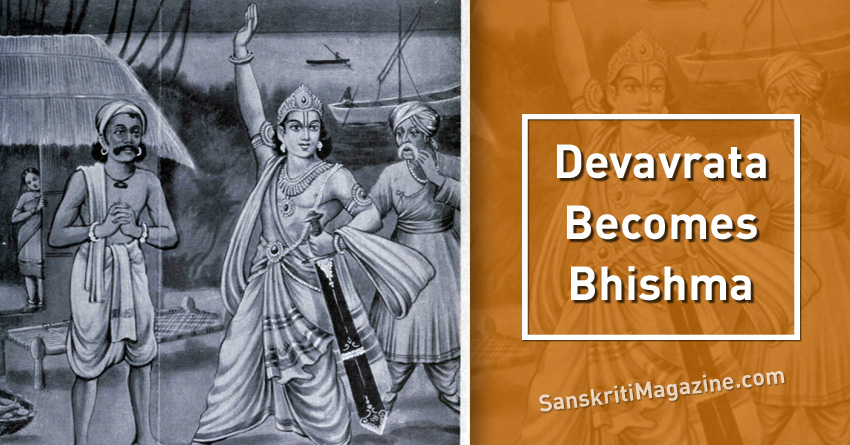
Devavrata Becomes Bhishma
Devavrata himself went there to find out what had happened. Dasa said, “He wants my daughter. All I am saying is her children should be the future kings. It’s a simple condition. The only problem is you are standing in the way.” Devavrata said, “That is not a problem. I need not be the king. I promise I will never be the king. Let Satyavati’s children be the kings.” The fisherman smiled and said, “As a young man, out of your bravado, you can say these things. But later, when you have children, they will fight for the throne.” Then Devavrata said, “I will never marry and have children to ensure that Satyavati’s children will have the right to be the kings.”
The fisherman was just having his meal, carefully taking the bones off the fish. He looked up and said, “Young man, I appreciate everything that you are saying. But you do not know the ways of life. You may not marry, but you may still have children.” Then Devavrata took the extreme step of castrating himself. He took a vow: “I will never have children. I am incapable of having children now. Does this satisfy you?” Finally, the fisherman said yes. Everyone said, “This is the harshest thing a man can do to himself.” So they called him Bhishma, one who was terribly harsh on himself, without anyone forcing him to take such a step. And so, Shantanu married Satyavati.
~Originally published in Isha Forest Flower June 2015