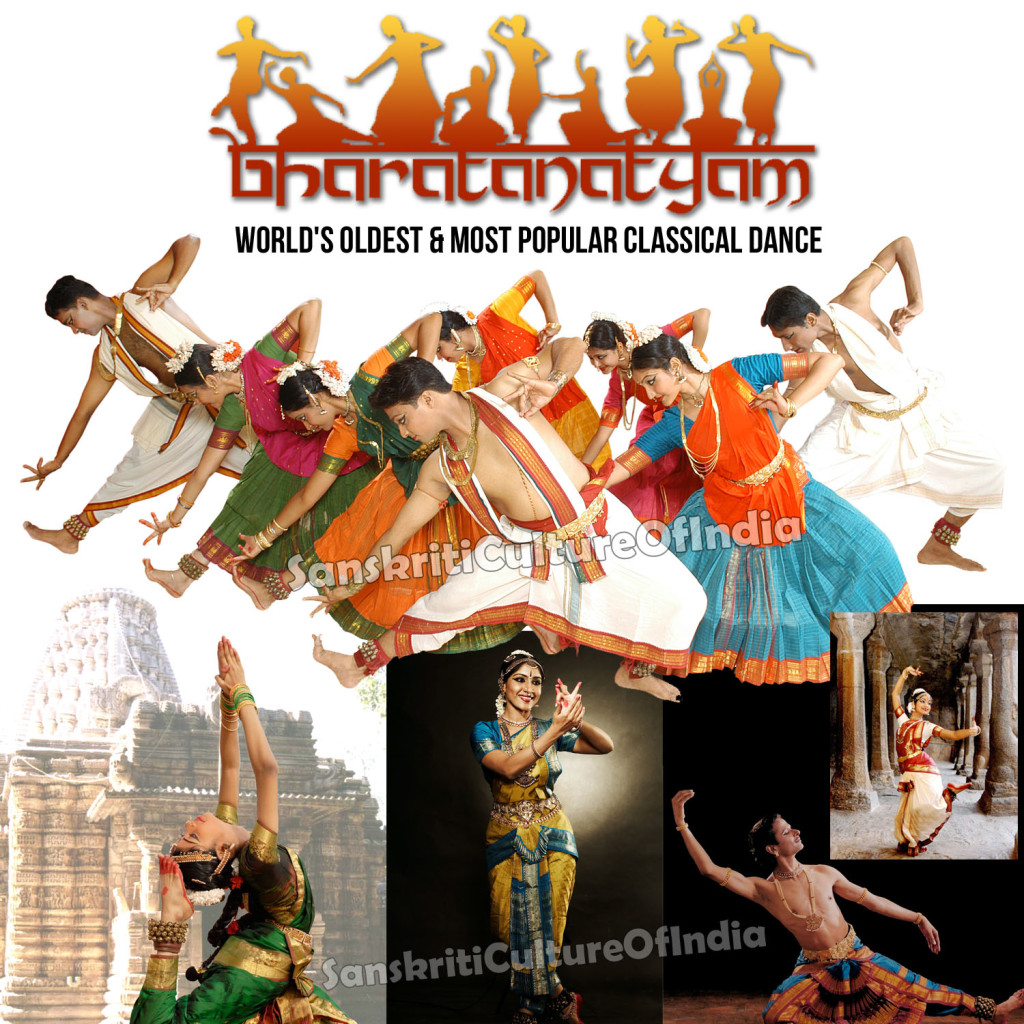
Bharatanatyam is a classical dance form originating in Tamil Nadu, India. One of the oldest of the classical dance forms in India, it is also known as the fifth Veda. It started as a temple dance tradition called Dasiyattam (the dance of the maid-servants) 2000 years ago and is perhaps the most advanced and evolved dance form of all the classical Indian dance forms.
Bharatanatyam is usually accompanied by the classical music. It has its inspirations from the sculptures of the ancient temple of Chidambaram. Bharatanatyam comes from the words Bhava (Expression), Raga (Music), Tala (Rhythm) and Natya (Classic Indian Musical Theatre). In this dance form the dancers make considerable use of hand-and-eye movements to express different emotions. Today, it is one of the most popular and widely performed dance styles and is practiced by many dancers all over the world.
Bharatanatyam is considered to be a fire-dance — the mystic manifestation of the metaphysical element of fire in the human body. It is one of the five major styles (one for each element) that include Odissi (element of water), Mohiniattam (element of air), Kuchipudi (element of earth) and Kathakali (element of sky). The movements of an authentic Bharatanatyam dancer resemble the movements of a dancing flame. Contemporary Bharatanatyam is rarely practiced as Natya Yoga, a sacred meditational tradition, except by a few orthodox schools. It is a solo, lasya (feminine) type of dance, which is tender & erotic.
There are a number of musicians and instrumentalist who provide the musical accompaniment. Typically there is one or more vocalist, a person reciting the dance syllables, and a mridangam. Additionally, one usually finds violin, vina (saraswati vina), or venu (bamboo flute). There is also a thallam (manjira) which is usually played by the person reciting the dance syllables.
E.Krishna Iyer was one of those who raised the social status of Bharatanatyam and greatly popularized it. Rukmini Devi Arundale was instrumental in bringing it to the attention of the West.
At present, Bharatanatyam recitals are usually not performed inside the temple shrine but outside it, and even outside the temple compounds at various festivals. Most contemporary performances are given on the stage with a live ensemble. In popular culture, the adapted, or “semi-classical”, Bharatanatyam has been exposed largely through depiction in popular movies and TV programs.
The most intriguing aspect of this dance is that its root deep into the religious and rich mythological heritage of India. Bharatnatyam, though underwent through a lot of changes has still retained its ancient quintessence. The technique, costume, style nad theme of the dance tell apart it from the other classical dances of India.
Bharatnatyam dance is renowned for its grace, purity, tenderness and sculpturesque poses.
~Abhishek Agrawal