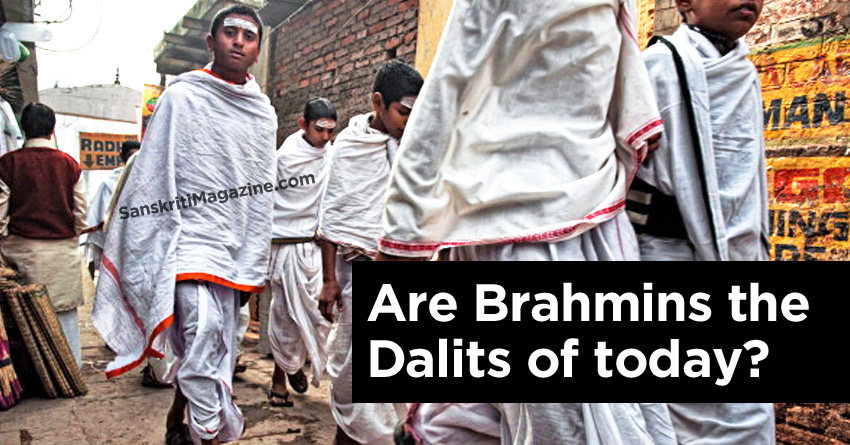
At a time when the Congress government wanted to raise the quota for Other Backward Classes to 49.5 per cent in private and public sectors, nobody talks about the plight of the upper castes. The public image of the Brahmins, for instance, is that of an affluent, pampered class. But is it so today?
50 Sulabh Shauchalayas (public toilets) in Delhi; all of them are cleaned and looked after by Brahmins (this very welcome public institution was started by a Brahmin). A far cry from the elitist image that Brahmins have!
There are five to six Brahmins manning each Shauchalaya. They came to Delhi eight to ten years back looking for a source of income, as they were a minority in most of their villages, where Dalits are in majority (60 per cent to 65 per cent). In most villages in UP and Bihar, Dalits have a union which helps them secure jobs in villages.
Did you know that you also stumble upon a number of Brahmins working as coolies at Delhi’s railway stations? One of them, Kripa Shankar Sharma, says while his daughter is doing her Bachelors in Science he is not sure if she will secure a job.
“Dalits often have five to six kids, but they are confident of placing them easily and well,” he says. As a result, the Dalit population is increasing in villages. He adds: “Dalits are provided with housing, even their pigs have spaces; whereas there is no provision for gaushalas (cowsheds) for the cows of the Brahmins.”
You also find Brahmin rickshaw pullers in Delhi. 50 per cent of Patel Nagar’s rickshaw pullers are Brahmins who like their brethren have moved to the city looking for jobs for lack of employment opportunities and poor education in their villages.
Even after toiling the whole day, Vijay Pratap and Sidharth Tiwari, two Brahmin rickshaw pullers, say they are hardly able to make ends meet. These men make about Rs 100 to Rs 150 on an average every day from which they pay a daily rent of Rs 25 for their rickshaws and Rs 500 to Rs 600 towards the rent of their rooms which is shared by 3 to 4 people or their families.
Did you also know that most rickshaw pullers in Banaras are Brahmins?
ALSO READ: BRAHMIN BASHING (Does it really deserve its due?)
This reverse discrimination is also found in bureaucracy and politics. Most of the intellectual Brahmin Tamil class has emigrated outside Tamil Nadu. Only 5 seats out of 600 in the combined UP and Bihar assembly are held by Brahmins — the rest are in the hands of the Yadavs.
400,000 Brahmins of the Kashmir valley, the once respected Kashmiri Pandits, now live as refugees in their own country, sometimes in refugee camps in Jammu and Delhi in appalling conditions. But who gives a damn about them? Their vote bank is negligible.
And this is not limited to the North alone. 75 per cent of domestic help and cooks in Andhra Pradesh are Brahmins. A study of the Brahmin community in a district in Andhra Pradesh (Brahmins of India by J Radhakrishna, published by Chugh Publications) reveals that today all purohits live below the poverty line.
Eighty per cent of those surveyed stated that their poverty and traditional style of dress and hair (tuft) had made them the butt of ridicule. Financial constraints coupled with the existing system of reservations for the ‘backward classes’ prevented them from providing secular education to their children.
In fact, according to this study there has been an overall decline in the number of Brahmin students. With the average income of Brahmins being less than that of non-Brahmins, a high percentage of Brahmin students drop out at the intermediate level. In the 5 to 18 year age group, 44 per cent Brahmin students stopped education at the primary level and 36 per cent at the pre-matriculation level.
The study also found that 55 per cent of all Brahmins lived below the poverty line — below a per capita income of Rs 650 a month. Since 45 per cent of the total population of India is officially stated to be below the poverty line it follows that the percentage of destitute Brahmins is 10 per cent higher than the all-India figure.
There is no reason to believe that the condition of Brahmins in other parts of the country is different. In this connection it would be revealing to quote the per capita income of various communities as stated by the Karnataka finance minister in the state assembly: Christians Rs 1,562, Vokkaligas Rs 914, Muslims Rs 794, Scheduled castes Rs 680, Scheduled Tribes Rs 577 and Brahmins Rs 537.
Appalling poverty compels many Brahmins to migrate to towns leading to spatial dispersal and consequent decline in their local influence and institutions. Brahmins initially turned to government jobs and modern occupations such as law and medicine. But preferential policies for the non-Brahmins have forced Brahmins to retreat in these spheres as well.
According to the Andhra Pradesh study, the largest percentage of Brahmins today are employed as domestic servants. The unemployment rate among them is as high as 75 per cent. Seventy percent of Brahmins are still relying on their hereditary vocation. There are hundreds of families that are surviving on just Rs 500 per month as priests in various temples (Department of Endowments statistics).
Priests are under tremendous difficulty today, sometimes even forced to beg for alms for survival. There are innumerable instances in which Brahmin priests who spent a lifetime studying Vedas are being ridiculed and disrespected.
At Tamil Nadu’s Ranganathaswamy Temple, a priest’s monthly salary is Rs 300 (Census Department studies) and a daily allowance of one measure of rice. The government staff at the same temple receive Rs 2,500 plus per month. But these facts have not modified the priests’ reputation as ‘haves’ and as ‘exploiters.’ The destitution of Hindu priests has moved none, not even the parties known for Hindu sympathy.
The tragedy of modern India is that the combined votes of Dalits/OBC and Muslims are enough for any government to be elected. The Congress quickly cashed in on it after Independence, but probably no other government than Sonia Gandhi’s has gone so far in shamelessly dividing Indian society for garnering votes.
The Indian government gives Rs 1,000 crores (Rs 10 billion) for salaries of imams in mosques and Rs 200 crores (Rs 2 billion) as Haj subsidies. But no such help is available to Brahmins and upper castes. As a result, not only the Brahmins, but also some of the other upper castes in the lower middle class are suffering in silence today, seeing the minorities slowly taking control of their majority.
Anti-Brahminism originated in, and still prospers in anti-Hindu circles. It is particularly welcome among Marxists, missionaries, Muslims, separatists and Christian-backed Dalit movements of different hues. When they attack Brahmins, their target is unmistakably Hinduism.
So the question has to be asked: are the Brahmins (and other upper castes) of yesterday becoming the Dalits of today?
~By Francois Gautier
Ref:
Doctors in arms
At Ground Zero of the quota protests
The middle class deserves what it is getting
Do our institutes connect with the real India?
Who are the real Dalits of India?
Caste shouldn’t overwrite merit
From the Indian Express: ‘These measures will not achieve social justice’