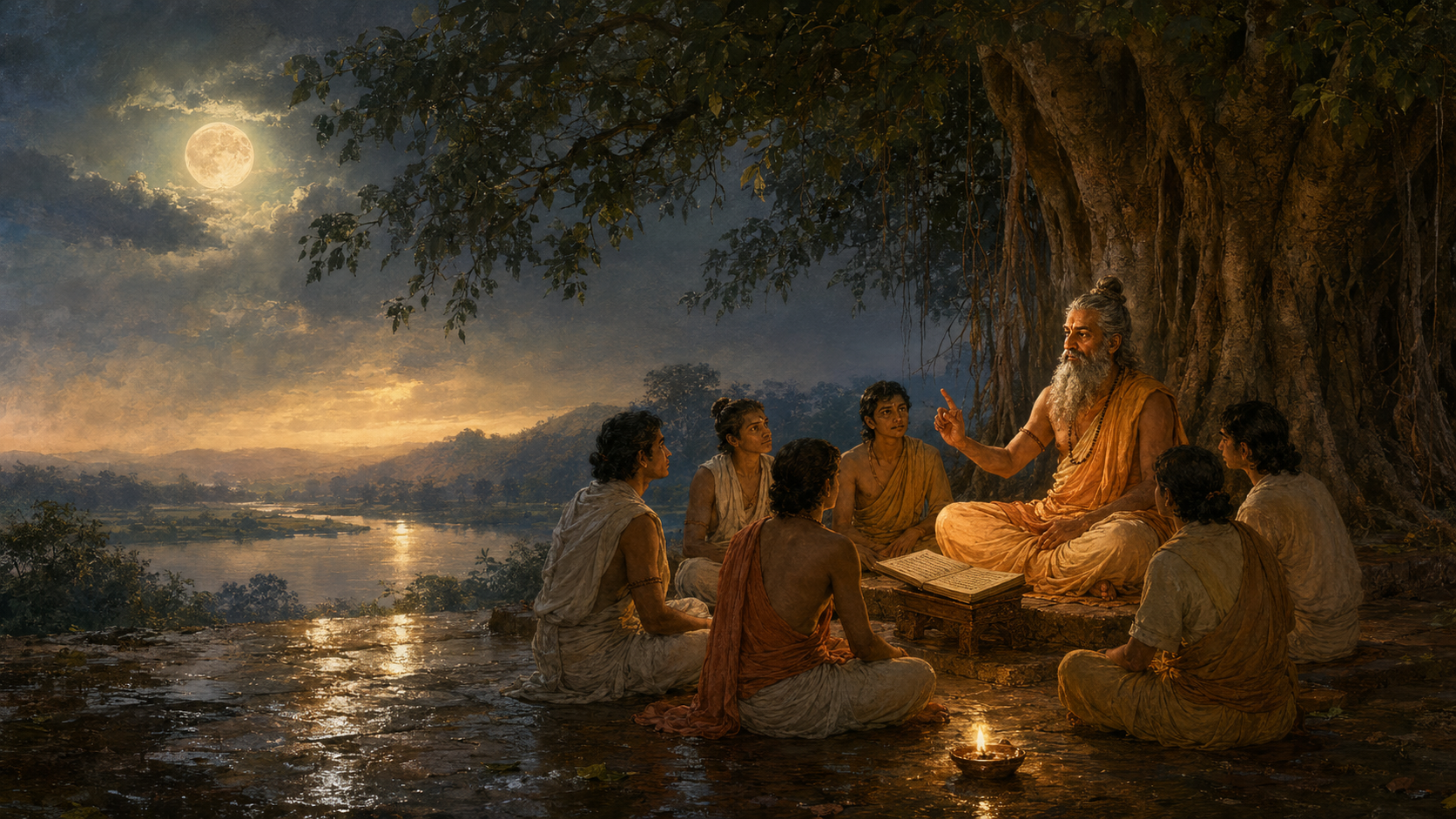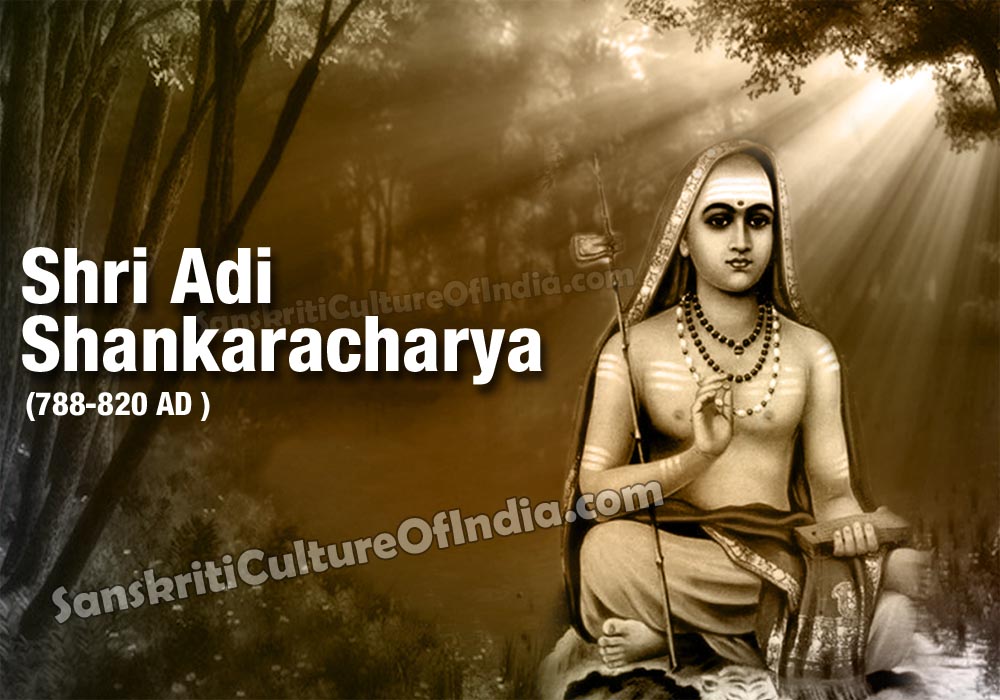
Shri Adi Shankaracharya or the first Shankara with his remarkable reinterpretations of Hindu scriptures, especially on Upanishads or Vedanta, had a profound influence on the growth of Hinduism at a time when chaos, superstition and bigotry was rampant. Shankara advocated the greatness of the Vedas and was the most famous Advaita philosopher who restored the Vedic Dharma and Advaita Vedanta to its pristine purity and glory.
Shri Adi Shankaracharya, known as Bhagavatpada Acharya (the guru at the feet of Lord), apart from refurbishing the scriptures, cleansed the Vedic religious practices of ritualistic excesses and ushered in the core teaching of Vedanta, which is Advaita or non-dualism for the mankind. Shankara restructured various forms of desultory religious practices into acceptable norms and stressed on the ways of worship as laid down in the Vedas.
Shankara’s Childhood
Shankara was born in a Brahmin family circa 788 AD in a village named Kaladi on the banks of the river Purna (now Periyar) in the Southern Indian coastal state Kerala. His parents, Sivaguru and Aryamba, had been childless for a long time and the birth of Shankara was a joyous and blessed occasion for the couple. Legend has it that Aryamba had a vision of Lord Shiva and promised her that he would incarnate in the form of her first-born child.
Shankara was a prodigious child and was hailed as ‘Eka-Sruti-Dara’, one who can retain anything that has been read just once. Shankara mastered all the Vedas and the six Vedangas from the local gurukul and recited extensively from the epics and Puranas. Shankara also studied the philosophies of diverse sects and was a storehouse of philosophical knowledge.
Philosophy of Adi Shankara
Shankara spread the tenets of Advaita Vedanta, the supreme philosophy of monism to the four corners of India with his ‘digvijaya’ (the conquest of the quarters). The quintessence of Advaita Vedanta (non-dualism) is to reiterate the truth of reality of one’s essential divine identity and to reject one’s thought of being a finite human being with a name and form subject to earthly changes.
According to the Advaita maxim, the True Self is Brahman (Divine Creator). Brahman is the ‘I’ of ‘Who Am I?’ The Advaita doctrine propagated by Shankara views that the bodies are manifold but the separate bodies have the one Divine in them.
The phenomenal world of beings and non-beings is not apart from the Brahman but ultimately become one with Brahman. The crux of Advaita is that Brahman alone is real, and the phenomenal world is unreal or an illusion. Through intense practice of the concept of Advaita, ego and ideas of duality can be removed from the mind of man.
The comprehensive philosophy of Shankara is inimitable for the fact that the doctrine of Advaita includes both worldly and transcendental experience.
Shankara while stressing the sole reality of Brahman, did not undermine the phenomenal world or the multiplicity of Gods in the scriptures.
Shankara’s philosophy is based on three levels of reality, viz., paramarthika satta (Brahman), vyavaharika satta (empirical world of beings and non-beings) and pratibhashika satta (reality).
Shankara’s theology maintains that seeing the self where there is no self causes spiritual ignorance or avidya. One should learn to distinguish knowledge (jnana) from avidya to realize the True Self or Brahman. He taught the rules of bhakti, yoga and karma to enlighten the intellect and purify the heart as Advaita is the awareness of the ‘Divine’.
Shankara developed his philosophy through commentaries on the various scriptures. It is believed that the revered saint completed these works before the age of sixteen. His major works fall into three distinct categories – commentaries on the Upanishads, the Brahmasutras and the Bhagavad Gita.
Shankaracharya’s Seminal Works
The most important of Shankaracharya’s works are his commentaries on the Brahmasutras –Brahmasutrabhashya – considered the core of Shankara’s perspective on Advaita, and Bhaja Govindam written in praise of Govinda or Lord Krishna – a Sanskrit devotional poem that forms the center of the Bhakti movement and also epitomizes his Advaita Vedanta philosophy.
Shankaracharya’s Monastic Centers
Shri Shankaracharya established four ‘mutts’ or monastic centers in four corners of India and put his four main disciples to head them and serve the spiritual needs of the ascetic community within the Vedantic tradition. He classified the wandering mendicants into 10 main groups to consolidate their spiritual strength.
Each mutt was assigned one Veda. The mutts are Jyothir Mutt at Badrinath in northern India with Atharva Veda; Sarada Mutt at Sringeri in southern India with Yajur Veda; Govardhan Mutt at Jaganath Puri in eastern India with Rig Veda and Kalika Mutt at Dwarka in western India with Sama Veda.
It is believed that Shankara attained heavenly abode in Kedarnath and was only 32 years old when he died.