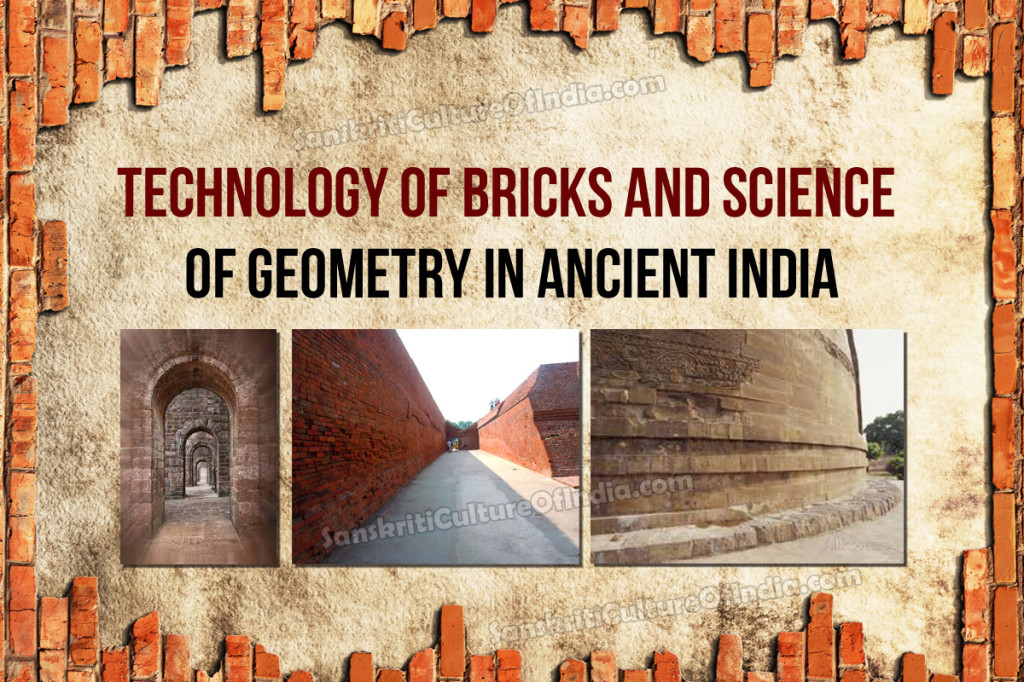
The Sanskrita equivalent for brick is ‘Istaka’ or ‘Istika’, which was primarily constructed for the use in an altar. ‘Medhatithi’ was the maker of bricks. He also contributed to the science of numerals by giving the concept of powers of ten in enumeration. Here is the English translation of the verse related to bricks and numerals as given in Yajurveda (XVII, 2) –
इमा मे अग्न इष्टका धेनवः सन्तु ।
एका च दश च, दश च शतं च,
शतं च सहस्रं च,
सहस्रं चायुतं चायुतं च नियुतं च,
नियुतं च प्रयुतं चार्बुदं च समुद्रश्च मध्यं
चान्तश्च परार्धश्चैता मे अग्न इष्टका धेनवः
सन्तवमुत्रामुष्मिंल्लोके ।
“O Agni, may these bricks be mine, own milch, kine, Eka (one) and Dasa (ten); ten tens, a Sata (hundred); ten hundreds, a Sahasra (thousand); ten thousand, an Ayuta (a myriad); a ten Ayutas, a Niyuta (a hundred thousand); a ten Niyutas, a Prayuta (one million); ten Prayutas, an Arbuda (ten millions); ten Arbudas, a Nyarbuda (one hundred millions); ten Nyarbudas, a Samudra (one thousand millions); ten Samudras, a Madhya (a ten thousand millions); ten Madhyas, an Anta (a hundred thousand millions); ten Antas, a Parardha (a million million or a billion).
May these bricks be mine own milch-kine in yonder world and in this world.”
Later in ‘Sulba Sutras’, these bricks have been described in relation to the geometrical figures of square, round, oblong and diagonal.
The mechanical devices connected with the grinding, pounding, macerating with water, allowing to ferment, squeezing out its juice or extract, filtering through various types of strainers, collecting it in receptacles, preserving it in suitable containers under favourable conditions and similar other processes laid the foundation of the pharmaceutical practices in connection with medicinal herbs. The ‘Yajnasala’ was thus a primitive laboratory and the utensil described in this connection became the basis of a chemical laboratory in the alchemic and iatrochemical period.
~ Dr. R.D. Sharma