Each of the seven days in a week has a special significance and is apportioned to one or more Hindu gods or goddesses and there are several folklore associated with the ritual fasting observed on these days.
On the following pages, we look at the seven days, the respective planet & deities associated with the particular days, relevant tales and legends, and the gemstones and colors that are said to be lucky for those days.
Fasting Associated with the Daily Deities
Hindu devotees keep occasional ‘upvaas’or fast corresponding to the fulfillment of a vow or a belief and ‘vratas’ (fasting and observance of religious rituals) that is analogous with material or other gains. Apart from these special occasions, many devotees also fast on a particular day of the week dedicated to a particular god in the Hindu pantheon to appease him/her. Ancient sages used observances like ritual fasts to spread the awareness of different gods. Fasting and other rituals pave the path of the divine for the devotees to realize god, which is considered the sole purpose of human existence.
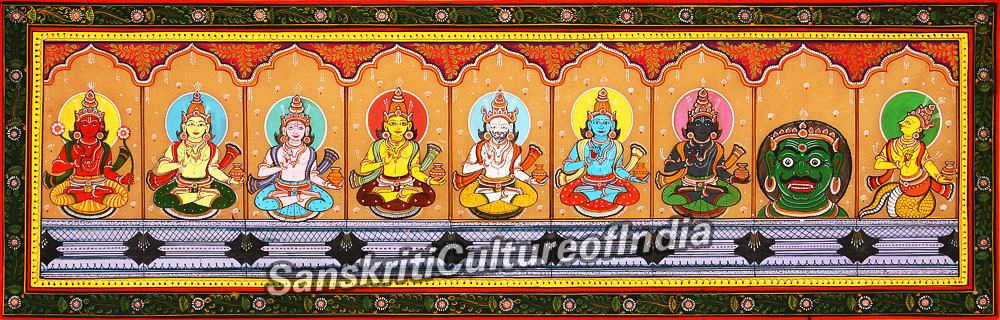
The Navagraha – the 9 Celestial Bodies
Navagraha represents the nine celestial influencers in Vedic Astrology. The seven days are named after the seven celestial bodies of our solar system – the Sun, Moon and the planets. Apart from these, mention should be made here of Rahu and Ketu, the two nodes of the Moon – the north and the south, the points of intersection of the paths of the Moon and the Sun. Lunar eclipses occur when the Moon and the Sun are at Rahu or Ketu. So, Navagraha comprises of:
- Surya (Sun)
- Chandra (Moon)
- Mangala (Mars)
- Budha (Mercury)
- Brihaspati (Jupiter)
- Shukra (Venus)
- Shani (Saturn)
- Rahu
- Ketu
~ Subhamoy Das