IndianSanskriti
Vaastu Shastra

Vaastu Shastra

Vaastu shastra, an ancient art and science of Indian architecture, explains the practices of constructing buildings which ensures a harmony between man and the five elements and thereby bring all round peace, health, wealth and prosperity. Vaastu Shastra is a Sanskrit name, where ‘vaastu’ means nature, surrounding or environment, and ‘shastra’ means science. Vaastu Shastra evolved during Vedic times in India. Excerpted from the Stapatya Veda, a part of the Atharva Veda. It is believed that Mayan, the great architect of ancient India, was the author of Vaastu Shastra.

Vastu study acquires a complete command over the knowledge of directions. As per Vaasthu shashtra rules, the point at which two different directions meet, it is more powerful, as it combines the forces coming from two distinctive directions. Vastu shashtra is the scientific study of directions that takes into consideration that everything in the universe is constructed by the five elements called Panchamabhoota (earth, water, fire, air and space) and that gravitational and magnetic effects and rotational influences of planets and other celestial bodies with cosmic rays, affects us and controls the way we live.

Vaastu as the actual physical manifestation of the dwelling is categorized into four

Bhoomi – the dwelling place or the main structural ground
Prasada – the structures on the earth
Yaana – movable objects like vehicles, etc.
Sayana – furniture

These categories suggests that the principles of Vaastu Shastra extend from property selection, planning and orientation to zonal segmentation and disposition of rooms, proportional relationships between the various parts of buildings and the character of buildings. Vaastu considered as a science forms the basis of each construction and experts who deal with it recommend that it has to be followed from the initial level of choosing a plot, construction of the house, interior decoration to the final stage of relocating to the house.

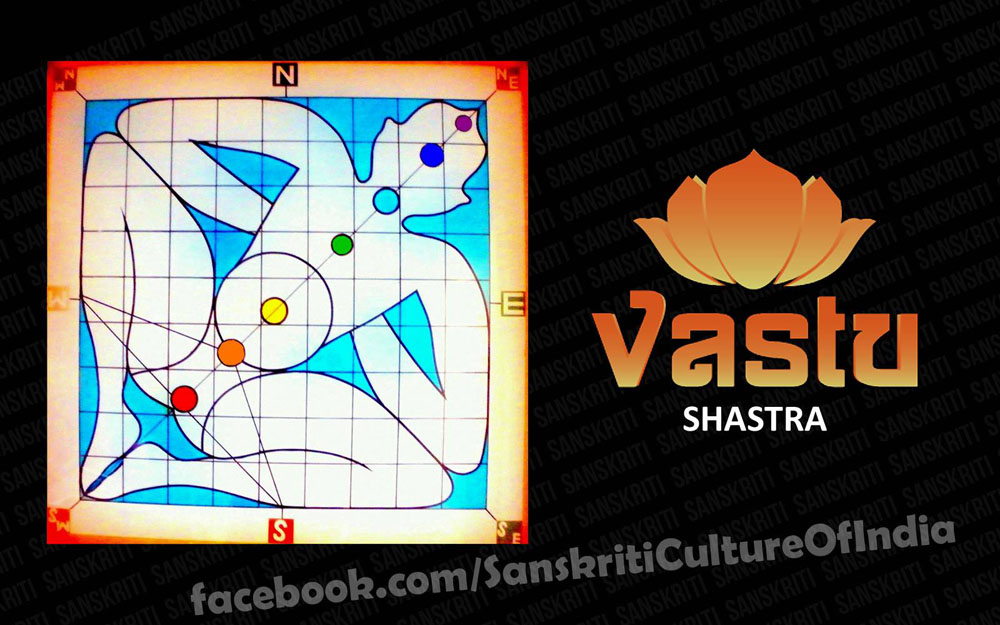
The principles of Vaastu are derived from Vaastu Purush Mandala; a man lying with his head-pointing North-East, in a grid of 64 squares dedicated to different Gods. Vaastu Purusha is present in each and every plot whether it is big or small. He has a fixed and peculiar body.

According to Vaastu Shastra, after we have a selected a plot/ house we have to consider its Vaastu Purusha Mandala. Vaastu Purusha Mandala is the basic model on which the house is based. ‘Vaastu’ means environment, ‘Purush’ means energy, ‘Mandala’ means the astrological chart which relates the layout to the orientation. Just like the earth with its magnetic field is centered to its core, the plot should have everything epic centered to it, in the concept of Vaastu Purush Mandala. We should consider the plot and all the items in it having a mystic power, like the earth, items within the earth and its planets.

Today, Vaastu Shastra is looked upon as a highly evolved, building philosophy in which directions and shapes are the most vital aspects of designing. The four directions of the plot are decided, based on the epic centre of the plot.
You may also like

Search the website

Like us on Facebook

Get daily updates via Email

Enter your email address:

Recent Posts

Jamai Shashthi 2026 — The Story of Maa Shashthi, the Cat, and the Wife Who Was Forgiven

Jamai Shashthi 2026 — The Story of Maa Shashthi, the Cat, and the Wife Who Was Forgiven

On Saturday, June 20, 2026, Bengali households across Bharata will welcome their married daughters and sons-in-law home for the legendary jamai-aador feast and perform the Shashthi Vrata. But behind the warmth lies a story most Bengalis know by heart and most non-Bengalis have never heard — the wife who stole the hilsa, blamed the cat, lost six sons to Maa Shashthi’s wrath, and was finally forgiven. The Vrat Katha, the vidhi, the mantras, and the deeper teaching.

Vat Purnima 2026 — The Wife Who Argued Yama Into Returning Her Husband’s Life

On Monday, June 29, 2026, women across Maharashtra, Gujarat, and southern Bharata will tie red thread around banyan trees and hear the story of Savitri — the wife who walked behind Yamaraja Himself when He came for her husband, and out-argued the Lord of Dharma into returning Satyavan’s life. The Mahabharata’s Pativrata Mahatmya Parva, the vrat vidhi, and why the banyan witnessed everything.

Nija Jyeshtha 2026 — The Real Jyeshtha Begins, and the Calendar Resumes

Nija Jyeshtha 2026 — The Real Jyeshtha Begins, and the Calendar Resumes

With Adhik Maas now closed on the Somvati Amavasya of June 15, the long-postponed festivals of Jyeshtha return — Vat Purnima (June 29, the Savitri-Yamaraja katha), Jamai Shashthi (June 20, the Bengali festival of Maa Shashthi), Sankashti Chaturthi (June 28), Yogini Ekadashi (July 10), and Devshayani Ekadashi (July 16, opening the four-month Chaturmas of Bhagavan Vishnu’s yoga-nidra). A guide to what the next four weeks hold and what the household that kept Purushottam Maas now carries forward.

The Closing of Purushottam Maas 2026 — Adhik Amavasya and the Sealing of the Month-Long Vrat

On Monday, June 15, 2026 — a rare Somvati Amavasya — the intercalary month that bears Bhagavan Vishnu’s own name comes to its close. The Acharyas teach that a vrat is not measured by its duration but by its closing. Here are the Padma Purana’s instructions for sealing the month-long Purushottam Maas vrat: the morning snan, the closing puja with the Vishnu Sahasranama, the day of dana, the Somvati Amavasya gift, and the final sarva-arpana — the offering of all merit at the feet of the Lord.

Parama Ekadashi 2026 — The Other Rare Ekadashi of Purushottam Maas, and the Poor Brahmin Who Kept It

Two weeks ago, Vaishnavas across Bharata kept Padmini Ekadashi — the rare Shukla Paksha Ekadashi of Adhik Maas. Padmini has a twin. On Thursday, June 11, 2026, the Krishna Paksha Ekadashi of the same intercalary month appears: Parama — the Supreme Ekadashi. The Padma Purana names it the rarer and more secret of the two, and reserves it for those whose poverty or sorrow has refused to lift in spite of every other vrat already kept. The story of Sumedha and Pavitra of Kampilya, the rishi Kaundinya, the prince sent by Bhagavan Brahma — and the vidhi for the day.

css.php